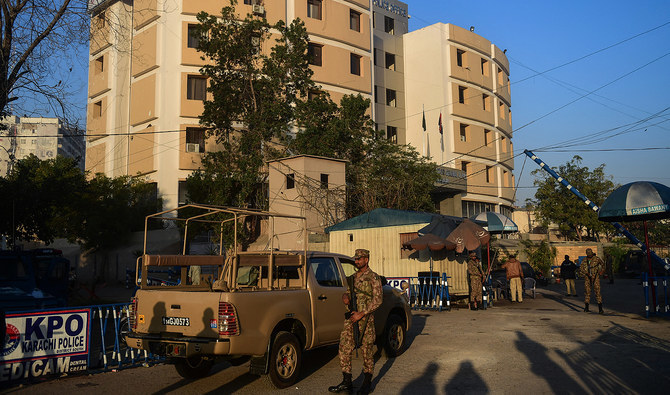
KARACHI: The counterterrorism department (CTD) in Pakistan’s southern Sindh province announced on Wednesday the killing of a suspected Tehreek-e-Taliban Pakistan (TTP) militant involved in a major 2013 bombing and last year’s attack on police headquarters in Karachi.
Umar Farooq, described as a TTP commander, was suspected of participating in a deadly assault on a Shia mosque in Abbas Town in March 2013, using a car bomb that killed 48 people and injured over 180.
Nearly a decade later, Karachi witnessed another major attack in February 2023 when militants laid siege to the city’s police headquarters, killing four, including two officers, in a battle claimed by the TTP.
Shortly after the second attack, police announced the killing of two militants, identifying one of them, Aryad Ullah, as the alleged mastermind.
In a statement issued earlier today, the CTD said it had acted on a tip-off and apprehended Farooq, who was waiting near Hanifia Masjid on the northern bypass of the city.
“The terrorist began firing at the police to evade arrest,” the statement said. “In the ensuing exchange of fire, he was wounded and fell down.”
The CTD informed Farooq shot a policeman in the chest, who survived because he was wearing a flak jacket.
The statement noted the TTP militant was declared a fugitive by an anti-terrorism court for his role in the police headquarters attack.
It also mentioned that a recent threat alert issued by the Sindh home office warned that Farooq had been sent to Karachi by the top TTP leadership to carry out “terrorist activities” and rebuild a network.
The statement said the TTP commander had fled to Afghanistan after his acquittal in several cases, including murder, attempted murder and militancy.
Police records show 10 cases were filed against him at different police stations in Karachi between 2013 and 2014.

Pakistan’s counterterrorism police announce killing of suspected militant involved in major Karachi attacks
https://arab.news/zdn5j
Pakistan’s counterterrorism police announce killing of suspected militant involved in major Karachi attacks
- Umar Farooq was said to be part of the 2013 Abbas Town bombing and last year’s attack on police headquarters
- The suspected militant, who was killed in a shootout, was believed to be working on rebuilding the TTP network
EU, Pakistan sign €60 million loan agreement for clean drinking water in Karachi
- Project will finance rehabilitation, construction of water treatment facilities in Karachi city, says European Investment Bank
- As per a report in 2023, 90 percent of water samples collected from various places in city was deemed unfit for drinking
ISLAMABAD: The European Investment Bank (EIB) and Pakistan’s government on Wednesday signed a €60 million loan agreement, the first between the two sides in a decade, to support the delivery of clean drinking water in Karachi, the EU said in a statement.
The Karachi Water Infrastructure Framework, approved in August this year by the EIB, will finance the rehabilitation and construction of water treatment facilities in Pakistan’s most populous city of Karachi to increase safe water supply and improve water security.
The agreement was signed between the two sides at the sidelines of the 15th Pak-EU Joint Commission in Brussels, state broadcaster Radio Pakistan reported.
“Today, the @EIB signed its first loan agreement with Pakistan in a decade: a €60 million loan supporting the delivery of clean drinking water for #Karachi,” the EU said on social media platform X.
Radio Pakistan said the agreement reflects Pakistan’s commitment to modernize essential urban services and promote climate-resilient infrastructure.
“The declaration demonstrates the continued momentum in Pakistan-EU cooperation and highlights shared priorities in sustainable development, public service delivery, and climate and environmental resilience,” it said.
Karachi has a chronic clean drinking water problem. As per a Karachi Water and Sewerage Corporation (KWSC) study conducted in 2023, 90 percent of water from samples collected from various places in the city was deemed unsafe for drinking purposes, contaminated with E. coli, coliform bacteria, and other harmful pathogens.
The problem has forced most residents of the city to get their water through drilled motor-operated wells (known as ‘bores’), even as groundwater in the coastal city tends to be salty and unfit for human consumption.
Other options for residents include either buying unfiltered water from private water tanker operators, who fill up at a network of legal and illegal water hydrants across the city, or buying it from reverse osmosis plants that they visit to fill up bottles or have delivered to their homes.
The EU provides Pakistan about €100 million annually in grants for development and cooperation. This includes efforts to achieve green inclusive growth, increase education and employment skills, promote good governance, human rights, rule of law and ensure sustainable management of natural resources.


