Pakistan’s counterterrorism police announce killing of suspected militant involved in major Karachi attacks

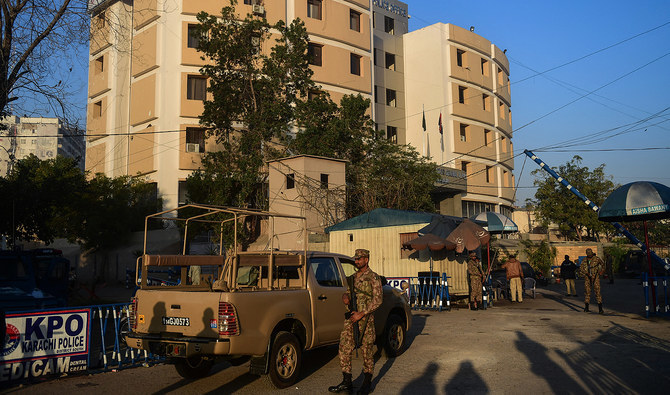
Pakistani army soldiers stand guard outside the Karachi Police Office compound a day after an attack by Pakistan’s Taliban in Karachi on February 18, 2023. (AFP/File)
Short Url
Updated 24 July 2024
Follow

Pakistan’s counterterrorism police announce killing of suspected militant involved in major Karachi attacks

  • Umar Farooq was said to be part of the 2013 Abbas Town bombing and last year’s attack on police headquarters
  • The suspected militant, who was killed in a shootout, was believed to be working on rebuilding the TTP network

KARACHI: The counterterrorism department (CTD) in Pakistan’s southern Sindh province announced on Wednesday the killing of a suspected Tehreek-e-Taliban Pakistan (TTP) militant involved in a major 2013 bombing and last year’s attack on police headquarters in Karachi.
Umar Farooq, described as a TTP commander, was suspected of participating in a deadly assault on a Shia mosque in Abbas Town in March 2013, using a car bomb that killed 48 people and injured over 180.
Nearly a decade later, Karachi witnessed another major attack in February 2023 when militants laid siege to the city’s police headquarters, killing four, including two officers, in a battle claimed by the TTP.
Shortly after the second attack, police announced the killing of two militants, identifying one of them, Aryad Ullah, as the alleged mastermind.
In a statement issued earlier today, the CTD said it had acted on a tip-off and apprehended Farooq, who was waiting near Hanifia Masjid on the northern bypass of the city.
“The terrorist began firing at the police to evade arrest,” the statement said. “In the ensuing exchange of fire, he was wounded and fell down.”
The CTD informed Farooq shot a policeman in the chest, who survived because he was wearing a flak jacket.
The statement noted the TTP militant was declared a fugitive by an anti-terrorism court for his role in the police headquarters attack.
It also mentioned that a recent threat alert issued by the Sindh home office warned that Farooq had been sent to Karachi by the top TTP leadership to carry out “terrorist activities” and rebuild a network.
The statement said the TTP commander had fled to Afghanistan after his acquittal in several cases, including murder, attempted murder and militancy.
Police records show 10 cases were filed against him at different police stations in Karachi between 2013 and 2014.


Pakistan’s top military commander hails Saudi defense pact as ‘historic’ at scholars’ conference

Updated 5 sec ago
Follow

Pakistan’s top military commander hails Saudi defense pact as ‘historic’ at scholars’ conference

  • Asim Munir says Pakistan has a unique bond with the Kingdom, citing the ‘honor’ of helping safeguard the holy sites
  • He says only the state can declare jihad, urging religious scholars to counter extremist narratives and promote unity

ISLAMABAD: Chief of Defense Staff Field Marshal Asim Munir on Wednesday described the country’s joint security pact with Saudi Arabia as a “historic” milestone, telling a gathering of religious scholars that Pakistan and the kingdom share a deep strategic relationship.

Signed in September, the Strategic Mutual Defense Agreement has solidified decades of Saudi–Pakistan defense cooperation, covering intelligence-sharing, counterterrorism and regional stability.

The two nations have long coordinated on defense matters, with Pakistani military personnel deployed in the Kingdom.

“The defense agreement [with Saudi Arabia] is historic,” he said in an address to the conference in the federal capital.

The top military commander said Pakistan regarded its connection with the Kingdom as unique.

“Among all Muslim countries, Allah has given Pakistan the honor of helping safeguard the Haramain,” he continued, referring to the two holiest sites of Islam in Makkah and Madinah.

Munir used his speech to warn against extremism, saying that under the Islamic framework, only the state could declare jihad, a pointed reference to groups such as the Tehreek-e-Taliban Pakistan (TTP), which claims to act in the name of religion while carrying out attacks on civilians and security forces.

“When nations abandon knowledge and the pen, disorder takes hold,” he said, urging the religious scholars to help keep society unified and to “broaden the nation’s vision.”

Munir also criticized India, describing “terrorism” as “India’s habit, not Pakistan’s.”

His remarks came months after a four-day military confrontation in May, during which the two nuclear-armed neighbors exchanged artillery and missile fire and deployed drones and fighter jets.

India blamed Pakistan for a militant attack in Indian-administered Kashmir before launching a missile attack. Islamabad denied involvement and called for an international probe.

Pakistan claimed it had shot down six Indian fighter jets before a US-brokered ceasefire took effect.

“We do not hide when confronting the enemy,” Munir said. “We challenge openly.”