US voices concern over arrests of opposition leaders, urges adherence to democratic norms in Pakistan

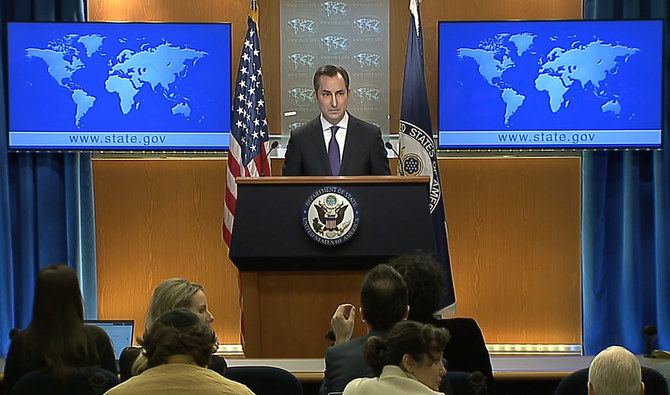
US State Department Spokesperson Matthew Miller speaks during a news conference at the State Department in Washington, DC, on January 4, 2024. (Photo courtesy: Screengrab/YouTube/@StateDept)
Short Url
Updated 24 July 2024
Follow

US voices concern over arrests of opposition leaders, urges adherence to democratic norms in Pakistan

  • A senior media manager, central information secretary of ex-PM Khan’s party were arrested in Pakistan this week
  • The two PTI members are facing charges of pushing an ‘anti-state narrative’ to undermine Pakistan’s sovereignty

ISLAMABAD: The United States on Tuesday expressed concern over the arrests of leaders belonging to former prime minister Imran Khan’s Pakistan Tehreek-e-Insaf (PTI) party, saying it was important to uphold democratic principles within the constitutional framework of the country.
PTI has frequently complained of a state crackdown since its top leaders and supporters were blamed for carrying out violent protests in different parts of the country in which government buildings were vandalized following Khan’s brief arrest on corruption charges last year in May.
Earlier this week, the party’s senior media manager Ahmed Waqas Janjua and its information secretary Raoof Hassan were arrested by the authorities after accusing them of pushing “anti-state narrative” to undermine Pakistan’s sovereignty.
While Janjua largely remains behind the scenes while managing PTI’s social media, Hassan has been quite vocal as its spokesperson.
“We have seen the reports of the arrests of PTI leaders,” Matthew Miller, the State Department’s spokesperson, told a media briefing in Washington. “We are always concerned when we see arrests of opposition leaders. I’m always personally concerned when I see the arrest of a spokesperson.”
“We support the peaceful upholding of constitutional and democratic principles, including the rule of law, equal justice under the law, and respect for human rights like freedom of expression and freedom of peaceful assembly,” he continued. “And we urge that these principles be respected in accordance with Pakistan’s constitution and laws.”
The Pakistani authorities also sealed the central PTI secretariat on Tuesday, saying it violated safety standards.
The development took place only a day after Hassan’s arrest from the same building in the federal capital.


Pakistani student launches ‘Urdu ChatGPT’ AI model

Updated 18 January 2026
Follow

Pakistani student launches ‘Urdu ChatGPT’ AI model

  • Developer says “Qalb” is largest large language model built exclusively for Urdu
  • Project highlights push to localize artificial intelligence for non-English users

ISLAMABAD: A Pakistani student studying in the United States has launched an artificial intelligence model designed exclusively for the Urdu language, a development its creator says could help bridge longstanding gaps in access to advanced digital tools for millions of speakers worldwide.

The project, called Qalb, is positioned as an Urdu-first large language model at a time when most generative AI systems are primarily trained on English and other widely used global languages. Supporters of language-specific models argue they can improve accuracy, cultural relevance and accessibility for users in education, business and public services.

Urdu is spoken by more than 230 million people globally, including in Pakistan, India and diaspora communities, but remains under-represented in advanced AI systems. Efforts to localize artificial intelligence have increasingly been seen as critical for widening participation in digital economies, particularly in developing countries.

“Qalb is now recognized as the world’s largest Large Language Model created exclusively for the Urdu language,” Taimoor Hassan, the project’s developer, was quoted this month in a report in state-run news agency APP. 

“Trained on a massive dataset of 1.97 billion tokens and benchmarked across seven-plus international evaluation frameworks, Qalb outperforms existing Urdu-focused AI models on key real-world performance indicators, setting a new standard for natural language processing in Pakistan,” Hassan said.

“This is a development model and in the next phase we would soon launch App for mobile and web so that people could use and benefit from Qalb ChatGPT.”

Hassan completed his undergraduate degree in computer science at FAAST University’s Peshawar campus and is currently studying for a master’s degree in computer science and software engineering at Auburn University in the United States. According to APP, he is a serial entrepreneur who has previously launched and exited multiple startups and has represented Pakistan at international technology forums.

“I had the opportunity to contribute in a small way to a much bigger mission for the country,” Hassan said.

“Together with my undergraduate roommates and teammates, Jawad Ahmed and Muhammad Awais, we are committed to continuously fine-tuning localized models for niche industries, which we believe can become a major breakthrough for Pakistan.”

Both collaborators are also graduates of FAAST University Peshawar Campus and are currently studying in Germany, APP reported.

The team behind Qalb said the model is intended to support local businesses, startups, educational platforms and voice-based digital services, arguing that meaningful innovation is no longer limited to large technology firms.

“Technology is no longer locked behind big budgets or big teams. With the right mindset, even a small group can build products that educate, automate, and serve millions,” Hassan told APP.