The vanishing roadside book stalls of Rawalpindi

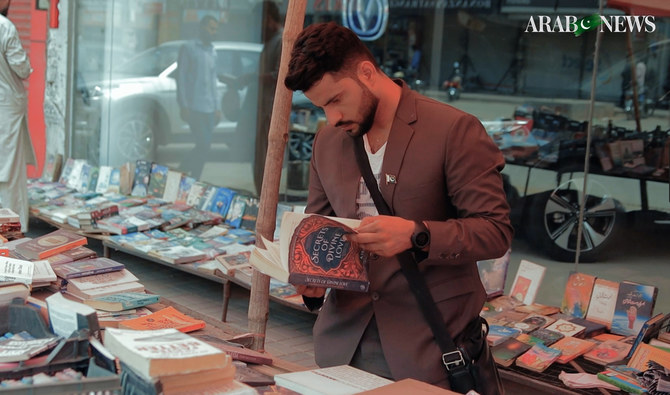
In this photograph taken on July 20, 2024, a man reads a book at a roadside book stall in Rawalpindi. (AN Photo)
Short Url
Updated 24 July 2024
Follow

The vanishing roadside book stalls of Rawalpindi

  • Roadside book bazaar along Rawalpindi’s main Saddar market came up in the eighties, thrived until at least 2010
  • Rise of e-books has changed reading habits, economic factors and urban development have also impacted bazaars

RAWALPINDI: For Kishwar Naheed, one of Pakistan’s greatest living Urdu poets and writers, visiting the hundreds of book stalls stretched along Rawalpindi’s main Saddar market was once a usual Sunday morning activity. 
But as the stalls have dwindled and book hawkers have disappeared, Naheed and others like her have been left only with the memories and a deep sense of loss over a disappearing literary culture and what was once the center of Rawalpindi’s intellectual life.
“Every Sunday morning, Zahid Dar [Urdu poet], Intizar [Hussain] Saab [novelist], myself, all my writer friends, we used to go there [Rawalpindi book bazaar] and try to pick up books,” Naheed told Arab News in an interview this week. “It was a craze for books.”
Rawalpindi’s open-air book stalls came up in the eighties and thrived until at least 2010 when the downfall slowly began, said Fareed-ul-Haq, a 69-year-old book stall owner. 
“I’ve been selling books in this market for 25 years and this roadside book bazaar has been around for 50 years,” he told Arab News, saying people used to travel from other cities to visit the stalls, browsing for hours and often arriving with handwritten notes of titles they wanted. 
“I have seen the high point of this market when the condition was such that it was so crowded it was difficult to walk here. Now people bring their books and it turns out they are their grandparents’ books and the grandson wants to sell them because he doesn’t value books.”
The roadside stalls offer a wide variety of new and old books: antique volumes, school books, historical works, fiction in different languages and all kinds of magazines. 
But the rise of digital media and online bookstores has impacted the viability of book bazaars, sellers and customers said, with smartphones and social media causing a shift worldwide in how people consume information and read.
“We live in an era of social media, online and virtual books and many people don’t prefer reading physical books anymore,” Noaman Sami, a media sciences student at Rawalpindi’s Riphah International University, told Arab News.
Economic factors are also behind the decline in book bazaars, according to Muhammad Hameed Shahid, a Pakistani short story writer, novelist and literary critic.
Rising rents, inflation and the increasing cost of living had made it difficult for many booksellers to sustain their businesses, while customers had less money to spend on luxuries like books. Urban development projects have also displacd book bazaars as the literary corners are repurposed for commercial or residential development.
“Ordinary people often can’t afford expensive books, but at these roadside book stalls, you would find treasures,” Shahid said. “There’s a wide variety of books available, and these vendors sitting on our footpaths deserve support so that through them the flame of knowledge stays alive and books continue to reach our children.”
The bazaar, the writer said, had been a major player in his own literary journey:
“These vendors who used to be sitting on the footpaths with books spread around them, those books, covering all sorts of topics, they played a vital role in my career, they inspired me to become a writer.”
Future generations in Rawalpindi won’t get to experience this, Haq, the bookseller, lamented. 
“I’ve seen this market crowded with people,” he said as he sat alone at his stall on a Sunday morning this month, waiting for customers. “But now, it’s nearly empty.”


Yataghan boutique in Jeddah celebrates Saudi heritage

Updated 20 December 2025
Follow

Yataghan boutique in Jeddah celebrates Saudi heritage

JEDDAH: Yataghan, the contemporary Saudi jewelry house founded in 2008 by designer and entrepreneur Sarah Abudawood, has announced an expansion with its Riyadh debut at Kingdom Centre, alongside the relocation of its headquarters and flagship store to a street-front location on Jeddah’s Thalia Street.

The brand, known for blending Arabian heritage with modern minimalism, unveiled two boutiques designed as immersive experiences rather than mere retail spaces.

Every detail of the new Jeddah location has been carefully curated; brass accents inspired by the Yataghan blade evoke precision and luxury, while striped, gray onyx symbolizes continuity and progress, according to the brand’s founder. Vast windows, softened by Yataghan’s signature hexagonal motif, a symbol of harmony, order, and strength, flood the boutiques with natural light, creating an inviting environment for visitors.

Inspired by the Yataghan sword, with its distinctive, single-edged blade, the brand’s collections fuse minimalist design with Arabic calligraphy and tribal motifs.

“The name Yataghan draws its meaning from the two swords on the Saudi flag — a symbol that has always fascinated me for what it represents: conviction, protection, truth, and above all, balance,” Abudawood told Arab News.

“The Yataghan sword, known for its graceful curve and exquisite craftsmanship, embodies purpose and precision. It is drawn to defend what matters and to guard what is sacred. It sets boundaries and restores equilibrium, reminding us that strength is not only about force, but about knowing when to advance and when to stand still.

“That balance is reflected in every piece we create. Because, like the sword, Yataghan is more than an ornament; it is a statement of purpose, and identity.”

Abudawood explained the cultural inspiration behind the brand, highlighting pieces connected to Saudi identity. “This branch carries designs that are deeply connected to Saudi identity and cultural memory. Some pieces are exclusive, inspired by symbols, rhythms, and forms rooted in our heritage, interpreted through a modern lens … Jeddah, in particular, has a unique spirit: fluid, expressive, open, and layered with history. That essence subtly informs the designs you’ll find here.” 

The founder also spoke of the brand’s philosophy of minimalism and meaningful design.

“It comes from my belief that simplicity creates space for meaning. I have always been drawn to architecture and the principle that form must follow function. I design with intention; nothing is accidental. Every line has a purpose, every curve holds a story. Minimalism, for me, is not about removing emotion; it is about distilling it. I want each piece to feel timeless, personal, and quietly powerful.”

The label has been flaunted by high-profile clients — including Jennifer Lopez, Lady Gaga and Lama Akeel — but Abudawood emphasized the brand’s focus on connection over visibility. “Whether someone is a public figure or not, what moves me is when they feel seen by the jewelry. Yataghan has always been about resonance, about creating pieces that speak to identity, strength, and personal stories,” she said.

Looking ahead, 2026 will mark new chapters for Yataghan, including local and international expansion, innovative collections, and a stronger focus on storytelling and community collaborations. “Growth has never been about reach alone; it’s about depth, integrity, and lasting impact,” Abudawood added.

“Ultimately, what drives me is purpose. I’m motivated by the desire to create work that matters, to offer women something that reflects who they are, not who they’re expected to be. Design, for me, is a form of dialogue, a way to translate emotion into form. As long as I’m creating with honesty, intention, and heart, I know I’m exactly where I’m meant to be.”