

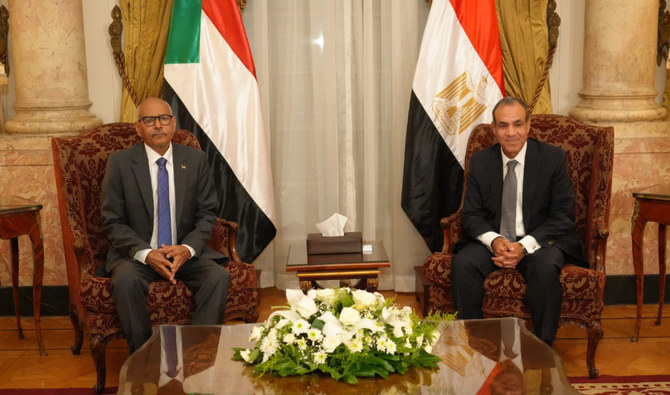
Egypt reiterates unwavering support for stability and security in war-torn Sudan

Other topics for discussion included wider bilateral ties and ways in which coordination between the countries might be enhanced. (X:@MfaEgypt)
Short Url
Updated 23 July 2024
Follow

Egypt reiterates unwavering support for stability and security in war-torn Sudan

  • Foreign Minister Badr Abdelatty also pledges Egypt’s continuing commitment to humanitarian aid efforts and development projects in Sudan
  • He stresses important need for donor countries and organizations to more quickly honor pledges of aid for Sudan and countries hosting Sudanese refugees

Egypt’s foreign minister, Badr Abdelatty, pledged his country’s continued support for the stability and security of Sudan, during a meeting on Tuesday with his counterpart from the country, Hussein Awad.

Abdelatty said Egypt would spare no effort to help its “Sudanese brothers overcome the political, security and humanitarian challenges resulting from the ongoing war” in the nation.

He highlighted the outcomes of a conference in Cairo on July 6 and 7 attended by Sudanese political factions and civil groups, the most important of which were, he said, recognition of the need to preserve state institutions, to provide relief and humanitarian support to Sudan and neighboring countries, and to ensure ownership of the political process remains with the Sudanese people.

He also reviewed the progress of development projects undertaken by Egypt in Sudan, and pledged his country’s continuing commitment to such initiatives along with its determination to respond to the nation’s humanitarian needs.

Abdelatty stressed the important need for donor countries and organizations to accelerate the fulfillment of pledges made during conferences in Geneva and Paris, in June 2023 and April 2024 respectively, of support for Sudan and neighboring countries hosting Sudanese refugees, support for the UN’s humanitarian response plan in the country, and to help bridge existing financing gaps.

He also discussed with Awad regional initiatives that have been proposed to help address the crisis in Sudan, and the important and pivotal role neighboring countries are playing, especially Egypt, which Abdelatty said was making strenuous efforts to help Sudan at this important time.

Other topics for discussion included wider bilateral ties and ways in which coordination between the countries might be enhanced, along with regional issues of mutual interest, including the situation in the Horn of Africa, the war in Gaza, security in the Red Sea, the situations in Libya, the Sahel and the Sahara region, and the Renaissance Dam built by Ethiopia on the Blue Nile upstream of Sudan and Egypt.

Awad thanked the Egyptian government for the facilities and services it has provided to the Sudanese people since the start of the crisis in his country.


Iran FM in Geneva for second round of US talks

Updated 5 sec ago
Follow

Iran FM in Geneva for second round of US talks

GENEVA: Iran’s foreign minister has arrived in Geneva ahead of a second round of negotiations with the United States, Iranian state television said Monday, as Washington keeps up pressure on the Islamic republic.
According to Tehran, “indirect” Iran-US nuclear talks mediated by Oman will be held on Tuesday, although Washington has previously pushed for other topics to be discussed including Iran’s ballistic missiles and support for regional proxies.
Tehran and Washington restarted negotiations this month after previous talks collapsed when Israel launched an unprecedented bombing campaign against Iran last June.
Considerable uncertainty surrounds the fate of Iran’s stockpile of more than 400 kilogrammes of 60-percent enriched uranium that was last seen by nuclear watchdog inspectors in June.
“The foreign minister has arrived in Geneva at the head of a diplomatic and expert delegation to take part in the second round of nuclear negotiation,” Iran’s state-run IRIB wrote on its Telegram channel.
During his visit to Geneva, Abbas Araghchi is expected to hold talks with his Swiss and Omani counterparts as well as the head of the International Atomic Energy Agency, Rafael Grossi, and other international officials, Iran’s foreign ministry said.
Washington has dispatched Middle East envoy Steve Witkoff and President Donald Trump’s son-in-law Jared Kushner, the White House confirmed on Sunday.
The latest talks follow repeated threats from Trump of military action against Tehran, first over Iran’s deadly crackdown on anti-government protests, and then more recently over the country’s nuclear program.
The West fears the program is aimed at making a bomb, which Tehran denies.
On Friday, Trump said a change of government in Iran would be the “best thing that could happen,” as he sent a second aircraft carrier to the Middle East to ratchet up military pressure.
Iran’s deputy foreign minister told the BBC that Tehran would consider compromises on its uranium stockpile if Washington lifts sanctions that have crippled the Islamic republic’s economy.
“If we see the sincerity on their (American) part, I am sure we will be on a road to have an agreement,” said Majid Takht-Ravanchi.
Israeli Prime Minister Benjamin Netanyahu said on Sunday that any deal must involve the removal of all enriched uranium from Iran as well as Tehran’s ability to enrich more.
“There should be no enrichment capability... dismantle the equipment and the infrastructure that allows you to enrich in the first place,” he said during a speech in Jerusalem.

- ‘Viable’ deal -

On February 6, Araghchi led the Iranian delegation in indirect talks with Witkoff and Kushner in Muscat.
Switzerland has played a key role in diplomatic relations between Iran and the United States for decades.
It has represented US interests in Iran since Washington broke off relations with Tehran after the 1980 hostage crisis, a year after the Iranian revolution.
Iranian deputy foreign minister for economic diplomacy Hamid Ghanbari said Tehran was seeking a deal with the United States that would generate economic benefits for both countries, particularly in sectors such as aviation, mining and oil and gas, the Fars news agency reported.
“For the agreement to be viable, it is essential that the United States also be able to benefit from it in areas with strong and rapid economic return potential,” he was quoted as saying.
