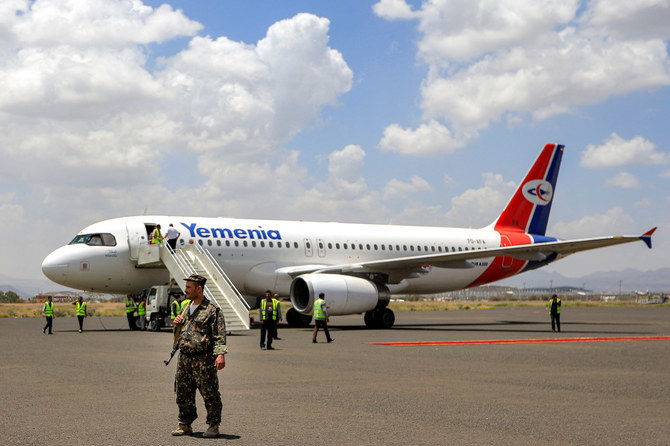
AL-MUKALLA: Yemen’s internationally recognized government have reached an agreement with the Houthis, facilitated by Saudi Arabia, to lift economic sanctions and increase the number of Yemenia Airways flights from Houthi-held Sanaa.
Hans Grundberg, the UN’s special envoy for Yemen, said both parties agreed to ease economic hostilities by canceling their most recent actions taken against banks in areas the other controls and pledged to halt all such measures in the future.
They agreed to increase the frequency of national carrier Yemenia’s flights from Sanaa to Jordan from one to three a day and to introduce daily flights from the capital to Cairo and India. In addition, the two sides will hold discussions about administrative, technological and budgetary issues related to the airline.
They will also hold talks on the humanitarian and economic challenges under an UN-proposed peace plan known as “the road map.”
Following the surprise announcement, Grundberg said the UN was ready to work with all parties to implement the agreed measures. He also “recognized the significant role of the Kingdom of Saudi Arabia in bringing this agreement about.”
The economic dispute between the government and the Houthis escalated in recent weeks when the government’s Central Bank sanctioned six banks in Houthi-held Sanaa and withdrew their licenses after they refused to relocate their headquarters from Sanaa to government stronghold Aden. The Central Bank had also withdrawn banknotes printed before 2016, which were in extensive use in Houthi-controlled areas, and shut down currency-exchange companies.
The economic sanctions were introduced after the Houthis this year, for the first time since the start of the civil war a decade ago, minted a new currency. The Yemeni government viewed this as an effort by the militia to establish an autonomous economy. The government also ordered Yemenia and telecoms companies to relocate their headquarters to Aden.
In an attempt to put pressure on the government to end its severe economic sanctions, the Houthis seized control of four Yemenia aircraft last month, announced that they would run the airline from Sanaa and threatened to fully restart the war. The militia previously attacked oil terminals in the government-controlled provinces of Shabwa and Hadramout, halting oil exports and preventing the circulation of banknotes printed by the Central Bank. They also banned traders in areas under their control from importing goods through the government and blocked the import of gas from the central city of Marib.
The Yemeni government said it eased its economic sanctions and reached an agreement with the Houthis to avoid exacerbating the economic crisis in militia-controlled areas, in response to requests from the business community and to comply with UN, regional and international mediation efforts.
“The government reiterates its steadfast determination not to subject Yemeni citizens in regions violently controlled by Houthi militia to additional living costs as a consequence of the militants’ unilateral actions, and to allow them to travel,” the official SABA news agency reported.
However critics of the deal, such as Kamel Al-Khoudani from the political bureau of the Yemeni National Resistance, said the government had conceded to Houthi demands for additional flights and an end to punitive measures against banks in Sanaa even though the militia had failed to meet counter-demands, including the resumption of oil exports.
Supporters, such as Yemeni journalist Sami Al-Kaf, argued that the government had successfully coerced the Houthis, who have previously rejected all demands to participate in negotiations, into agreeing to economic talks.

Houthis and Yemeni government agree to end economic hostilities, expand Yemenia flights
Short Url
https://arab.news/9crj6
Houthis and Yemeni government agree to end economic hostilities, expand Yemenia flights
- UN’s special envoy for Yemen, Hans Grundberg, welcomes deal and acknowledges ‘significant role’ of Saudi Arabia in achieving it
- Following the surprise announcement, Grundberg said the UN was ready to work with all parties to implement the agreed measures
US touts ‘New Gaza’ filled with luxury real estate
Davos, Switzerland: US officials on Thursday presented their vision for a “New Gaza” that would turn the shattered Palestinian territory into a glitzy resort of skyscrapers by the sea, saying the transformation could emerge in three years.
The war in Gaza, sparked by Hamas’s October 2023 attack on Israel, left much of the Palestinian territory damaged or destroyed and forced most of its residents to flee their homes.
A US-brokered ceasefire took effect last October, reducing the level of bombing and fighting, but for most Gazans, the humanitarian disaster has endured three months on.
“We’re going to be very successful in Gaza. It’s going to be a great thing to watch,” President Donald Trump said while presenting his controversial “Board of Peace” conflict-resolution body in Davos.
“I’m a real estate person at heart... and I said, look at this location on the sea. Look at this beautiful piece of property. What it could be for so many people,” he said at the World Economic Forum.
His son-in-law Jared Kushner, who has no official title but is one of Trump’s envoys for the Gaza ceasefire, said his “master plan” aimed for “catastrophic success.”
With a slide showing dozens of shiny terraced apartment towers overlooking a tree-lined promenade, he promised a Mediterranean utopia rising from the scarred Gaza landscape.
“In the Middle East they build cities like this, you know for two or three million people, they build this in three years,” Kushner said.
“And so stuff like this is very doable if we make it happen.”
He touted investments of at least $25 billion to rebuild destroyed infrastructure and public services.
Within 10 years, the territory’s GDP would be $10 billion, and households would enjoy average income of $13,000 a year thanks to “100-percent full employment and opportunity for everybody there,” he said.
“It could be a hope. It could be a destination, have a lot of industry and really be a place that the people there can thrive.”
’Amazing’ opportunities
Kushner said the so-called National Committee for the Administration of Gaza (NCAG) had enlisted help from Israeli real estate developer Yakir Gabay.
“He’s volunteered to do this not for profit, really because of his heart he wants to do this,” Kushner said.
“So the next 100 days, we’re going to continue to just be heads down and focused on making sure this is implemented.”
Trump had earlier in the conflict floated his vision of turning Gaza into a “Riviera of the Middle East,” sparking outrage around the world.
Notably absent from Kushner’s presentation was Egypt’s President Abdel Fattah El-Sisi, whose country had spearheaded in 2025 a reconstruction plan for Gaza supported by Arab nations and welcomed by the European Union.
According to a brief statement from his office, El-Sisi flew home at dawn on Thursday, hours after he and Trump exchanged praise in a tete-a-tete, with the US president calling him “a great leader, a great guy.”
Ali Shaath, Gaza’s recently appointed administrator under Trump’s “Board of Peace,” has said the Egyptian plan was the “foundation” of his committee’s reconstruction project.
A top UN official warned this month that Gazans were living in “inhumane” conditions even as the US-backed truce entered its second phase.
Entire neighborhoods, hospitals and schools have been heavily damaged or destroyed, forcing hundreds of thousands of people to live in makeshift shelters.
Kushner said 85 percent of Gaza’s economic output had been aid for a long time.
“That’s not sustainable. It doesn’t give these people dignity. It doesn’t give them hope,” he said.
He insisted that the full disarming of Hamas, as called for in the October ceasefire, would convince firms and donors to commit to the territory.
“We’ll announce a lot of the contributions that will be made in a couple of weeks in Washington,” he said.
“There’ll be amazing investment opportunities.”
Hamas’s October 7, 2023 attack on Israel resulted in the deaths of 1,221 people, and 251 people were taken hostage that day, including 44 who were dead.
Israel’s retaliatory assault on Gaza has killed at least 71,562 people, according to figures from the territory’s health ministry that the United Nations considers reliable.
The ministry also said 477 Palestinians have been killed since the ceasefire took effect on October 10.
The war in Gaza, sparked by Hamas’s October 2023 attack on Israel, left much of the Palestinian territory damaged or destroyed and forced most of its residents to flee their homes.
A US-brokered ceasefire took effect last October, reducing the level of bombing and fighting, but for most Gazans, the humanitarian disaster has endured three months on.
“We’re going to be very successful in Gaza. It’s going to be a great thing to watch,” President Donald Trump said while presenting his controversial “Board of Peace” conflict-resolution body in Davos.
“I’m a real estate person at heart... and I said, look at this location on the sea. Look at this beautiful piece of property. What it could be for so many people,” he said at the World Economic Forum.
His son-in-law Jared Kushner, who has no official title but is one of Trump’s envoys for the Gaza ceasefire, said his “master plan” aimed for “catastrophic success.”
With a slide showing dozens of shiny terraced apartment towers overlooking a tree-lined promenade, he promised a Mediterranean utopia rising from the scarred Gaza landscape.
“In the Middle East they build cities like this, you know for two or three million people, they build this in three years,” Kushner said.
“And so stuff like this is very doable if we make it happen.”
He touted investments of at least $25 billion to rebuild destroyed infrastructure and public services.
Within 10 years, the territory’s GDP would be $10 billion, and households would enjoy average income of $13,000 a year thanks to “100-percent full employment and opportunity for everybody there,” he said.
“It could be a hope. It could be a destination, have a lot of industry and really be a place that the people there can thrive.”
’Amazing’ opportunities
Kushner said the so-called National Committee for the Administration of Gaza (NCAG) had enlisted help from Israeli real estate developer Yakir Gabay.
“He’s volunteered to do this not for profit, really because of his heart he wants to do this,” Kushner said.
“So the next 100 days, we’re going to continue to just be heads down and focused on making sure this is implemented.”
Trump had earlier in the conflict floated his vision of turning Gaza into a “Riviera of the Middle East,” sparking outrage around the world.
Notably absent from Kushner’s presentation was Egypt’s President Abdel Fattah El-Sisi, whose country had spearheaded in 2025 a reconstruction plan for Gaza supported by Arab nations and welcomed by the European Union.
According to a brief statement from his office, El-Sisi flew home at dawn on Thursday, hours after he and Trump exchanged praise in a tete-a-tete, with the US president calling him “a great leader, a great guy.”
Ali Shaath, Gaza’s recently appointed administrator under Trump’s “Board of Peace,” has said the Egyptian plan was the “foundation” of his committee’s reconstruction project.
A top UN official warned this month that Gazans were living in “inhumane” conditions even as the US-backed truce entered its second phase.
Entire neighborhoods, hospitals and schools have been heavily damaged or destroyed, forcing hundreds of thousands of people to live in makeshift shelters.
Kushner said 85 percent of Gaza’s economic output had been aid for a long time.
“That’s not sustainable. It doesn’t give these people dignity. It doesn’t give them hope,” he said.
He insisted that the full disarming of Hamas, as called for in the October ceasefire, would convince firms and donors to commit to the territory.
“We’ll announce a lot of the contributions that will be made in a couple of weeks in Washington,” he said.
“There’ll be amazing investment opportunities.”
Hamas’s October 7, 2023 attack on Israel resulted in the deaths of 1,221 people, and 251 people were taken hostage that day, including 44 who were dead.
Israel’s retaliatory assault on Gaza has killed at least 71,562 people, according to figures from the territory’s health ministry that the United Nations considers reliable.
The ministry also said 477 Palestinians have been killed since the ceasefire took effect on October 10.
© 2026 SAUDI RESEARCH & PUBLISHING COMPANY, All Rights Reserved And subject to Terms of Use Agreement.


