Saudi wildlife center celebrates cheetah conservation milestone

1 / 5
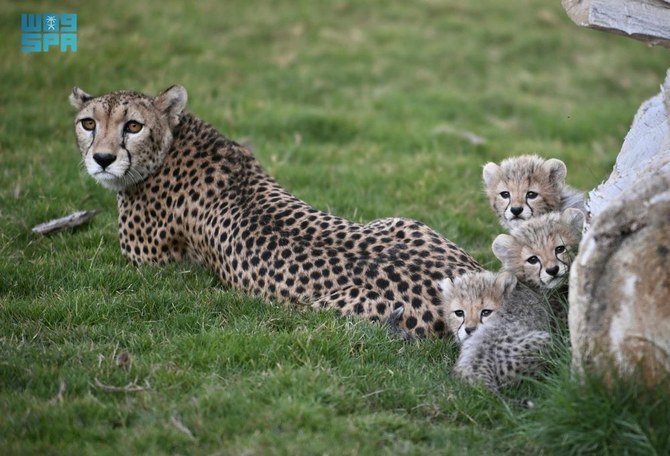
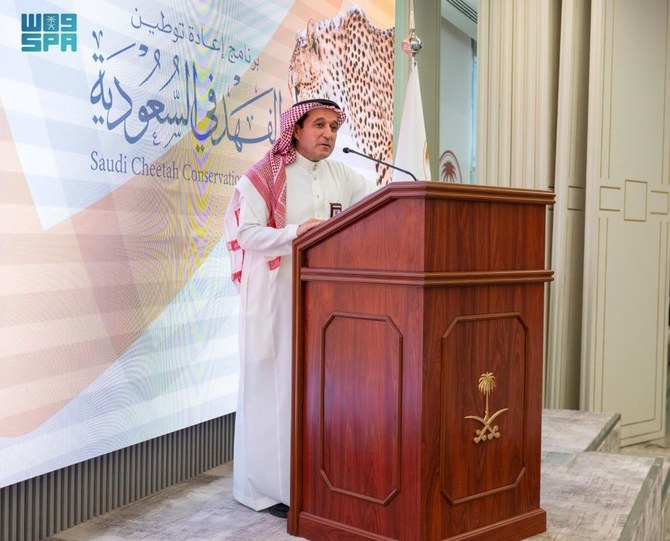
The NCW has announced a major breakthrough in its cheetah conservation efforts, with the birth of four cubs. (SPA)
2 / 5
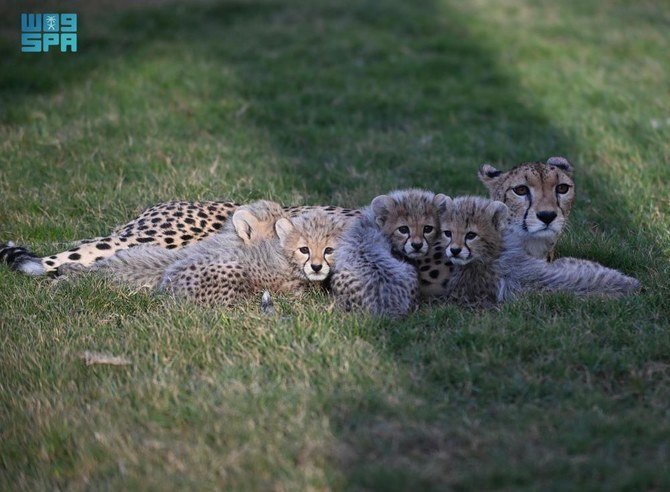
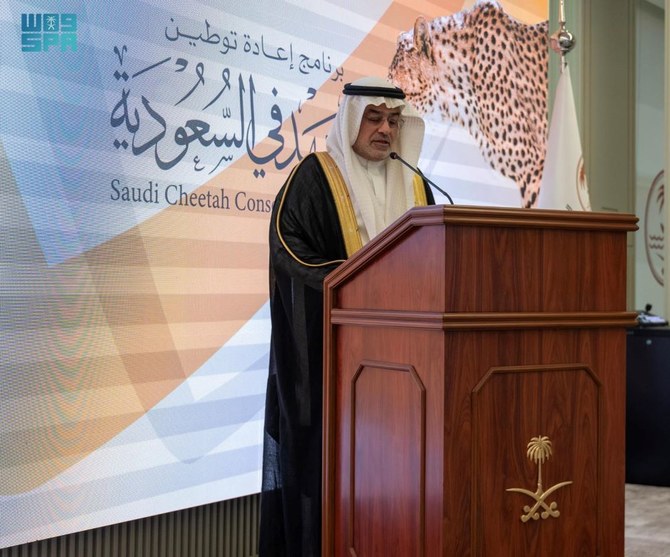
The NCW has announced a major breakthrough in its cheetah conservation efforts, with the birth of four cubs. (SPA)
3 / 5
The NCW has announced a major breakthrough in its cheetah conservation efforts, with the birth of four cubs. (SPA)
4 / 5
The NCW has announced a major breakthrough in its cheetah conservation efforts, with the birth of four cubs. (SPA)
5 / 5
The NCW has announced a major breakthrough in its cheetah conservation efforts, with the birth of four cubs. (SPA)
Short Url
Updated 23 July 2024
Follow

Saudi wildlife center celebrates cheetah conservation milestone

  • Four cubs born as part of national strategy

RIYADH: Saudi Arabia’s National Center for Wildlife has announced a major breakthrough in its cheetah conservation efforts, with the birth of four cubs and the completion of a comprehensive national strategy.

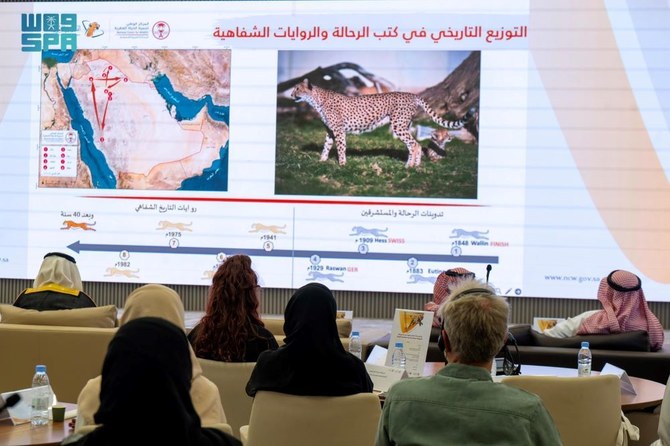
The announcement came during a session held by the center on Tuesday to introduce the cheetah, and outline efforts for its reintroduction. This initiative is part of the National Cheetah Conservation Strategy within the National Cheetah Reintroduction Program, launched last year under the auspices of the minister of environment, water and agriculture, Abdulrahman Al-Fadhli, who is also chairman of the center.

The center’s CEO, Dr. Mohammed Qurban, said: “The official launch of the National Cheetah Conservation Strategy and the announcement of the birth of four cheetah cubs signifies an important achievement in our conservation efforts. This strategy reflects our unwavering commitment to ensuring a sustainable future for wild cheetahs in their natural habitats in the Kingdom.”

Qurban added that the birth of the cubs was especially important given the cheetah’s absence from the Arabian Peninsula for more than four decades.

“Our recent discovery of ancient cheetah mummies in northern Saudi Arabia underscores the region’s historical role as a prime cheetah habitat,” he said.

Qurban said that this discovery would fuel the determination to reestablish cheetah populations, “guided by an integrated strategy designed in accordance with best international practices.”

He said: “The current remaining distribution of cheetahs worldwide is limited to 9 percent of their historical range, with only 7,100 in existence among 34 different groups in the wild.”

The center also unveiled its multi-phase National Cheetah Conservation Strategy during the briefing session. The plan outlines a series of critical steps aimed at reestablishing a viable cheetah population in Saudi Arabia.

The strategy begins with the creation of specialized breeding facilities and rewilding centers, identifying protected areas that offer suitable habitats for the reintroduced cheetahs, preparing for reintroduction, community partnership in the protection program, and finally, reintroduction and establishment of a self-sustaining breeding population.

The announcement reflects Saudi Arabia’s leading role and success in efforts to enhance environmental balance through the conservation of endangered species, their captive breeding, and reintroduction. The center said that only 15 percent of cheetahs born in the wild could breed in captivity, and of this group, only 20 percent continued to reproduce.

The center’s research team, in collaboration with global experts, has recently disclosed pivotal findings from its comprehensive cheetah research, offering new perspectives on the species’ presence in the Arabian Peninsula. The study, which examined the chronological age of specimens and identified cheetah subspecies, provided a fresh look at the cultural and historical significance of these big cats in the region. The findings are set to recalibrate current conservation strategies. By correcting long-held misconceptions and providing region-specific data, the study allows for more targeted and effective conservation efforts.

The team has successfully pinpointed the timeline of the cheetah’s extinction in the region and extracted crucial genetic information from historical specimens. The scientists have identified the specific subspecies of the Arabian cheetah, comparing its genetic sequence with those of cheetahs currently housed in the center’s facilities and populations worldwide. The findings support the center’s ongoing efforts to breed and reintroduce cheetahs to their native habitats in Saudi Arabia.

The Kingdom is ramping up its commitment to cheetah conservation, employing a multi-faceted approach that combines scientific research, innovative strategies and collaborative partnerships.


How 2025 became a landmark year in Saudi transformation and global leadership

Updated 26 sec ago
Follow

How 2025 became a landmark year in Saudi transformation and global leadership

  • From the Riyadh Metro launch to Nobel Prize glory, the Kingdom’s 2025 journey marked a new era of progress
  • Strategic alliances and domestic milestones dominated the year as Saudi Arabia moved closer to its Vision 2030 goals

RIYADH: From major announcements placing the Kingdom at the forefront of global sports to forums setting a precedent for regional investment and the heroic actions of citizens that stand as a testament to Saudi traditions, 2025 marked a historic benchmark in the nation’s transformation.

With fewer than five years remaining until the Vision 2030 deadline, Arab News looks back at the pivotal moments this year that helped shape the Kingdom’s future.

It was in 2012 that the Council of Ministers approved the implementation of the King Abdulaziz Project for Riyadh Public Transport, which included the Riyadh Metro. At the time, the $22.5 billion project was seen as a massive undertaking to transform Riyadh’s infrastructure.

Fast forward to January 2025, and that vision became a reality with the inauguration of the Orange Line. This marked the completion of the capital’s six-line metro project — a significant step in modernizing urban transport and advancing Saudi Arabia’s Vision 2030 goals.

In just nine months, the Riyadh Metro reached another major milestone, carrying more than 100 million passengers since its launch.

On the world stage, 2025 marked a major step forward in Saudi-US ties, specifically regarding diplomatic, technological, and economic relations.

In May, US President Donald Trump made his first international visit of his second administration to Saudi Arabia. Saudi Ambassador to the US, Princess Reema bint Bandar, described the visit in The Washington Times on May 12 as a pivotal step for “global peace, security, and prosperity.”

During this visit, the Kingdom hosted the Saudi-US Investment Forum, which confirmed a $600 billion Saudi investment commitment to the US. The US Embassy noted that this was the largest set of commercial agreements on record between the two nations.

The forum broadened its scope to include technology, artificial intelligence, energy, and critical minerals. In the field of AI, the two countries signed a Strategic Artificial Intelligence Partnership to cooperate on the supply of advanced semiconductors for the PIF-backed Humain.

In the energy sector, Saudi Aramco announced agreements with US companies valued at over $30 billion. Additionally, in the sector of critical minerals, Saudi’s Ma’aden and the US Department of Defense signed an agreement to build a rare earths refinery.

Another highlight of the year came in February when Saudi Arabia emerged as a key international mediator. By hosting US-Russia talks on the Ukraine crisis, the Kingdom helped foster dialogue and promote international stability.

Over the course of the Russia-Ukraine conflict, Saudi Arabia has facilitated multiple discussions to find a diplomatic solution, positioning itself as a vital bridge in the current geopolitical environment.

The Saudi-brokered talks successfully established a direct negotiation channel. Following the dialogue, Russian President Vladimir Putin signaled a readiness to de-escalate, marking the first time the foundations for a formal peace plan began to emerge.

It was not all positive news in 2025, however. The Kingdom mourned the tragic loss of a citizen following an attack in the UK university town of Cambridge in August. Mohammed Al-Qasim, 20, was stabbed near Cambridge’s main railway station on Aug. 1 and died in the early hours of the following morning.

In a tribute following his death, Al-Qasim’s family described him as “a dutiful son, a loving brother, and the leader of the family in spirit, not in appearance. Over time, he became the family’s charisma, leaving behind an unforgettable legacy in every gathering.”

A trial date for the 21-year-old suspect, Chas Corrigan, has been set for Feb. 2, 2026.

In November, justice was served in a separate case when 42-year-old Ian Hudson was convicted and sentenced to nine years in prison for attempted rape.

The attack was stopped by heroic 24-year-old Saudi student Hamzah Al-Bar, who rushed to a woman’s defense on Dec. 30, 2024. The student, nicknamed “Hero Hamzah” by UK police, later recalled: “I had the chance to step in and help somebody that needed help.”

He spotted Hudson at a bus stop and pursued him, noting: “Hudson knew that what he had done was despicable and he was trying to run away from the consequences as urgently as he could. Ultimately, I wasn’t going to let that happen.”

The judge, Recorder David Gordon, formally commended Al-Bar for his “extraordinary courage and public-spiritedness,” adding: “Mr. Al-Bar intervened without hesitation to prevent the rape of the complainant who was in clear and immediate danger.”

September marked a pivotal step in defense diplomacy during the state visit of Pakistani Prime Minister Muhammad Shehbaz Sharif to Riyadh.

Building on a partnership spanning nearly eight decades, the Saudi crown prince and Prime Minister Sharif signed a Strategic Mutual Defense Agreement. This formalized defense cooperation and strengthened joint deterrence, stipulating that an attack against one country shall be considered an attack against both.

In early October, chemist Omar M. Yaghi, a professor at UC Berkeley, was awarded the 2025 Nobel Prize in Chemistry, becoming the first Saudi citizen to receive the honor. Yaghi, granted Saudi citizenship in 2021, was recognized for his breakthrough development of metal-organic frameworks — sponge-like structures that can store CO2 or harvest water from the air.

The year also saw a transition in religious leadership. Sheikh Saleh bin Fawzan bin Abdullah Al-Fawzan was appointed Grand Mufti and Chairman of the Council of Senior Scholars following the passing of Sheikh Abdulaziz Al-Asheikh on Sept. 23. This role carries the heavy responsibility of advising the leadership and providing religious guidance for the nation.

Closing a historic year was the Saudi crown prince’s state visit to the US in mid-November. President Trump received the crown prince at the White House, where both participated in a summit reaffirming the strategic partnership.

During the visit, numerous agreements and memoranda of understanding valued at approximately $270 billion were announced across defense, AI, education, and energy.

President Trump concluded the visit by conveying his best wishes to King Salman and the crown prince, wishing the Saudi people continued progress and prosperity.

The year concluded on a high note for regional stability as Saudi Arabia successfully navigated a complex shift in the Yemeni landscape. In December, the Kingdom played a key role when the Coalition to Restore Legitimacy in Yemen underwent a realignment.

The UAE-backed Southern Transitional Council launched an offensive that seized the oil-rich Hadhramaut and Al-Mahrah provinces, effectively bringing nearly half of Yemen’s territory under separatist control.

In late December, Saudi Arabia, which backs the Presidential Leadership Council, the executive body of Yemen’s internationally recognized government, conducted airstrikes against STC positions in Mukalla, prompting the UAE to agree to withdraw its remaining forces from the country.