Philippine police deny man inhaling white powder in video is president Marcos

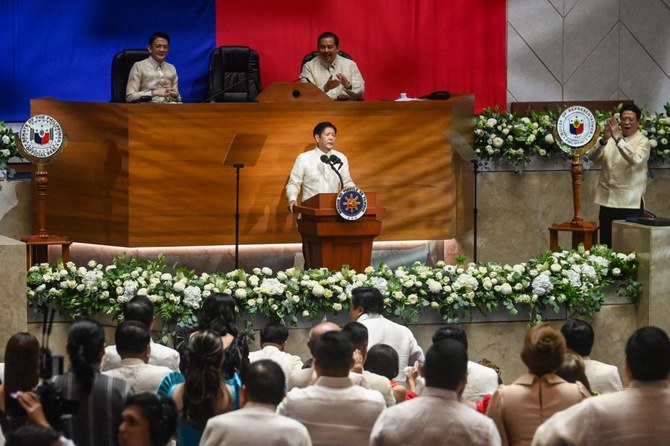
Philippine President Ferdinand Marcos Jr., center, gives his annual State of the Nation Address at the House of Representatives in Manila on July 22, 2024. (AFP)
Short Url
Updated 23 July 2024
Follow

Philippine police deny man inhaling white powder in video is president Marcos

  • Police forensic experts present photos of Marcos and the unidentified man to compare their facial features

MANILA: A video allegedly showing Philippine President Ferdinand Marcos inhaling a white powder has been denounced as “fake” and “malicious,” with investigators on Tuesday presenting close-up images of his ear to prove it was not him.
The clip featuring a dark-haired man was part of a video shown at a rally in Los Angeles that was organized by a political group linked to Marcos’s predecessor Rodrigo Duterte.
The rally was livestreamed on the Facebook page of pro-Duterte broadcaster SMNI in the Philippines early Monday local time, hours before Marcos was due to deliver his annual State of the Nation address to Congress.
“It is obvious from the video that that is not our president. Their video is fake and obviously not real,” Defense Secretary Gilberto Teodoro said Monday, after the video went viral on social media.
Teodoro said it was part of a “serious plan to destabilize our government.”
The video spread rapidly on Facebook, YouTube and TikTok. One Facebook post was viewed at least eight million times.
Duterte’s former spokesman Harry Roque shared it on his Facebook page with a caption in Tagalog reading: “You be the judge.”
It was viewed 17,000 times.
Police forensic experts held a news conference on Tuesday to prove the man in the video was not the president, presenting photos of Marcos and the unidentified man to compare their facial features.
Enlarged images of their faces and right ears were placed side by side to demonstrate that Marcos’s ear was larger in proportion to his face and had a different shape to those of the other man, whose ear curled over at the top.
“Be it AI (artificial intelligence) or imposter or whatever it was, as far as the (police) is concerned that is not the president,” Interior Secretary Benjamin Abalos said Tuesday.
“That is a different person based on the ear. That’s not even considering the jawline and the entire facial structure,” Abalos said, describing the video as “malicious.”
The Marcos and Duterte families have had a bitter, public falling out as they attempt to shore up their rival support bases and secure key positions ahead of the 2025 mid-term elections.
Duterte and Marcos have accused each other of being drug addicts, although neither man has offered proof of their allegations.


US intercepts fifth sanctioned tanker as it exerts control over Venezuelan oil distribution

Updated 4 sec ago
Follow

US intercepts fifth sanctioned tanker as it exerts control over Venezuelan oil distribution

WASHINGTON: US forces boarded another oil tanker in the Caribbean Sea on Friday, the US military said, as the Trump administration targets sanctioned tankers traveling to and from Venezuela as part of a broader effort to take control of the South American country’s oil.
The predawn raid was carried out by Marines and Navy sailors launched from the aircraft carrier USS Gerald R. Ford, part of the extensive force the US has built up in the Caribbean in recent months, according to US Southern Command, which declared “there is no safe haven for criminals” as it announced the seizure of the tanker called the Olina. The Coast Guard then took control of the vessel, officials said.
Southern Command and Homeland Security Secretary Kristi Noem both posted unclassified footage on social media Friday morning of a US helicopter landing on the vessel and US personnel conducting a search of the deck and tossing what appeared to be an explosive device in front of a door leading to inside the ship.
In her post, Noem said the ship was “another ‘ghost fleet’ tanker ship suspected of carrying embargoed oil” and it had departed Venezuela “attempting to evade US forces.”
The Olina is the fifth tanker that has been seized by US forces as part of the effort by President Donald Trump’s administration to control the production, refining and global distribution of Venezuela’s oil products, and the third since the US ouster of Venezuela President Nicolás Maduro in a surprise nighttime raid.
In a post on his social media network later in the day, Trump said the seizure was conducted “in coordination with the Interim Authorities of Venezuela” but offered no elaboration.
The White House did not immediately respond to requests for more details.
Venezuela’s government acknowledged in a statement that it was working with US authorities to return the tanker, “which set sail without payment or authorization from the Venezuelan authorities,” to the South American nation.
“Thanks to this first successful joint operation, the ship is sailing back to Venezuelan waters for its protection and relevant actions,” according to the statement.
Samir Madani, co-founder of TankerTrackers.com, said his organization used satellite imagery and surface-level photos to document that at least 16 tankers left the Venezuelan coast in contravention of the quarantine US forces have set up to block sanctioned ships from conducting trade. The Olina was among that flotilla.
US government records show that the Olina was sanctioned for moving Russian oil under its prior name, Minerva M, and flagged in Panama.
While records show the Olina is now flying the flag of Timor-Leste, it is listed in the international shipping registry as having a false flag, meaning the registration it is claiming is not valid. In July, the owner and manager of the ship on its registration was changed to a company in Hong Kong.
According to ship tracking databases, the Olina last transmitted its location in November in the Caribbean, north of the Venezuelan coast. Since then, however, the ship has been running dark with its location beacon turned off.
While Noem and the military framed the seizure as part of an effort to enforce the law, other officials in the Trump administration have made clear they see it as a way to generate cash as they seek to rebuild Venezuela’s battered oil industry and restore its economy.
In an early morning social media post, Trump said the US and Venezuela “are working well together, especially as it pertains to rebuilding, in a much bigger, better, and more modern form, their oil and gas infrastructure.”
The administration said it expects to sell 30 million to 50 million barrels of sanctioned Venezuelan oil, with the proceeds to go to both the US and Venezuelan people. But the president expects the arrangement to continue indefinitely. He met Friday with executives from oil companies to discuss his goal of investing $100 billion in Venezuela to repair and upgrade its oil production and distribution.
Vice President JD Vance told Fox News this week that the US can “control” Venezuela’s “purse strings” by dictating where its oil can be sold.
Madani estimated that the Olina is loaded with 707,000 barrels of oil, which at the current market price of about $60 a barrel would be worth more than $42 million.