

Pakistani PM sets sights on annual exports of $60 billion in 3 years

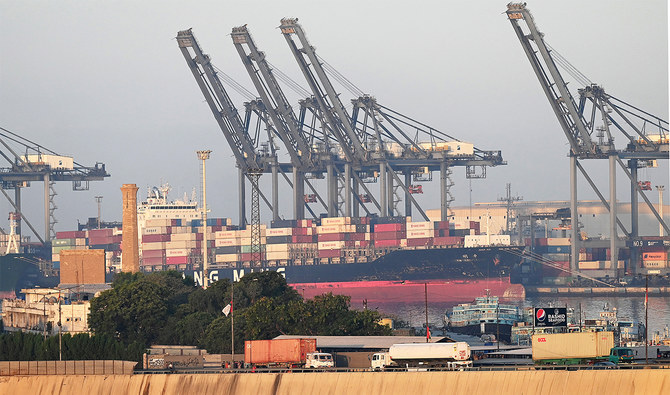
Shipping containers are seen stacked on a ship at a sea port in Karachi on April 6, 2023. (AFP/File)
Short Url
Updated 23 July 2024
Follow

Pakistani PM sets sights on annual exports of $60 billion in 3 years

  • Pakistan’s exports in previous fiscal year crossed $30 billion, says Shehbaz Sharif
  • Directs power ministry to develop plan to provide low-cost electricity to industries

ISLAMABAD: Prime Minister Shehbaz Sharif on Tuesday tasked authorities to increase Pakistan’s annual exports to $60 billion within three years, stressing the need to resolve exporters’ complaints as Islamabad seeks to enhance its foreign exchange reserves while grappling with a macroeconomic crisis. 

Pakistan is trying to navigate a tricky path to recovery from a prolonged economic crisis that has seen the South Asian country’s national currency weaken, its reserves plummet and inflation rise to a record high over the last two years. To stabilize its fragile $350 billion economy, Islamabad has increasingly sought to establish trade and investment relations with regional allies in recent months. 

Sharif chaired a meeting of Pakistan’s National Export Development Board on Tuesday to take stock of the country’s exports and discuss ways to enhance them. 

“The Ministry of Commerce and other institutions should take practical steps to achieve the target of taking exports to $60 billion in the next three years,” the prime minister was quoted as saying by his office. 

Sharif noted that Pakistan’s annual exports had crossed the $30 billion mark during the previous fiscal year, adding that the government’s policies took the country’s IT exports to over $3.2 billion. He directed authorities to resolve exporters’ complaints and submit a report to him within two weeks. 

“We salute the businesspersons and investors who have played their role in increasing Pakistan’s exports despite difficult conditions,” Sharif said, according to the Prime Minister’s Office (PMO).

The prime minister called for reducing the delivery time Pakistani goods take to reach Europe and America, saying that this could be achieved by solving problems related to shipping. He emphasized increasing the quality of Pakistani exports through research and development, innovation and brand development. He directed Pakistan’s power ministry to present a comprehensive plan through which low-cost electricity is provided to industries.

Sharif warned Pakistan’s tax authority, the Federal Board of Revenue, (FBR) against delaying refunds to exporters, urging trade officers in Pakistan’s missions abroad to promote the country’s exports and guide exporters on increasing their sales.


US pump prices surge as Iran war upends global energy supply

Updated 07 March 2026
Follow

US pump prices surge as Iran war upends global energy supply

  • Fuel prices jump over 10 percent as oil prices surge
  • Analysts predict further price rises due to market conditions

MARIETTA/NEW YORK : US retail gasoline and diesel prices are soaring as the US-Israel war with Iran constrains oil and fuel exports, which could be a political test for President Donald Trump’s Republican Party ahead of midterm ​elections in November.
Fuel prices jumped more than 10 percent this week as oil rose above $90 a barrel, its highest in years, adding pain at the pump for consumers already strained by inflation.
Trump on Thursday shrugged off higher gasoline prices in an interview with Reuters, saying “if they rise, they rise.”
The president had vowed to lower energy prices and unleash US oil and gas drilling during his second term, but much of his tenure has been marked by volatility and uncertainty amid shifts in policies like tariffs and geopolitical turmoil.
The US is the world’s largest oil producer. It is a major exporter but also imports millions of barrels a day since it is the world’s largest oil consumer.
As of Friday, the national average prices for regular gasoline stood at $3.32 a gallon, up 11 percent from a ‌week ago and ‌the highest since September 2024, according to data from the motorists association AAA. Diesel was at $4.33, ​up ‌15 percent ⁠from a week ​ago, ⁠surging to the highest since November 2023.

Midwest, south feel the pinch
US motorists in parts of the Midwest and the South, including states that supported Trump, have seen some of the steepest increases in fuel costs since the conflict in Iran started.
In Georgia, a swing state, average retail gasoline prices rose 40.1 cents a gallon over the past week, according to fuel tracking site GasBuddy.
Andrenna McDaniel, a health care insurance worker in South Fulton, Georgia, said she was surprised to see prices skyrocket overnight.
“They jumped up so quickly,” she said on Friday, adding that she does not agree with the war at all.
McDaniel, a Democrat, said that for now she is only driving for the most important things, ⁠and feels lucky that she works from home so she does not have to drive as ‌much as other people do. Georgia voted for Donald Trump in the 2024 election.
Trump voter ‌Richard Soule, 69, a US Air Force veteran and a retired firefighter, said ​a little pain at the pump is worth Trump’s efforts to ‌protect America.
“When President Trump went in there and bombed out their nuclear, and they just thumbed their nose at it, ‌I believe he did the right thing at the right time,” Soule said on Friday as he filled up his Ford F-150 truck in Marietta, Georgia.
Other states, including Indiana and West Virginia have seen prices rise by 44.3 cents and 43.9 cents, respectively.

Prices may rise further
More pain may be on the way, analysts said, as oil prices continue to trend upward. On Friday, US oil futures settled at $90.90 a barrel, up nearly $10 and ‌the biggest single-day rise since April 2020.
“Given current market conditions, the national average price of gasoline could climb toward $3.50 to $3.70 per gallon in the coming days if oil continues rising and supply ⁠disruptions persist,” GasBuddy analyst Patrick De ⁠Haan said.
The disruptions in the Middle East and the Strait of Hormuz, a key trade conduit, have boosted demand for US oil abroad, which in turn has driven up prices for domestic refiners too.
“The US has weaned itself off of its dependence on Middle Eastern crude, but obviously Asian refineries, and to a lesser extent, European refineries have not,” Denton Cinquegrana, chief oil analyst with OPIS. “That’s what you’re seeing happen in the spot market, because the demand for US exports rise, and so the price rise.”
Seasonal factors could add further pressure. Gasoline prices typically go up in the spring and peak in the summer due to higher gasoline demand and production of summer-blend gasoline, which is more costly to produce. Diesel fuel saw an even more aggressive jump since Iran began retaliating against US and Israeli strikes, significantly disrupting shipping in the Strait of Hormuz.
Global diesel inventories have remained in tight supply due to heavy demand for heating and power generation during a prolonged winter in the US and other parts of the world and a structural tightness of refining ​capacity. Sticker prices of everything from food to furniture go up ​when the cost of diesel goes up, as the fuel is mainly used in freight transportation, manufacturing, agriculture, and global shipping, analysts said.
“In a world where buzzword seems to be ‘affordability’, that is certainly not going to help,” Cinquegrana said.