LONDON: Britain’s Conservative Party will name its new leader on Nov. 2, the Times reported on Monday, following the party’s worst ever election performance earlier this month that prompted former Prime Minister Rishi Sunak to say he would stand down.
The contest would last almost four months, culminating in a ballot of rank and file members to select one of the final two candidates, Times Political Editor Steven Swinford said in a post on X.
Sunak’s election campaign ended in failure on July 4, when the center-left Labour Party, led by Keir Starmer, won a landslide election victory that ended 14 years of Conservative-led government.
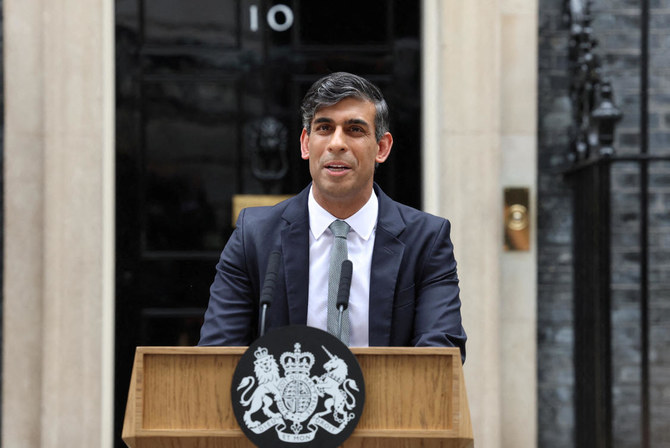
Sunak said in his final speech outside the Prime Minister’s Downing Street office that he would quit as leader of the party once the formal arrangements for his successor were in place.
The Times report came ahead of the formal announcement of those arrangements later this week. The Conservative Party did not respond to a request for comment on the report.
The Times said up to eight candidates were expected to put their name forward.
Conservative Party leadership contests usually involve a series of ballots among its elected lawmakers to whittle down the number of candidates, before the whole party gets to choose between the final two.

UK Conservative Party to announce new leader Nov 2, Times report says
https://arab.news/r5e62
UK Conservative Party to announce new leader Nov 2, Times report says
- The Times said up to eight candidates were expected to put their name forward
- Contest would last almost four months, culminating in a ballot of rank and file members to select one of the final two candidates, Times political editor said
Trump expands travel ban, adding 5 more countries and imposing new limits on others
- Nationals from Syria, South Sudan, Burkina Faso, Mali and Niger are banned from visiting the US
- The White House also fully restricted travel on people with Palestinian-Authority-issued travel documents
WASHINGTON: The Trump administration is expanding its travel ban to include five more countries and impose new limits on others.
This move Tuesday is part of ongoing efforts to tighten US entry standards for travel and immigration. The decision follows the arrest of an Afghan national suspect in the shooting of two National Guard troops over Thanksgiving weekend.
In June, President Donald Trump announced that citizens of 12 countries would be banned from visiting the United States and those from seven others would face restrictions. The decision resurrected a hallmark policy of his first term.
At the time the ban included Afghanistan, Myanmar, Chad, the Republic of Congo, Equatorial Guinea, Eritrea, Haiti, Iran, Libya, Somalia, Sudan and Yemen and heightened restrictions on visitors from Burundi, Cuba, Laos, Sierra Leone, Togo, Turkmenistan and Venezuela.
On Tuesday, the Republican administration announced it was expanding the list of countries whose citizens are banned from entering the US to Burkina Faso, Mali, Niger, South Sudan and Syria. The administration also fully restricted travel on people with Palestinian-Authority-issued travel documents.
An additional 15 countries are also being added to the list of countries facing partial restrictions: Angola, Antigua and Barbuda, Benin, Côte d’Ivoire, Dominica, Gabon, Gambia, Malawi, Mauritania, Nigeria, Senegal, Tanzania, Tonga, Zambia and Zimbabwe.
The Trump administration said in its announcement of the expanded travel ban that many of the countries from which it was restricting travel had “widespread corruption, fraudulent or unreliable civil documents and criminal records” that made it difficult to vet their citizens for travel to the US. It also said some countries had high rates of people overstaying their visas, refused to take back their citizens who the US wished to deport or had a “general lack of stability and government control,” which made vetting difficult.
“The restrictions and limitations imposed by the Proclamation are necessary to prevent the entry of foreign nationals about whom the United States lacks sufficient information to assess the risks they pose, garner cooperation from foreign governments, enforce our immigration laws, and advance other important foreign policy, national security, and counterterrorism objectives,” reads the White House proclamation announcing the changes.
The Afghan man accused of shooting the two National Guard troops near the White House has pleaded not guilty to murder and assault charges.


