

Islamabad police raid headquarters of ex-PM Khan party, arrest official over ‘anti-state propaganda’

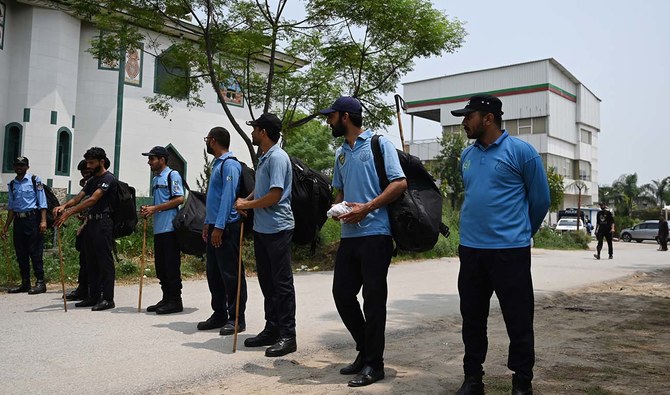
Policemen stand guard near the Pakistan Tehreek-e-Insaf (PTI) party's headquarters after a security raid in Islamabad on July 22, 2024. (AFP)
Short Url
Updated 22 July 2024
Follow

Islamabad police raid headquarters of ex-PM Khan party, arrest official over ‘anti-state propaganda’

  • Videos shared online showed policemen surrounding PTI party secretariat in Islamabad, leading away Information Secretary Raoof Hasan
  • Pakistan’s interior ministry says the raid was conducted on the basis of initial investigation and analysis of the party’s digital content

ISLAMABAD: Pakistan’s police on Monday raided the headquarters of jailed former prime minister Imran Khan’s Pakistan Tehreek-e-Insaf (PTI) party in Islamabad and arrested a top official of the party for involvement in anti-state propaganda, the interior minister said.
PTI social media accounts shared videos of dozens of policemen surrounding the PTI secretariat in Pakistan’s federal capital of Islamabad and leading away PTI Information Secretary, Raoof Hasan.
Pakistan’s interior ministry confirmed Hasan’s arrest and said the Islamabad police and the Federal Investigation Agency (FIA) raided the PTI digital media wing based on initial investigation and analysis of party’s digital content.
“The PTI is involved in anti-state propaganda,” the interior ministry said in a statement. “A JIT [joint investigation team] is being constituted [to investigate the allegations].”
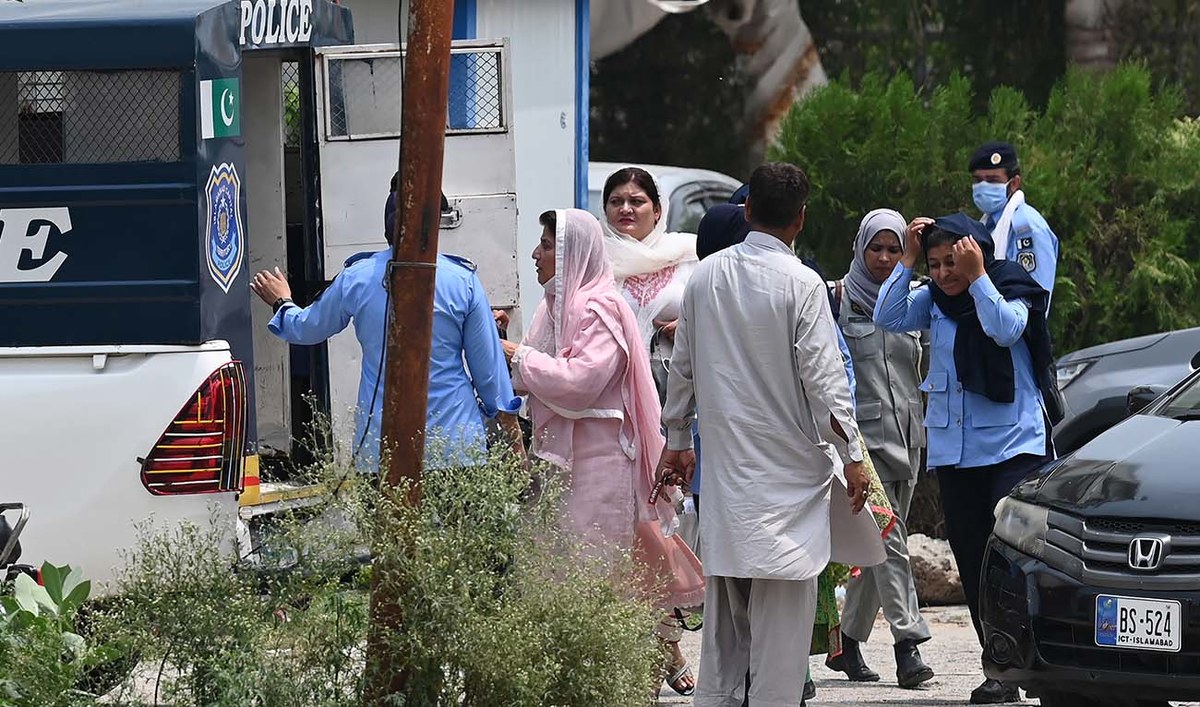


Women police officers taking the arrested female workers of the Pakistan Tehreek-e-Insaf (PTI) from the party's headquarters into police van after a security raid in Islamabad on July 22, 2024. (AFP)

Authorities also briefly detained PTI Chairman Gohar Khan, who is also Khan’s lawyer, on Monday but released him later, Sayed Zulfikar Abbas Bukhari, Khan’s key adviser on media, told Arab News.
The raid at PTI headquarters and the arrest of the party’s information secretary comes days after several other PTI members, including the party’s top media manager Ahmed Waqqas Janjua, were arrested by authorities.
An anti-terrorism court on Monday remanded Janjua into police custody for seven days after the investigating officer said he was found in possession of explosives during the arrest and they wanted to probe his alleged links with outlawed organizations, according to the PTI and Janjua’s lawyer.
Pakistan’s Information Minister Ataullah Tarar last week said the government planned to ban the PTI, days after the Supreme Court made a crucial ruling in the party’s favor that dealt a huge blow to the government.
Khan has been jailed for nearly a year, but this month an Islamabad judge overturned his illegal marriage conviction while the Supreme Court awarded PTI more parliamentary seats — a move set to make them the largest party in the National Assembly.
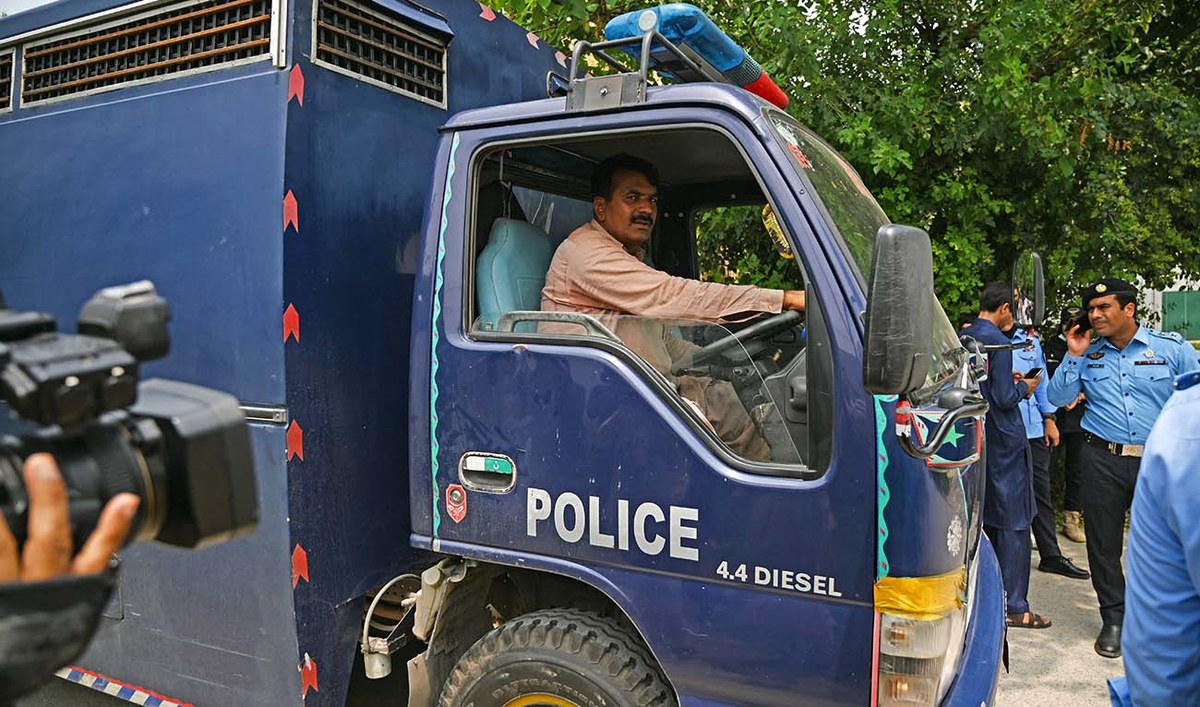


Policemen make way for prison van after a security raid at the Pakistan Tehreek-e-Insaf (PTI) party's headquarters in Islamabad on July 22, 2024. (AFP)

Both cases were considered a major blow to the government of Prime Minister Shehbaz Sharif, who has been leading a weak coalition since the February 8 election.
The Human Rights Commission of Pakistan (HRCP) described the attempt to ban the PTI as “an enormous blow to democratic norms” and said it “reeks of political desperation.”
“If pushed through, it will achieve nothing more than deeper polarization and the strong likelihood of political chaos and violence,” HRCP Chairman Asad Iqbal Butt said in a statement.
Khan, who says the cases against him have been orchestrated to prevent his return to power, remains languishing in jail on fresh charges of inciting protests and graft.
A United Nations panel of experts this month found that Khan’s detention “had no legal basis and appears to have been intended to disqualify him from running for political office.”


Pakistan reaffirms commitment to clamp down on informal sector to encourage investment

Updated 6 sec ago
Follow

Pakistan reaffirms commitment to clamp down on informal sector to encourage investment

  • Nestlé delegation briefs Finance Minister Muhammad Aurangzeb on localization, efficiency enhancements in Pakistan
  • Improved compliance, transparency, strengthened tax ecosystem central to economic recovery, stresses finance minister

KARACHI: Pakistan’s Finance Minister Muhammad Aurangzeb reaffirmed the government’s commitment to clamp down on the informal sector on Monday, the Finance Division said, citing transparency and a strengthened tax ecosystem as central to the country’s economic recovery. 

Pakistan’s government has cracked down on smuggled items and tightened enforcement in poorly taxed sectors, such as tobacco, in recent months as it pushes ahead with its efforts to maximize tax collection by discouraging the formal sector. Informal sector comprises businesses that operate outside the tax net, avoid registration and as a result, neglect regulatory oversight and violate quality, safety or labor standards. 

Aurangzeb met a delegation from Nestlé Pakistan at the Finance Division, where the two sides discussed the multinational’s efforts to strengthen its operations in the country through localization, portfolio adjustments and efficiency enhancements. 

“Emphasizing the government’s resolve to clamp down on the informal sector, an effort that has already begun yielding visible results in multiple industries, the finance minister noted that improved compliance, transparency and a strengthened tax ecosystem are central to Pakistan’s economic recovery,” the Finance Division said in a statement. 

Nestlé Pakistan Chief Executive Officer Jason Avancena provided an overview of the organization’s operations, claiming it had strengthened them through localization, portfolio adjustments, advanced automation, efficiency enhancements and continued innovation across product categories. 

Avancena said Nestlé is implementing solar and biomass energy systems, digital dashboards, environmentally improved packaging, and supply-chain automation in Pakistan. The delegation highlighted that Nestlé’s localization efforts have materially strengthened its resilience. 

“They noted that through sustained efforts to localize raw materials and reconfigure product portfolios, Nestlé Pakistan has reduced its import volumes by nearly half over the past three years from around $150 million to approximately $76–80 million, thereby minimizing exposure to foreign-exchange pressures and deepening integration with Pakistan’s agricultural and manufacturing base,” the Finance Division said. 

Aurangzeb commended the multinational for its efforts and underscored the government’s intention to facilitate greater formalization and enhanced tax equity across the food and beverages sector. He noted that informal players have “rapidly expanded” their market share by operating outside the tax net in sectors such as food and beverages. 

The delegation also discussed export performance, including the company’s presence in markets such as the United States, Canada, the Gulf, and the United Kingdom, sharing insights into challenges related to regional trade, particularly the Afghanistan corridor. 

Aurangzeb advised Nestlé to explore logistics partnerships to expand access to Central Asian markets, reiterating that Islamabad remains committed to enabling export-oriented industry growth.