

National Housing Co. partners with Korean firm Naver to boost smart city solutions in the Kingdom  

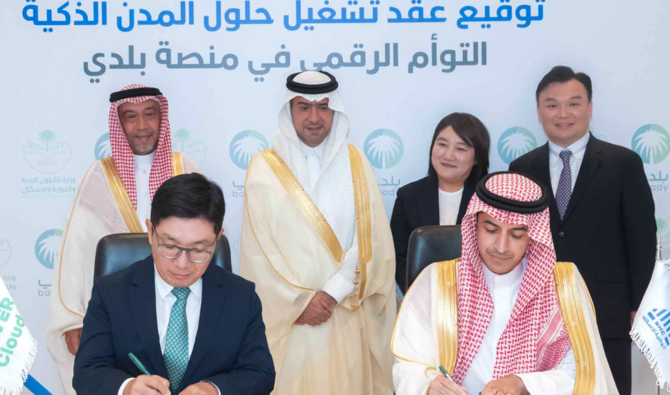
The agreement was signed in the presence of Housing Minister Majid Al-Hogail. NHC
Short Url
Updated 22 July 2024
Follow

National Housing Co. partners with Korean firm Naver to boost smart city solutions in the Kingdom  

RIYADH: The Saudi real estate sector is set to embrace advanced technologies after the National Housing Co. partnered with Korean tech firm Naver Corp. to enhance smart city solutions. 

The collaboration, formalized in the presence of Housing Minister Majid Al-Hogail, aims to integrate Digital Twin technology, utilizing Naver’s advanced cloud system.  

The technology mirrors real-world entities in a virtual environment, supporting real-time decision-making through data analysis, prediction, and optimization. It will be cloud-based, with a focus on three-dimensional digital modeling. 

This move aligns with Saudi Arabia’s Vision 2030 goals, aiming to use this technology for urban planning and flood predictions while advancing smart city development.

The integration of Digital Twin technology is part of the Kingdom’s broader strategy to modernize its real estate sector and adopt cutting-edge solutions to enhance urban management and infrastructure efficiency. 

Minister Al-Hogail highlighted the significance of this partnership, stating on X that the deal opens the doors for innovation in digital solutions.

“Together, we achieve strategic visions for the municipalities and housing sectors in our relentless pursuit of sustainable smart cities,” he said.

This deal builds on Naver’s initial entry into the Middle East and Saudi markets in 2023 by establishing a contract with the ministries of investment and housing to use their systems.

The ambitious roadmap also includes amalgamating advanced technologies such as AI, robotics, and cloud solutions. 

The company emphasized the platform’s open-ended architecture, fostering collaborations with local Saudi and South Korean entities.

Abdullah Al-Ghamdi, the president of the Saudi Data and Artificial Intelligence Authority, visited the firm’s site in May, denoting the establishment’s long-standing relationship with the Kingdom.

During the meeting, potential collaborations between the two entities were discussed, as SDAIA is responsible for strategy, research, and development in the AI, data, and smart city sectors in Saudi Arabia. 

Officials from other major Saudi institutions, including the Ministry of Communications and Information Technology, the National Information Center, and the National Data Management Office, have also paid visits to the site to experience the company’s technological advancements and discuss collaborative opportunities, a release on the Korean entity’s website revealed.

This comes after Naver became part of the “One Team Korea” consortium in November 2022. The partnership sought to secure Saudi projects under the patronage of South Korea’s Ministry of Land, Infrastructure, and Transport.


Gulf-EU value chain integration signals shift toward long-term economic partnership: GCC secretary general

Updated 5 sec ago
Follow

Gulf-EU value chain integration signals shift toward long-term economic partnership: GCC secretary general

RIYADH: Value chains between the Gulf and Europe are poised to become deeper and more resilient as economic ties shift beyond traditional trade toward long-term industrial and investment integration, according to the secretary general of the Gulf Cooperation Council.

Speaking on the sidelines of the World Governments Summit 2026 in Dubai, Jasem Al-Budaiwi said Gulf-European economic relations are shifting from simple commodity trade toward the joint development of sustainable value chains, reflecting a more strategic and lasting partnership.

His remarks were made during a dialogue session titled “The next investment and trade race,” held with Luigi Di Maio, the EU’s special representative for external affairs.

Al-Budaiwi said relations between the GCC and the EU are among the bloc’s most established partnerships, built on decades of institutional collaboration that began with the signing of the 1988 cooperation agreement.

He noted that the deal laid a solid foundation for political and economic dialogue and opened broad avenues for collaboration in trade, investment, and energy, as well as development and education.

The secretary general added that the partnership has undergone a qualitative shift in recent years, particularly following the adoption of the joint action program for the 2022–2027 period and the convening of the Gulf–European summit in Brussels.

Subsequent ministerial meetings, he said, have focused on implementing agreed outcomes, enhancing trade and investment cooperation, improving market access, and supporting supply chains and sustainable development.

According to Al-Budaiwi, merchandise trade between the two sides has reached around $197 billion, positioning the EU as one of the GCC’s most important trading partners.

He also pointed to the continued growth of European foreign direct investment into Gulf countries, which he said reflects the depth of economic interdependence and rising confidence in the Gulf business environment.

Looking ahead, Al-Budaiwi emphasized that the economic transformation across GCC states, driven by ambitious national visions, is creating broad opportunities for expanded cooperation with Europe. 

He highlighted clean energy, green hydrogen, and digital transformation, as well as artificial intelligence, smart infrastructure, and cybersecurity, as priority areas for future partnership.

He added that the success of Gulf-European cooperation should not be measured solely by trade volumes or investment flows, but by its ability to evolve into an integrated model based on trust, risk-sharing, and the joint creation of economic value, contributing to stability and growth in the global economy.

GCC–EU plans to build shared value chains look well-timed as trade policy volatility rises.

In recent weeks, Washington’s renewed push over Greenland has been tied to tariff threats against European countries, prompting the EU to keep a €93 billion ($109.7 billion) retaliation package on standby. 

At the same time, tighter US sanctions on Iran are increasing compliance risks for energy and shipping-related finance. Meanwhile, the World Trade Organization and UNCTAD warn that higher tariffs and ongoing uncertainty could weaken trade and investment across both regions in 2026.