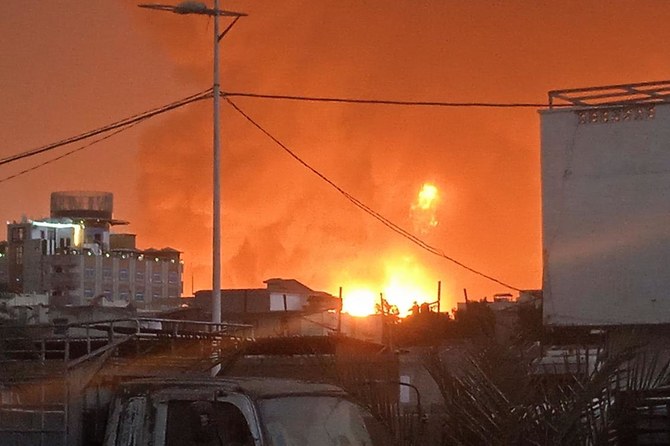
HODEIDAH: Firefighting teams on Monday were struggling to contain a massive blaze at Yemen’s Hodeida port, days after a deadly Israeli strike hit oil tanks and a power plant in the harbor.
Heavy flames and black smoke were seen spiralling into the sky for a third consecutive day following the strike on Saturday, said an AFP correspondent in Hodeidah.
Firefighting teams appear to have made little progress, with the blaze seemingly expanding in some parts of the port, the correspondent said, amid fears it could reach food storage facilities.
High-resolution satellite images taken by Maxar Technologies showed flames consuming a heavily damaged fuel storage area at the Hodeidah harbor.
The fuel depot is run by the Yemen Petroleum Company which said late Sunday that the six people killed in the Israel strike were its employees.
The Houthis say more than 80 others were wounded in the attack, many of them with severe burns.
With black smoke billowing overhead, a funeral ceremony was held Monday for the victims of the strikes.
Their coffins were carried through the streets of Hodeidah, flanked by crowds and led by a Houthi marching band.
The strike on Saturday was the first by Israel on the Arabian Peninsula’s poorest country and came in response to a Houthi drone strike that breached Israel’s air defenses, killing one person in Tel Aviv the day before.
The Houthis, who are fighting Israel, have pledged a “huge” response to the strikes and threatened to once again attack Tel Aviv.
Yemeni port authorities said Hodeidah “is operating at its full capacity,” according to the rebels’ Saba news agency.
“We are working around the clock to receive all ships and there is no concern about the supply chain and supplies of food, medicine, and oil derivatives,” port official Nasr Al-Nusairi was quoted by Saba as saying on Sunday.
But the US-based Navanti Group said the strikes on Hodeidah destroyed five cranes and reduced the port’s fuel storage capacity from 150,000 to 50,000 tons.
Hodeidah port is a vital entry point for fuel imports and international aid for Houthi-held areas of Yemen, a country where the United Nations says more than half the population relies on humanitarian assistance.
“Hodeidah port is a vital lifeline for delivering humanitarian aid to Yemen,” the International Rescue Committee (IRC) said in an emailed statement to AFP.
“Any impact on this infrastructure jeopardizes the entry of essential goods and hampers aid efforts.”


![]()

Houthi harbor still ablaze days after Israel strikes on Yemen
Short Url
https://arab.news/wmw35
Houthi harbor still ablaze days after Israel strikes on Yemen
- Hodeidah port is a vital entry point for fuel imports and international aid for Houthi-held areas of Yemen, a country where the United Nations says more than half the population relies on humanitarian assistance
Latest updates


© 2026 SAUDI RESEARCH & PUBLISHING COMPANY, All Rights Reserved And subject to Terms of Use Agreement.