

Pakistan’s Hajj Medical Mission wraps up operations, says treated over 169,000 pilgrims 

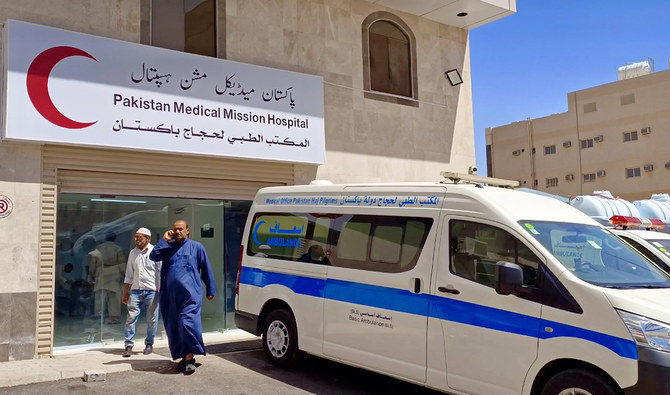
People walk past Pakistan Medical Mission Hospital in Madinah on May 16, 2024, as Pakistani Hajj Mission sets up medical facilities for Pakistani pilgrims in Saudi Arabia ahead of annual Islamic pilgrimage. (Photo courtesy: Pakistan Hajj Medical Mission/File)
Short Url
Updated 21 July 2024
Follow

Pakistan’s Hajj Medical Mission wraps up operations, says treated over 169,000 pilgrims 

  • Pakistan Hajj Medical Mission also treated pilgrims from other countries who sought assistance, says director 
  • Over 400-member mission provided pilgrims with health care facilities in Makkah and Madinah since May 9

ISLAMABAD: The Pakistan Hajj Medical Mission wrapped up its operations in Saudi Arabia this week after treating over 169,000 pilgrims in the kingdom, the mission’s director confirmed on Sunday. 

Over 160,000 Pakistanis attended this year’s annual Hajj pilgrimage, which ran from June 14-19. Pakistan established two hospitals and 11 dispensaries in the holy cities of Makkah and Madinah on May 9. 

“The Pakistan Hajj Medical Mission completed its operations in Saudi Arabia on July 20, and since the start of services on May 9 this year, almost 169,000 pilgrims received free health treatment,” Brig. Jamil Ahmed Lakhair, the mission’s director, told Arab News over the phone from Makkah.

Lakhair said that out of the total number of patients, at least 60 percent were male while 40 percent were women. He said the mission also provided services to pilgrims from other countries who sought medical assistance.

Lakhair said a dedicated team of over 400 members from the medical mission tirelessly performed their duties to assist Pakistani pilgrims in Saudi Arabia during the annual Islamic pilgrimage.

“More than 19000 lab tests were done on almost 4000 patients and around 5000 patients availed dental treatment facilities, including minor procedures,” he revealed. Lakhair said over 3,000 patients availed radiological facilities, including ultrasound, at the hospital.

The Pakistani official credited the Saudi government for ensuring excellent medical facilities, praising their robust patient evacuation system and well-equipped hospitals, adding that Pakistan’s medical mission helped pilgrims access these facilities.

“Two hundred and fifty patients treated in tertiary care facilities of the kingdom’s hospitals as indoor cases,” Lakhair said. 

He shared that over 12,000 pilgrims were treated as emergency cases while 188 bed-ridden patients were taken to Arafat for Hajj rituals in ambulances and buses.

He said respiratory tract infections and musculoskeletal problems were the most common among pilgrims, accounting for 18 percent of the total cases, followed by gastrointestinal problems at 12 percent, diabetes mellitus at 11 percent, unspecified fever at 9 percent, and cardiovascular diseases, including hypertension and ischemic heart diseases, at 5 percent


Pakistan, UK launch £10 million higher education partnership

Updated 5 sec ago
Follow

Pakistan, UK launch £10 million higher education partnership

  • Pak-UK Education Gateway second phase expands climate research, scholarships, university exchanges
  • First phase was launched in 2018 and delivered 165 partnerships, 2,000 joint studies and £5 million in grants

ISLAMABAD: Pakistan’s Higher Education Commission (HEC) and the British Council have launched the £10 million second phase of the Pak-UK Education Gateway, the HEC said on Monday, a joint initiative aimed at deepening collaboration between universities in both countries on research, mobility and higher-education reform.

The program, funded equally by the HEC and the British Council, builds on a partnership launched in 2018 and seeks to strengthen institutional ties between Pakistani and British universities, focusing on shared challenges including climate change, skills development and economic growth.

Education cooperation has become an increasingly important pillar of broader Pakistan-UK relations, as both countries look to expand academic mobility, research collaboration and international recognition of qualifications at a time when higher-education systems face pressure to respond to climate risks, labor-market shifts and funding constraints.

“This £10 million partnership is set to deepen collaboration between UK and Pakistani universities on critical issues like Climate Change and Mobility. A true system-to-system commitment,” the HEC said in an X post. 

According to the British Council and HEC, the first phase of the Pak-UK Education Gateway supported 165 institutional partnerships, generated around 2,000 joint research papers and awarded £5 million in research grants. Officials say the second phase aims to build on that foundation as part of a longer-term effort to internationalize Pakistan’s higher-education sector.

“Education is the building block of growth and prosperity. Our work on education in Pakistan supports people throughout their lives: from helping reform education policy at the school level, to our strong partnership in higher education,” British High Commissioner Jane Marriott said in a statement.

“This next phase builds on our already strong relationship, and will unlock opportunities to help both our higher education sectors thrive.”

Opportunities under the second phase include increased funding for scholarships, joint research grants and faculty exchanges, alongside a Start-Up Challenge Fund to support Pakistan-UK university collaborations pursuing commercial opportunities and access to new markets.

The program will also focus on leadership and governance reforms within Pakistan’s higher-education system, including quality assurance, improved campus accessibility for people with disabilities, and greater participation of women in senior leadership roles. It further aims to expand opportunities for Pakistani students to study UK-accredited courses without leaving their home cities, alongside a commitment to mutual recognition of qualifications.

Pakistan’s Minister for Federal Education and Professional Training Khalid Maqbool Siddiqui said the initiative had already delivered concrete results since its launch in 2018, calling education “the bridge that connects people, cultures, and futures.”

Acting HEC Chairperson Nadeem Mahbub described the Gateway as a system-to-system partnership rather than a stand-alone program, noting that it had benefited institutions and students in both countries.