Biden pushes party unity as he resists calls to step aside, says he’ll return to campaign next week

1 / 2
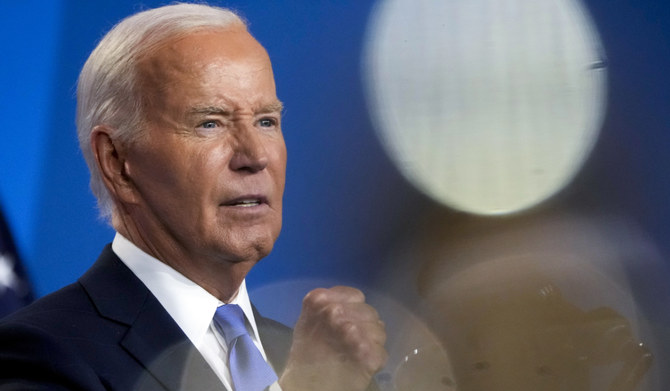
President Joe Biden speaks at a news conference on the final day of the NATO summit in Washington, July 11, 2024. (AP)
2 / 2
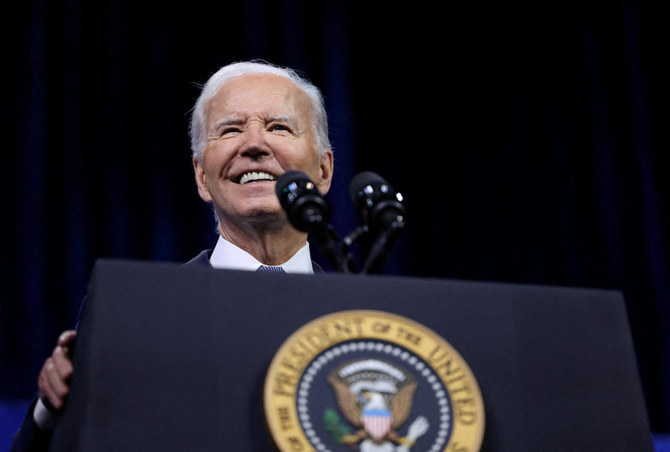
US President Joe Biden speaks at the 115th NAACP National Convention in Las Vegas, Nevada, US, July 16, 2024. (Reuters)
Short Url
Updated 20 July 2024
Follow

Biden pushes party unity as he resists calls to step aside, says he’ll return to campaign next week

  • More Democratic members of Congress called for president to drop out Friday

WASHINGTON DC: A growing chorus of Democratic lawmakers called Friday for President Joe Biden to drop his reelection bid, even as the president insisted he’s ready to return to the campaign trail next week to counter what he called a “dark vision” laid out by Republican Donald Trump.
As more Democratic members of Congress called for him to drop out Friday — bringing the total since his disastrous debate against Trump to at least 30 — Biden remained isolated at his beach house in Delaware after being diagnosed with COVID-19. The president, who has insisted he can beat Trump, was huddling with family and relying on a few longtime aides as he resisted efforts to shove him aside.
Biden said Trump’s acceptance speech at the Republican National Convention showcased a “dark vision for the future.” The president, seeking to move the political conversation away from his fate and onto his rival’s agenda, said Friday he was planning to return to the campaign trail next week and insisted he has a path to victory over Trump, despite the worries of some of his party’s most eminent members.
“Together, as a party and as a country, we can and will defeat him at the ballot box,” Biden said. “The stakes are high, and the choice is clear. Together, we will win.”
Earlier in the day, his campaign chair, Jen O’Malley Dillion, acknowledged “slippage” in support for the president but insisted he’s “absolutely” remaining in the race and the campaign sees “multiple paths” to beating Trump.
“We have a lot of work to do to reassure the American people that, yes, he’s old, but he can win,” she told MSNBC’s “Morning Joe” show. She said voters concerned about Biden’s fitness to lead aren’t switching to vote for Trump.
Meanwhile, the Democratic National Committee’s rulemaking arm held a meeting Friday, pressing ahead with plans for a virtual roll call before Aug. 7 to nominate the presidential pick, ahead of the party’s convention later in the month in Chicago.
“President Biden deserves the respect to have important family conversations with members of the caucus and colleagues in the House and Senate and Democratic leadership and not be battling leaks and press statements,” Sen. Chris Coons of Delaware, Biden’s closest friend in Congress and his campaign co-chair, told The Associated Press.
It’s a pivotal few days for the president and his party: Trump has wrapped up an enthusiastic Republican National Convention in Milwaukee on Thursday. And Democrats, racing time, are considering the extraordinary possibility of Biden stepping aside for a new presidential nominee before their own convention.
Among the democrats expressing worries to allies about Biden’s chances were former President Barack Obama and Speaker Emerita Nancy Pelosi, who has privately told Biden the party could lose the ability to seize control of the House if he doesn’t step aside.
New Mexico Sen. Martin Heinrich called on Biden to exit the race, making him the third Senate Democrat to do so.
“By passing the torch, he would secure his legacy as one of our nation’s greatest leaders and allow us to unite behind a candidate who can best defeat Donald Trump and safeguard the future of our democracy,” said Heinrich, who’s up for reelection.
And Reps. Jared Huffman, Mark Veasey, Chuy Garcia and Mark Pocan, representing a wide swath of the caucus, together called on Biden to step aside.
“We must defeat Donald Trump to save our democracy,” they wrote.
Separately, Rep. Sean Casten of Illinois wrote in an op-ed that with “a heavy heart and much personal reflection” he, too, was calling on Biden to “pass the torch to a new generation.”
Campaign officials said Biden was even more committed to staying in the race. And senior West Wing aides have had no internal discussions or conversations with the president about dropping out.
On Friday, Biden picked up a key endorsement from the political arm of the Congressional Hispanic Caucus. CHC BOLD PAC said the Biden administration has shown “unwavering commitment” to Latinos and “the stakes couldn’t be higher” in this election.
But there is also time to reconsider. Biden has been told the campaign is having trouble raising money, and key Democrats see an opportunity as he is away from the campaign for a few days to encourage his exit. Among his Cabinet, some are resigned to the likelihood of him losing in November.
The reporting in this story is based in part on information from almost a dozen people who insisted on anonymity to discuss sensitive private deliberations. The Washington Post first reported on Obama’s involvement.
Biden, 81, tested positive for COVID-19 while traveling in Las Vegas earlier this week and experienced “mild symptoms” including “general malaise” from the infection, the White House said.
White House doctor Kevin O’Connor said Friday that the president still had a dry cough and hoarseness, but that his COVID symptoms had improved.
In Congress, Democratic lawmakers have begun having private conversations about lining up behind Harris as an alternative. One lawmaker said Biden’s own advisers are unable to reach a unanimous recommendation about what he should do. More in Congress are considering joining the others who have called for Biden to drop out. Some prefer an open process for choosing a new presidential nominee.
“It’s clear the issue won’t go away,” said Vermont Sen. Peter Welch, the other Senate Democrat who has publicly said Biden should exit the race. Welch said the current state of party angst — with lawmakers panicking and donors revolting — was “not sustainable.”
However, influential Democrats including Senate Majority Leader Chuck Schumer and House Democratic Leader Hakeem Jeffries are sending signals of concern.
“There is of course work to be done, and that in fact is the case because we are an evenly divided country,” Jeffries said in an interview on WNYC radio Friday.
But he also said, “The ticket that exists right now is the ticket that we can win on. ... It’s his decision to make.”
To be sure, many want Biden to stay in the race. But among Democrats nationwide, nearly two-thirds say Biden should step aside and let his party nominate a different candidate, according to an AP-NORC Center for Public Affairs Research poll. That sharply undercuts Biden’s post-debate claim that “average Democrats” are still with him.
Amid the turmoil, a majority of Democrats think Vice President Kamala Harris would make a good president herself.
A poll from the AP-NORC Center for Public Affairs Research found that about 6 in 10 Democrats believe Harris would do a good job in the top slot. About 2 in 10 Democrats don’t believe she would, and another 2 in 10 say they don’t know enough to say.


An internal document shows the Vietnamese military preparing for a possible American war

Updated 4 sec ago
Follow

An internal document shows the Vietnamese military preparing for a possible American war

HANOI: A year after Vietnam elevated its relations with Washington to the highest diplomatic level, an internal document shows its military was taking steps to prepare for a possible American “war of aggression” and considered the United States a “belligerent” power, according to a report released Tuesday.
More than just exposing Hanoi’s duality in approach toward the US, the document confirms a deep-seated fear of external forces fomenting an uprising against the Communist leadership in a so-called “color revolution,” like the 2004 Orange Revolution in Ukraine, or the 1986 Yellow Revolution in the Philippines.
Other internal documents that The 88 Project, a human rights organization focused on human rights abuses in Vietnam, cited in its analysis point to similar concerns over US motives in Vietnam.
“There’s a consensus here across the government and across different ministries,” said Ben Swanton, co-director of The 88 Project and the report’s author. “This isn’t just some kind of a fringe element or paranoid element within the party or within the government.”
‘The 2nd US Invasion Plan’
The original Vietnamese document titled “The 2nd US Invasion Plan” was completed by the Ministry of Defense in August 2024. It suggests that in seeking “its objective of strengthening deterrence against China, the US and its allies are ready to apply unconventional forms of warfare and military intervention and even conduct large-scale invasions against countries and territories that ‘deviate from its orbit.’”
While noting that “currently there is little risk of a war against Vietnam,” the Vietnamese planners write that “due to the US’s belligerent nature we need to be vigilant to prevent the US and its allies from ‘creating a pretext’ to launch an invasion of our country.”
The Vietnamese military analysts outline what they see as a progression over three American administrations — from Barack Obama, through Donald Trump’s first term, and into Joe Biden’s presidency — with Washington increasingly pursuing military and other relationships with Asian nations to “form a front against China.”
Vietnam balances diplomatic outreach with internal fears
In his term, Biden in 2023 signed a “Comprehensive Strategic Partnership” with Vietnam, elevating relations between the nations to their highest diplomatic level on par with Russia and China as “trusted partners with a friendship grounded in mutual respect.”
In the 2024 military document, however, Vietnamese planners said that while the US views Vietnam as “a partner and an important link,” it also wants to “spread and impose its values regarding freedom, democracy, human rights, ethnicity and religion” to gradually change the country’s socialist government.
“The 2nd US Invasion Plan provides one of the most clear-eyed insights yet into Vietnam’s foreign policy,” Swanton wrote in his analysis. “It shows that far from viewing the US as a strategic partner, Hanoi sees Washington as an existential threat and has no intention of joining its anti-China alliance. ”
Vietnam’s Foreign Ministry did not answer emails seeking comment on The 88 Project report or the document it highlighted.
The US State Department refused to comment directly on the “2nd US Invasion Plan,” but stressed the new partnership agreement, saying it “promotes prosperity and security for the United States and Vietnam.”
“A strong, prosperous, independent and resilient Vietnam benefits our two countries and helps ensure that the Indo-Pacific remains stable, secure, free and open,” the State Department said.
Documents offer a window into internal thinking
Nguyen Khac Giang, of Singapore’s ISEAS–Yusof Ishak Institute research center, said the plans highlighted tensions within Vietnam’s political leadership, where the Communist Party’s conservative, military-aligned faction has long been preoccupied with external threats to the regime.
“The military has never been too comfortable moving ahead with the Comprehensive Strategic Partnership with the United States,” Giang said.
Tensions within the government spilled into the public realm in June 2024, when US-linked Fulbright University was accused of fomenting a “color revolution” by an army TV report. The Foreign Ministry defended the university, which US and Vietnamese officials had highlighted when the two countries upgraded ties.
Zachary Abuza, a professor at the National War College in Washington, said the Vietnamese military still has “a very long memory” of the war with the US that ended in 1975. While Western diplomats have tended to see Hanoi as most concerned by possible Chinese aggression, the document reinforces other policy papers suggesting leaders’ biggest fear is that of a “color revolution,” he said.
Further undermining trust between the US and Vietnam were cuts made to the US Agency for International Development by President Donald Trump’s administration, which disrupted projects such as efforts to clean up tons of soil contaminated with deadly dioxin from the military’s Agent Orange defoliant and unexploded American munitions and land mines.
“This pervasive insecurity about color revolutions is very frustrating, because I don’t see why the Communist Party is so insecure,” said Abuza, whose book “The Vietnam People’s Army: From People’s Warfare to Military Modernization?” was published last year.
“They have so much to be proud of — they have lifted so many people out of poverty, the economy is humming along, they are the darling of foreign investors.”
While China and Vietnam have been at odds over territorial claims in the South China Sea, the documents portray China more as a regional rival than a threat like the US
“China doesn’t pose an existential threat to the Communist Party (of Vietnam),” Abuza said. “Indeed, the Chinese know they can only push the Vietnamese so far, because they’re fearful that the Communist Party can’t respond forcefully to China (and will) look weak and it will cause a mass uprising.”
China is Vietnam’s largest two-way trade partner, while the US is its largest export market, meaning Hanoi needs to perform a balancing act in keeping up diplomatic and economic ties, while also hedging its bets.
“Even some of the more progressive leaders look at the United States, saying, ‘Yes, they like us, they’re working with us, they are good partners for now, but given the opportunity if there were a color revolution, the Americans would support it,’” Abuza said.
Trump’s second administration softens some concerns, but raises more
Under Vietnamese leader To Lam, who became Communist Party general secretary at around the same time the document was written, the country has moved to strengthen ties with the US, especially under Trump, Giang said.
Lam was reappointed general secretary last month and is expected to also assume the presidency, which would make him the country’s most powerful figure in decades.
With Lam at the helm, Trump’s family business has broken ground on a $1.5 billion Trump-branded golf resort and luxury real estate project in northern Hung Yen province. The Vietnamese leader almost immediately accepted Trump’s invitation to join the Board of Peace, which Giang said was an unusually swift decision given that foreign policy moves are typically calibrated with close attention to Beijing’s possible reaction.
But Trump’s military operation to capture former Venezuelan President Nicolás Maduro have given Vietnamese conservatives fresh justification for their unease about closer ties with Washington. Any US military action involving Hanoi’s ally Cuba could upset Vietnam’s strategic balance, Giang added.
“Cuba is very sensitive,” he said. “If something happens in Cuba, it will send shock waves through Vietnam’s political elites. Many of them have very strong, intimate ties with Cuba.”
Overall, the first year of Trump’s second term is likely to have left the Vietnamese happy about the focus on the Western Hemisphere but wondering about other developments, Abuza said.
“The Vietnamese are going to be confused by the Trump administration, which has downplayed human rights and democracy promotion, but at the same time been willing to violate the sovereignty of states and remove leaders they don’t like,” he said.