

Pakistan’s population expected to double by 2050, says census data

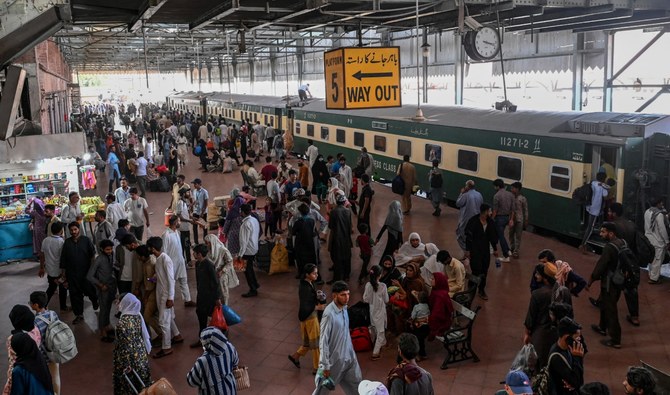
People wait to board a train at a railway station in Lahore, Pakistan, on June 15, 2024. (AFP/File)
Short Url
Updated 19 July 2024
Follow

Pakistan’s population expected to double by 2050, says census data

  • Pakistan fifth-largest country in the world with population of 241.9 million people, says census data
  • Pakistan records highest population growth rate in South Asia at 2.55 percent, according to census

ISLAMABAD: Pakistan has recorded the highest population growth rate in the region, the detailed results of last year’s population census revealed on Thursday, warning that the country’s population is expected to double by 2050. 

The Pakistan Bureau of Statistics (PBS) launched the detailed results of the seventh Population and Housing Census 2023 on Thursday. The report provides comprehensive data crucial for the development of urban and rural areas, and effective disaster response.

Addressing a ceremony to launch the report in Islamabad, Planning Minister Ahsan Iqbal highlighted that Pakistan was the first country in South Asia to conduct a digital census last year.

As per the census results, Pakistan is now the world’s fifth most populous country, housing 241.49 million people. Of these, 51.48 percent are males and 48.51 percent are females

“The census data shows that the current population growth rate is 2.55 percent which is the highest in the region and if it continues, the country’s population will be doubled by 2050,” state broadcaster Radio Pakistan said. 

The report said the average number of family members in Pakistan is 6.30 while the dominant religion in the country is Islam, representing 96 percent of the population.

The age-wise distribution of the population shows 36.47 million people are aged under five years, 97.53 million under 15 years, 62.58 million between 15 to 29 while 190.27 million are aged below 40 years. 

“Literacy indicators show 61 percent of Pakistan’s population aged ten years and above is literate,” Radio Pakistan said. 

Speaking at the occasion, Iqbal acknowledged that fellow South Asian countries India and Bangladesh had outperformed Pakistan in several sectors. 

“We are not behind them in intelligence and ability,” he said. “But if we do not open our eyes, we will not be even counted in the global competition.”

The minister stressed the need for peace and political stability, highlighting the importance of continuity of policies for at least ten years. 

“If we do not keep pace with the world, we will become irrelevant,” he warned.


Pakistani president arrives in Iraq to deepen trade, energy cooperation

Updated 7 sec ago
Follow

Pakistani president arrives in Iraq to deepen trade, energy cooperation

  • Visit follows recent high-level contacts as Islamabad seeks to expand limited commercial ties with Baghdad
  • Talks are expected to cover investment, manpower and facilitation of Pakistani pilgrims visiting holy sites in Iraq

ISLAMABAD: President Asif Ali Zardari arrived in Iraq on Saturday on an official visit aimed at expanding cooperation in trade, energy and investment, as Pakistan seeks to deepen ties with Baghdad after years of limited engagement.

Pakistan and Iraq established diplomatic relations in 1947 and have traditionally maintained cordial ties, though commercial links remain modest, with officials and business groups identifying scope for cooperation in construction services, pharmaceuticals, manpower and agricultural exports.

“President Asif Ali Zardari arrived in Baghdad on a four-day official visit to Iraq,” his office said in a post on X. “He was received by Culture Minister Dr. Ahmed Fakkak Al-Badrani. During the visit, meetings with senior Iraqi leadership are expected to advance cooperation and further strengthen Pakistan-Iraq relations.”

Zardari’s visit follows a series of recent high-level contacts between the two countries, reflecting efforts to broaden bilateral engagement beyond traditional diplomatic ties and explore collaboration across economic, political and people-to-people domains.

According to Pakistan’s foreign office, the president is expected to hold meetings with Iraq’s senior leadership to discuss cooperation in various areas such as trade and investment, energy, technology, education and manpower.

He is also expected to discuss regional and international issues with Iraqi officials.

Earlier this month, Pakistan’s Interior Minister Mohsin Naqvi met his Iraqi counterpart, Abdul Ameer Al-Shammari, on the sidelines of meetings in Brussels, where both sides agreed to enhance cooperation on security and facilitate travel for Pakistani Shia pilgrims to Najaf and Karbala.

The two officials discussed measures to ensure the smoother movement of these pilgrims and their compliance with visa regulations.