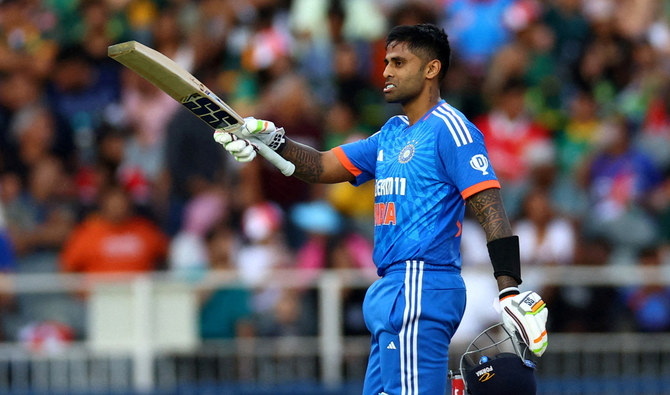
Suryakumar takes over as India’s new T20 skipper

In this file photograph, taken on December 14, 2023, India’s Suryakumar Yadav celebrates after reaching his century during the third T20 International between South Africa and India at the Wanderers Stadium in Johannesburg. (REUTERS/File)
Short Url
Updated 18 July 2024
Follow

Suryakumar takes over as India’s new T20 skipper

  • Decision comes after former skipper Rohit Sharma quit shortest format last month
  • Suryakumar last year led India to a 4-1 series win over Australia, 1-1 draw against South Africa

NEW DELHI: Suryakumar Yadav has been named India’s T20 captain, the country’s cricket board announced Thursday, after Rohit Sharma quit the shortest format following last month’s World Cup triumph.
The 33-year-old Suryakumar will lead a 15-member T20 squad to tour Sri Lanka for three internationals starting on July 27 in Pallekele. 
Shubman Gill recently led a second-string Indian side to a 4-1 T20 series victory in Zimbabwe and has been named vice-captain in T20 and ODI matches.
Rohit will continue to lead the ODI team, which will follow the T20 side by taking on Sri Lanka in three matches on August 2, 4 and 7 at Colombo’s R. Premadasa Stadium.
Virat Kohli will also return for the 50-over matches, while pace spearhead Jasprit Bumrah remains absent from the tour after a grueling season.
Rohit and Kohli had decided to take a break but returned for the ODI matches as India begin preparations for next year’s Champions Trophy to be hosted by Pakistan.
All-rounder Hardik Pandya, who was Rohit’s deputy in the T20 World Cup, had started as a frontrunner for the job but lost out due to his frequent injury breakdowns.
Pandya, 30, suffered an ankle injury during the ODI World Cup at home last year and was out of action until the start of this season’s Indian Premier League where he returned to captain Mumbai Indians.
Pandya remains part of the T20 squad but is out of the ODI series, which will see the return of Shreyas Iyer, who earlier lost out on his contract with the Board of Control for Cricket in India (BCCI).
Suryakumar, an attacking middle-order batsman who has been India’s go-to player in the T20 format, remained new coach Gautam Gambhir’s top choice, according to media reports.
Rohit, Kohli and Ravindra Jadeja announced their retirements from the T20 format after India’s thrilling win over South Africa in the final last month in Barbados.
The match was also Rahul Dravid’s last as head coach and Gambhir was handed the job last week to build on the team’s World Cup win.
Suryakumar, who previously captained Mumbai in domestic cricket, last year led India to a 4-1 T20 series win over Australia and followed it up with a 1-1 result in South Africa.
T20I squad: Suryakumar Yadav (capt), Shubman Gill (vice-capt), Yashasvi Jaiswal, Rinku Singh, Riyan Parag, Rishabh Pant (wk), Sanju Samson (wk), Hardik Pandya, Shivam Dube, Axar Patel, Washington Sundar, Ravi Bishnoi, Arshdeep Singh, Khaleel Ahmed, Mohammed Siraj
ODI squad: Rohit Sharma (capt), Shubman Gill (vice-capt), Virat Kohli, KL Rahul (wk), Rishabh Pant (wk), Shreyas Iyer, Shivam Dube, Kuldeep Yadav, Mohammed Siraj, Washington Sundar, Arshdeep Singh, Riyan Parag, Axar Patel, Khaleel Ahmed, Harshit Rana


Unfancied nations face up to challenges in T20 World Cup

Updated 26 February 2026
Follow

Unfancied nations face up to challenges in T20 World Cup

  • Seeding process had a predestined feel to it
  • Dice loaded against associates, even unseeded full members

COLOMBO: Seven weeks prior to the 2026 ICC T20 Men’s World Cup, each of the 20 teams were pre-assigned a fixed label by the International Cricket Council. In each of the four groups, those teams considered to be the top ranked were numbered 1 and 2. In Group A, for example, India were A1 and Pakistan A2. Given that the tournament is co-hosted by India and Sri Lanka, the labels provided a basis for the ICC to allocate venues and teams for the Super Eight stage, as well as assisting fans and broadcasters to plan travel and schedules. My focus was on attending matches in Sri Lanka.

This seeding process had a predestined feel to it, as if those teams labelled 3, 4 and 5, nine of which are associate ICC members, were not expected to qualify for the Super Eight stage. Undeterred, several of them have provided surprises and near shocks in the group stages. Leading the way have been Zimbabwe, as Australia found out to their cost, being the only seeded team not to qualify for the Super Eights.

If there were to be an award for the most devoted and inspiring set of supporters it would surely be those of Zimbabwe. A hard core of six, the Castle Corner group, dressed in the national colours of red and yellow, chanted and danced their way through Zimbabwe’s matches. Zimbabwean cricket has experienced dark days in the last 25 years, including suspension by the ICC in 2019, largely because of political interference. 

After the team’s qualification, their players saluted them, singing in unison across the small divide between the dressing rooms and the terraces. The chants of the supporters, backed by drums and horns, have been much more resonant than the muzak which is belted out between overs or when boundaries are scored. Success has come at price because Zimbabwe have to play their Super Eight matches in India. The supporters, who paid their own way, were faced with unexpected extra costs.  

Overall, support for teams other than the host nations has been limited. This has not stopped those supporters making themselves heard. Nepal are always guaranteed raucous support, Irish supporters can always be heard, while England’s barmy army is a constant source of support for the team in overseas venues. However, English voices struggled to make themselves heard above the incessant noise generated by Sri Lanka supporters in the match at Pallekele, Kandy, last Sunday, until it became apparent that Sri Lanka had crumbled to a defeat that seemed unlikely at halfway.

There was a feeling of expectancy that at least one of the associate nations would spring a shock. Nepal almost beat England. Requiring 10 runs to win in the last over, Sam Curran denied them, conceding six runs, to leave the Nepal team and their supporters in despair.

Perhaps the disappointment of that narrow loss seeped into Nepal’s next performance. Quite how they were bowled out for 123 by Italy, who then reached the target with the loss of no wickets in 12.4 overs, beggars belief. The Italian team and their supporters brought typical Italian elan to the tournament. It is obviously something that is in the genes, since the players do not live in Italy.

Several of them have never been to the country they represent. In October 2024 I was invited to an evening with the Italian Cricket Federation in London and wrote about that experience in my column at the time. Simone Gambino, a leading light for decades in the development of Italian cricket, explained to me that qualification is based on citizenship, a concept for which he fought long and hard. The majority of the squad have Italian grandparents. One of those is Marcus Campopiano, who lives and plays his cricket in southern England.

As the team were about to embark on their World Cup qualifying tournament in Uganda in 2024, I remarked to Campopiano that if the team were successful, it would join the “big boys.” His reply was that they had a good team, and so it has proved. The injury in the first World Cup match to South African-born captain Wayne Madsen, a seasoned player in English county cricket, was a setback. Throughout the group stage, the PR campaign to support the team has been excellent, especially on Instagram. It will be interesting to watch how the two weeks in the spotlight are used to build the team in the future and whether further success will be achieved.

On the surface it may appear that the gap is narrowing between full and associate-member teams. It is undeniable that there have been close finishes. On Feb. 7, in the opening match in Colombo, Pakistan required 29 runs from the last 12 deliveries to beat the Netherlands. In the 19th over, Max O’Dowd failed to catch Faheem Ashraf, who proceeded to win the game for Pakistan. In a sign of the times, O’Dowd immediately received social media abuse. Shortly afterwards, in Mumbai, the US reduced India to 77 for six by the 13th over. Suryakumar Yadav, India’s captain, who survived a dropped catch when he had scored 15, rescued his team, scoring 84 from 49 deliveries. India won by 29 runs.

Those scares may have been the result of “first night” nerves for Pakistan and India, or two associate teams running high on adrenalin. In the aftermath of England’s scrape against Nepal and an indifferent performance against Scotland, the team captain, Harry Brook, let slip that those opponents may have been underestimated. This is a dangerous stance for any full member team to adopt. Associates have shown that, on certain days, they can take their more powerful opponents to the brink. However, in the five-team group format adopted for the 2024 and 2026 T20 World Cups, consisting of two full and three associate members, only once, in 2024, have one of the latter (Canada) beaten any of the former (Pakistan).

While this meant that Pakistan failed to reach the Super Eights, it was Canada’s only win. In order to finish in the top two places, an associate probably has to beat the other two associates and hope that the full member they beat will also lose to the other full member. These scenarios can be modeled, but that would ignore the reality faced by associates. This is driven by economics. The expansion to 20 teams in 2024 has been hailed as another step toward the democratization of cricket but, under the ICC’s revenue distribution model, associate member boards receive about 1/60 of the amount received by their Indian counterpart. The reasons for this are well rehearsed: India generates over 80 percent of cricket’s global revenues and remains determined to receive what it considers to be its fair share.     

An impressive but losing performance by an associate against a full member will catch the headlines, but it will not lay the foundations to beat full members on a regular basis. This requires the opportunity to play against those teams more often. The chances are low. Instead, associates will play other associates, often in qualification pathways for subsequent World Cups. Captains of associate teams have spoken of players lacking experience in crucial moments, of lacking depth compared with full member teams, and of not playing cricket regularly enough. The Netherlands, for example, do not have another international fixture between their last World Cup match on Feb. 18 until the summer. If their players are not involved in any intervening tournaments, the top edges of their performance will atrophy.

It seems that the dice are loaded against associates and even the unseeded full members. The romance of a brave, close defeat; vociferous, loyal, but limited support; and appearances in cricket’s media channels, is tempered by economic reality.

The UAE, Nepal, the US, and Canada have each developed their own T20 franchise leagues, with a European one set to launch. These provide an opportunity for local talent to learn from established international players and coaches. Yet, without an unlikely reform of the ICC’s revenue distribution model, associates will continue to be locked into a hierarchical system that encourages expanding numbers of them to fight for places at an increasingly rich man’s table.