


LONDON: Using metal filings, X-rays adorned with calligraphy, and a grandiose mihrab transformed into a body scanner, leading Saudi artist Ahmed Mater is documenting a kingdom undergoing a swift process of change.
Born in Tabuk in 1979, Mater grew up in Abha in southwestern Saudi Arabia, close to the militarized Yemeni border, at a time of immense social change in the region.
The first presentation of his art outside the Kingdom came in 2005 at an exhibition hosted by the British Museum in London. Just over a decade later, he became the first artist to host a solo exhibition in the US, with “Symbolic Cities: The Work of Ahmed Mater” in 2016.
Now, the 44-year-old has returned to England with the exhibition “Ahmed Mater: Chronicles,” hosted by Christie’s London until Aug. 22. The mid-career retrospective collection features more than 100 of his works, and promises to highlight the major milestones of his career.

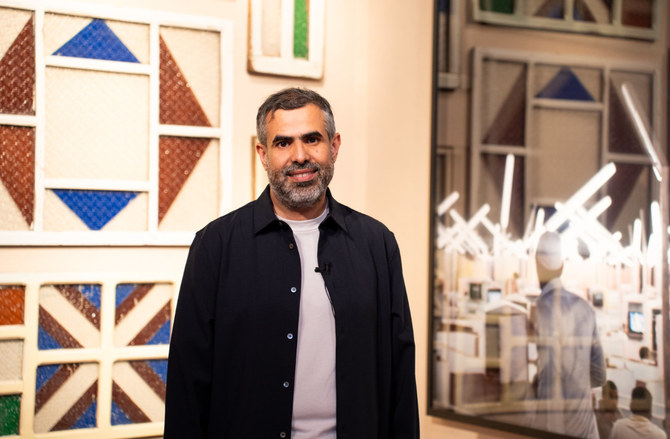
Ahmed Mater at the opening of ‘Chronicles.’ (AN photo)
“It’s very amazing and extraordinary for me to be back and connect again with the audience here in London after 2005, and now, maybe, with more artwork to share and 20 years of experimental work,” Mater told Arab News on the exhibition’s opening day.
“So, it’s something that, really, I want the audience to share all of this — the experiment and the time and sharing all of this journey together.”
Despite being heavily influenced by his mother’s work as an Asiri calligrapher and painter, and art being the “passion and DNA” of his childhood, Mater began his professional life working in medicine.

Mater first encountered city life as a teenager in Abha. (AN photo)
“At that time, there was no … you have to do something, especially in Saudi Arabia, there was no school of art,” he said.
“So, medicine was very close to me. I studied a more human science; that’s very close to me.”
Despite “building a lot of things and experiences” during his work as a physician, Mater returned to his roots in art “because it became the only voice that I could continue with.”

The artist began experimenting with X-rays during his medical studies. (AN photo)
The physician-turned-artist described the difference between his two careers as one of “subjectivity versus objectivity.”
Mater’s oeuvre, from the satirical to the striking, details the changes, big and small, in a kingdom undergoing unprecedented social, religious and economic transformation.
“I think it’s a kind of synergistic study of all of the artwork together,” he said. “When you are an artist, you are also a philosopher, you are a thinker, and all of these events together shape our generation at a time, our societies.
“I was really fascinated by studying a community — about urban change surrounding me. Maybe I take this from medicine, maybe I take it from the art, or maybe I take it from my transition from the village to the city.”
In the photograph “Hajj Season” (2015), which is part of his “Desert of Pharan” collection documenting change in Makkah, masses of pilgrims wait patiently in a gated courtyard. Behind them, KFC and Burger King restaurants can be seen.
“Stand in the Pathway and See” (2012) shows a narrow alleyway bisecting dilapidated buildings, part of an old settlement that was soon to be demolished to make way for new hotels. A young boy sits in the shadows amid the waste and graffiti. The alley appears to be illuminated by the fierce glow of Makkah’s Clock Tower, which looms ominously, or as a figurative light at the end of the tunnel, over the old city.
The dual meaning of the photograph is a hallmark of Mater’s work. In “Nature Morte” (2012) and “Room With a View ($3,000/night)” (2012), Mater again reveals some of the peculiarities of Makkah’s transformation through simple photographs.

Left to right: ‘Nature Morte,’ ‘Stand in the Pathway and See’ and ‘Room With a View ($3,000/night).’ (AN photo)
In both, the Kaaba and masses of pilgrims are seen at a low angle through the windows of a luxury hotel room, replete with a bowl of decorative fruit and cable TV. Viewers will inevitably be divided in their reaction.
Mater’s status as a passive spectator taking the photographs reinforces his self-described role as a documenter of change, and is part of the subtlety that typifies much of his work.
For other pieces he takes a more direct approach, however. Viewers are met with loud beeping and flashing red lights in his simple but ingenious “Boundary” (2024), for example. The artist combines a mihrab, a prayer niche from the interior of a mosque, with a body scanner; the result is a striking summation of modern-day security fears and the commercialization of religion.

Viewers should expect a surprise with Mater’s modern mihrab. (AN photo)
Many of Mater’s works explore the theme of the individual sublimating to the group, which emerges as a distinct entity. This is epitomized in “Magnetism IV” (2012), a diminutive model of the Kaaba surrounded by perfectly arranged iron filings, representing a swirling mass of pilgrims.

The artist depicts the magnetism of Islam’s holiest site. (AN photo)
To create a similar effect in a photograph, Mater used a long exposure to capture the Kaaba at the height of Hajj in “Tawaf” (2013), an image in which the resulting movement of pilgrims resembles a hurricane around the holiest site in Islam.
The artist admits that the theme might be an unconscious effect of his Islamic upbringing.

A selection from Mater’s ‘Magnetism’ series. (AN photo)
“I think it’s something that is unconsciously done by an artist in their practices,” he said. “You know, sometimes I didn’t pay full attention but after I did my artwork, I noticed. I noticed these kind of things. But maybe spirituality has this feeling.
“So, I come from a religious background and this has, maybe, shaped a lot of my understanding. It’s given me a lot of imagination. You know, religion is part of this big imagination.”

Long exposure creates a hurricane effect at the height of Hajj. (AN photo)
For Mater, 1938 might have been the most important year in the Kingdom’s history. Oil was struck on March 3 that year at the Dammam No. 7 well, and the liquid gold that began to flow would soon begin to finance the Kingdom’s transformation.
Again juxtaposing old and new, traditional and modern, in “Lightning Land” (2017) the artist captures a stunning shot of lightning arcing toward the ground, with a disused Bedouin tent in the foreground and oil machinery in the background.

Mater’s ‘Lightning Land’ highlights the tensions between old and new in Saudi Arabia. (AN photo)
“Evolution of Man” (1979) is Mater’s most morbid work. A horizontal collage begins with a front-on X-ray shot of a man holding a gun to his own head. The next shots morph as a square shape begins to form. The final image is a gas pump, with the nozzle resembling the gun featured in the first image.
The former physician’s prognosis of the Kingdom’s arts scene takes a more positive path, however. Mater believes that cooperation between the public and private sectors is the key to further unleashing Saudi Arabia’s burgeoning cultural industries.
A “big, big awakening of art and culture” is taking place in the Kingdom, he said. Mater himself is part of this public-private synthesis, and one of five leading artists commissioned by Wadi AlFann (Valley of the Arts) in AlUla to produce a large-scale installation in the desert sands.
The result is Ashab Al-Lal, a mighty but unintrusive oculus that will harness light refraction, in a homage to the scientists of the Islamic golden age. Wadi AlFann will start welcoming visitors in 2025.

A model of Mater’s Ashab Al-Lal installation was unveiled at Christie’s. (AN photo)
“I think now it’s a very optimistic generation; there is a lot of movement,” Mater said.
“So, it’s from both the private body and the public body, together shaping a new future. That’s what I’ve noticed today.”


