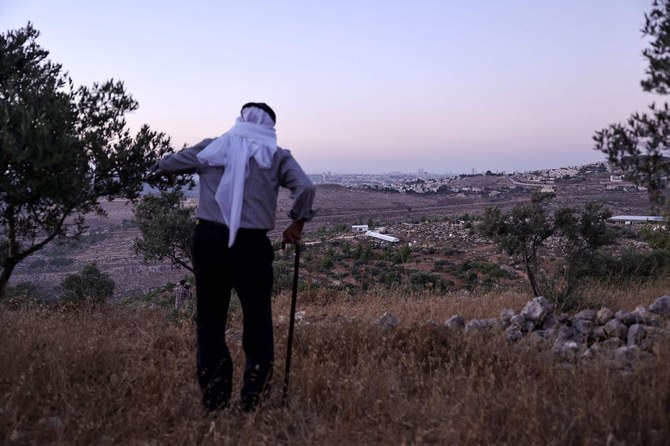
BATTIR, Palestinian Territories: On a hillside near Palestinian landowner Olayan Olayan’s olive groves, young Israeli settlers are hammering out a new, illegal outpost in a UNESCO-protected zone.
Olayan and his neighbors have long battled attempts to settle the land in Battir, a heritage site in the Israeli-occupied West Bank famed for its ancient stone terraces.
Israeli construction in the West Bank has boomed since the war began in the Gaza Strip, even though all settlements in the territory are considered illegal under international law.
The new outpost on a Battir hilltop, also not approved by Israel, was served an eviction notice that Olayan’s cousin Ghassan Olayan said has not been enforced because of the Gaza war.
The outpost already has a flagpole, living quarters and a barn for sheep that roam a rocky hill covered by olive trees belonging to Palestinian farmers.
“I plowed the land and planted it until it bore fruit trees,” said Olayan, who at 83 is older than the state of Israel itself.
“Some trees were 50 years old, or even more, and suddenly the settlers came and wanted to devour the land and take it from us,” he added, his voice shaky.
Even more concerning to the Olayans than the encroaching outpost is the adjacent, future settlement of Heletz.
Yonatan Mizrahi of settlement watchdog Peace Now said Heletz was among five settlements “deep in Palestinian territory” approved by the Israeli government on June 27.
“It is a settlement that is going to block Battir and in many ways create tension between the neighbors,” he said.
Heletz and the outpost sit inside the UNESCO protection zone for Battir, one of four listed heritage sites in the West Bank.
The UNESCO classification means the village can get technical, legal, and monetary assistance to preserve sites deemed in danger.
In Battir, children splash in the Roman-era fountain that waters the terraces where tomatoes, corn, aubergines and olive trees grow.
The 2,000-year-old dry stone walls supporting the landscape earned the village its cultural inscription in 2014. But the classification has done little to prevent seizures of the surrounding farmland.
Battir’s inhabitants have beaten in court at least three previous Israeli settlement outpost attempts.
But Ghassan Olayan fears the war since the Hamas attacks of October 7 on Israel will make the new, government-approved Heletz more likely to become reality.
According to Olayan, Heletz is intended to link Jerusalem to Gush Etzion, a cluster of settlements deeper in the West Bank.
If that is achieved, Battir and the nearby Palestinian villages would be cut off from Bethlehem and the rest of the West Bank, a process they fear will fragment a future Palestinian state.
“There will be no (territorial) continuity,” said Olayan, leaving only what some observers describe as an archipelago of Palestinian sovereignty.
Israel’s far-right Finance Minister Bezalel Smotrich, a settler himself, openly states that preventing Palestinian statehood is the objective.
“We will continue to develop the settlements in order to maintain Israel’s security and prevent the establishment of a Palestinian state,” he wrote on the X social media platform after the five latest settlements were approved in June.
In recent months, Israeli forces have blocked a road to Battir, nearly doubling the time it takes to reach Jerusalem just 10 kilometers (six miles) north.
When asked about the new outpost in Battir, an Israeli security official acknowledged that “an Israeli farm had been established without proper authorization.”
The official told AFP “the possibility of authorizing the farm will be weighed” as the development of Heletz gets under way.
Battir residents “raised several claims that the land belongs to them” but have “not presented documentation to support their position,” according to the official.
Olayan said documents from Ottoman times prove Battir inhabitants’ ownership of the land.
A UNESCO spokesperson said the UN cultural agency’s world heritage committee had been told about “reports of illegal constructions” and that Battir would be discussed at a session in late July.
Olayan fears that sleepy Battir, with its collective life centered around the Roman fountain’s irrigation system allotting each family a specific time slot to irrigate their crops, faces a difficult future.
“Battir is a peaceful village and the settlement will only bring trouble,” he said.


![]()


Israeli settlement threatens Palestinian UNESCO village
Short Url
https://arab.news/yqvez
Israeli settlement threatens Palestinian UNESCO village
- Palestinians have long battled attempts to settle the land in Battir, a heritage site in the Israeli-occupied West Bank famed for its ancient stone terraces
- Israeli construction in the West Bank has boomed since the war began in the Gaza Strip, even though all settlements in the territory are considered illegal


MSF suspends some Gaza hospital work over presence of gunmen, suspected weapons transfers, group says
- Charity also concerned of possible weapons movement at hospital
- Suspension cites neutrality concerns, repeated security breaches
Medecins Sans Frontieres has halted “non-critical” medical activities at a major hospital in southern Gaza following reports from patients and its own staff of armed men inside the facility and concerns over the movement of weapons within it.
MSF’s statement appeared to mark the first time that an international humanitarian group in Gaza has publicly reported the presence of armed men in a hospital or the possible use of such a facility for moving weapons.
The Geneva-based medical charity said non-essential operations at Nasser Hospital in Khan Younis were suspended on January 20 over concerns with the “management of the structure, the safeguarding of its neutrality, and security breaches.”
In recent months, patients and personnel had “seen armed men, some masked,” in areas of the hospital compound, MSF said.
The Hamas-run Interior Ministry said in a statement it was committed to preventing any armed presence inside hospitals, and that legal action would be taken against violators. It suggested that armed members of certain Gazan families had recently entered hospitals, but did not identify those involved.
‘Unacceptable acts’ reported, including weapons movements
Israel and Hamas agreed to a ceasefire in October as part of a US plan to end the war in Gaza. Both sides have repeatedly accused each other of violations.
Since the ceasefire, “MSF teams have reported a pattern of unacceptable acts, including the presence of armed men, intimidation, arbitrary arrests of patients, and a recent situation of suspicion of movement of weapons,” it said.
According to Gaza’s Health Ministry, more than 590 Palestinians have been killed by Israeli troops in the territory since the ceasefire began, while Palestinian militants have killed four Israeli soldiers in the same period.
MSF, also known as Doctors Without Borders, disclosed the Nasser Hospital suspension in a “frequently asked questions” section on its website about its work in Gaza, last updated on February 11.
The armed men had been seen in areas of the hospital compound where MSF does not carry out activities, but their presence, along with suspected weapons transfers, posed serious security risks to patients and personnel, MSF said.
An MSF representative told Reuters the organization continued to support some critical services at Nasser Hospital, including inpatient and surgical care for certain patients requiring lifesaving treatment.
‘Hospitals must remain neutral spaces’
MSF said it had expressed concern to the relevant authorities, without detailing whom the reports were submitted to.
“Hospitals must remain neutral, civilian spaces, free from military presence or activity, to ensure the safe and impartial delivery of medical care,” MSF said.
Israel last month ordered MSF and 30 other international organizations to stop its work in Gaza and the Israeli-occupied West Bank if they did not meet new rules, including sharing details about their staff.
MSF on January 30 said it would not submit a staff list to Israel after failing to receive assurances over their safety.
Parts of tunnel network found under hospitals
The Israeli military says it has targeted hospitals during the war because Hamas fighters were operating inside them, and parts of Hamas’ tunnel network have been found running beneath medical facilities. The Palestinian Islamist group denies using hospitals for military purposes.
Some Israeli hostages, taken during Hamas’ October 7, 2023 attack on southern Israel that ignited the war, have said they were held at Nasser Hospital, the largest in southern Gaza.
Hospitals are protected sites under international law. Both attacking hospitals and their use for military purposes are typically considered a breach of law.
Although medical facilities can lose their protected status under certain conditions, rights groups say Israel has not shown sufficient evidence in many cases to justify its attacks on them during the war.
MSF’s statement appeared to mark the first time that an international humanitarian group in Gaza has publicly reported the presence of armed men in a hospital or the possible use of such a facility for moving weapons.
The Geneva-based medical charity said non-essential operations at Nasser Hospital in Khan Younis were suspended on January 20 over concerns with the “management of the structure, the safeguarding of its neutrality, and security breaches.”
In recent months, patients and personnel had “seen armed men, some masked,” in areas of the hospital compound, MSF said.
The Hamas-run Interior Ministry said in a statement it was committed to preventing any armed presence inside hospitals, and that legal action would be taken against violators. It suggested that armed members of certain Gazan families had recently entered hospitals, but did not identify those involved.
‘Unacceptable acts’ reported, including weapons movements
Israel and Hamas agreed to a ceasefire in October as part of a US plan to end the war in Gaza. Both sides have repeatedly accused each other of violations.
Since the ceasefire, “MSF teams have reported a pattern of unacceptable acts, including the presence of armed men, intimidation, arbitrary arrests of patients, and a recent situation of suspicion of movement of weapons,” it said.
According to Gaza’s Health Ministry, more than 590 Palestinians have been killed by Israeli troops in the territory since the ceasefire began, while Palestinian militants have killed four Israeli soldiers in the same period.
MSF, also known as Doctors Without Borders, disclosed the Nasser Hospital suspension in a “frequently asked questions” section on its website about its work in Gaza, last updated on February 11.
The armed men had been seen in areas of the hospital compound where MSF does not carry out activities, but their presence, along with suspected weapons transfers, posed serious security risks to patients and personnel, MSF said.
An MSF representative told Reuters the organization continued to support some critical services at Nasser Hospital, including inpatient and surgical care for certain patients requiring lifesaving treatment.
‘Hospitals must remain neutral spaces’
MSF said it had expressed concern to the relevant authorities, without detailing whom the reports were submitted to.
“Hospitals must remain neutral, civilian spaces, free from military presence or activity, to ensure the safe and impartial delivery of medical care,” MSF said.
Israel last month ordered MSF and 30 other international organizations to stop its work in Gaza and the Israeli-occupied West Bank if they did not meet new rules, including sharing details about their staff.
MSF on January 30 said it would not submit a staff list to Israel after failing to receive assurances over their safety.
Parts of tunnel network found under hospitals
The Israeli military says it has targeted hospitals during the war because Hamas fighters were operating inside them, and parts of Hamas’ tunnel network have been found running beneath medical facilities. The Palestinian Islamist group denies using hospitals for military purposes.
Some Israeli hostages, taken during Hamas’ October 7, 2023 attack on southern Israel that ignited the war, have said they were held at Nasser Hospital, the largest in southern Gaza.
Hospitals are protected sites under international law. Both attacking hospitals and their use for military purposes are typically considered a breach of law.
Although medical facilities can lose their protected status under certain conditions, rights groups say Israel has not shown sufficient evidence in many cases to justify its attacks on them during the war.
Latest updates


Recommended



© 2026 SAUDI RESEARCH & PUBLISHING COMPANY, All Rights Reserved And subject to Terms of Use Agreement.