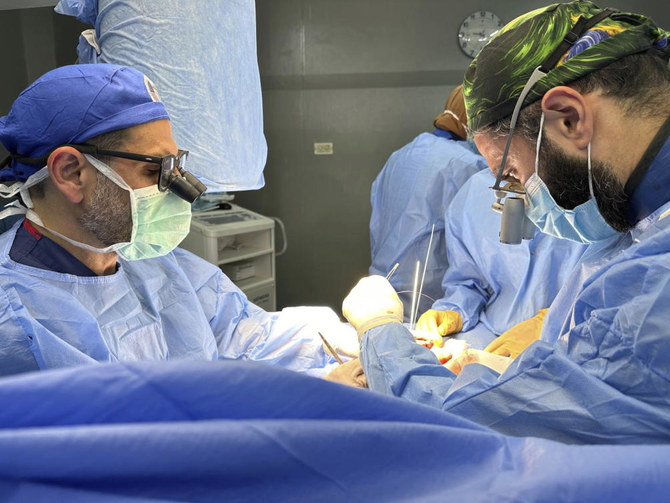
BEIRUT: Dr. Hassan Hamdan was one of the few trained plastic surgeons in Gaza, a specialist in wound reconstruction. His skills were vitally needed as Israel’s military onslaught filled hospitals with patients torn by blasts and shrapnel, so the 65-year-old came out of retirement to help.
Earlier this month, an Israeli airstrike killed him along with his wife, son, two daughters, a daughter-in-law, a son-in-law, six grandchildren and one other person, as his family sheltered in their home in an Israeli-declared “safe zone.”
Israel’s 9-month-old war with Hamas in Gaza has decimated the territory’s medical system. It has not only wreaked physical destruction on hospitals and health facilities, it has devastated Gaza’s medical personnel. More than 500 health care workers have been killed since October, according to the UN.
Among them were many specialists like Hamdan.
Dr. Ahmed Al-Maqadma, also a reconstructive surgeon and a former fellow at UK Royal College, was found shot to death alongside his mother, a general practitioner, on a street outside Gaza City’s Shifa hospital after a two-week raid on the facility by Israeli forces in April.
One of Gaza’s most prominent fertility doctors, Omar Ferwana, was killed along with his family in a strike on his home in October. The territory’s only liver transplant doctor, Hamam Alloh, was killed in a hit on his home in Gaza City.
Israeli strikes in November on a northern Gaza hospital killed two doctors working with Doctors Without Borders. They are among six staffers killed from the international charity, which focuses on reconstructive and orthopedic surgeries, physiotherapy and burn care in Gaza.
Israel has detained doctors and medical staff. At least two have died in Israeli detention, allegedly of ill-treatment: the head of Shifa’s orthopedics department, Adnan Al-Bursh, and the head of a women’s hospital, Iyad Al-Rantisi. Israel has not returned either man’s body. Hundreds of other medical workers have been displaced or left Gaza altogether.
Along with the personal toll, their deaths rob Gaza’s medical system of their skills when they have become crucial.
Since the Hamas attack against Israel on Oct. 7 — which left some 1,200 people dead and 250 kidnapped — Israel’s campaign has killed more than 38,000 people in Gaza and wounded more than 88,000, according to local health officials. Malnutrition and disease have become widespread as hundreds of thousands of Palestinians cram into squalid tent camps.
Dr. Adam Hamawy, a former US Army combat plastic surgeon who volunteered in Gaza in May, said Hamdan’s death “leaves a significant void that will be hard to fill.”
Like many in Gaza, he believes Israel is deliberately destroying the health system, pointing to how Israeli forces have raided hospitals, destroyed medical complexes, fired on medical convoys and hit ambulances. Israel says it is targeting Hamas, which it says uses hospitals as command centers and ambulances for transport. The military has provided limited evidence for its claims.
Twenty-three of Gaza’s 36 hospitals are out of service, and the rest are only partially functioning, according to the latest UN figures. Only five field hospitals out of nine are operational. And more than 60 percent of Gaza’s primary health facilities have shut down.
Hamdan’s death leaves only one other specialist in reconstructive plastic surgery in Gaza. Other doctors have had to learn the skills of repairing major wounds on the job amid relentless daily waves of maimed patients.
Hamawy saw firsthand the need during his work in Gaza as part of an international medical team that came to help the territory’s health workers.
During three weeks at the European General Hospital in Khan Younis, he said he performed 120 surgeries, more than half of them on children, and all but one of them for treatment and reconstruction of war wounds. Two colleagues at the hospital were killed in strikes on their homes while he was there, and he spoke to doctors who had been released from Israeli detention and described being tortured, he said.
Hamawy said a general surgeon at the hospital stepped in to fill the demand for plastic surgeons, but he had no formal training. Five medical students volunteered with him.
They “are doing their best to fill in the gap,” Hamawy said.
On July 2, the European General Hospital evacuated its staff and patients, fearing it would be attacked. That left Al-Aqsa Martyrs Hospital in Deir Al-Balah and a field hospital in Rafah as the only facilities able to offer reconstructive surgery, said Dr. Ahmed Al-Mokhallalati, Gaza’s last reconstructive plastic surgery specialist.
Al-Mokhallalati said he has been rushing between hospitals, at one point overseeing treatment for 400 patients in one and 500 in another. At the Rafah field hospital, he was doing up to 10 surgeries a day.
“It is a very critical situation,” he said.
Hamdan founded the burns and plastic surgery department in Khan Younis’ Nasser Medical complex in 2002, after serving at the territory’s first such unit, at Shifa hospital. He headed the department at Nasser until 2019, when he retired.
When the Israeli army invaded Hamdan’s home city of Khan Younis in December, he returned as a volunteer at Nasser, Gaza’s second largest hospital, said his son Osama Hamdan, an orthopedic surgeon. His colleagues said he was cool under pressure. “The smile never left his face,” said Dr. Mohamad Awad, a surgeon who worked with him.
Soon after, Israeli forces besieged and raided Nasser Hospital, forcing its evacuation. Hamdan was displaced, taking shelter in the home of one of his daughters in Deir Al-Balah, further north.
Troops occupied Nasser hospital for weeks, wreaking extensive damage. After they withdrew, the facility was rehabilitated. In mid-June, Hamdan returned home and was discussing returning to work with hospital officials.
On July 2, Israel ordered another evacuation of Khan Younis. Hamdan and his family fled again, returning to his daughter’s home in Deir Al-Balah.
Only hours after they arrived, an airstrike hit the building on July 3 – “a direct hit with two rockets on my sister’s apartment,” Osama Hamdan said. He said no one in the family was affiliated with militant groups.
The Israeli military did not respond to requests for comment on the strike.
Osama was on duty in the emergency room at Nasser hospital when he received the call. His wife and two sons – 3 and 5 years old – were among those killed.
“I was only able to collect some body parts of my kids and their mother because of how huge the explosion was,” he said.
One of his sisters died days later in the hospital from her wounds. Another sister remains in intensive care.
Osama is feeling partially responsible. “I had pressed him to leave Khan Younis,” he said in a text message, marked with two broken hearts emojis.


![]()

As Gaza’s doctors struggle to save lives, many lose their own in Israeli airstrikes
Short Url
https://arab.news/5x6bn
As Gaza’s doctors struggle to save lives, many lose their own in Israeli airstrikes
- Israel’s 9-month-old war with Hamas in Gaza has decimated the territory’s medical system
- One of Gaza’s most prominent fertility doctors, Omar Ferwana, was killed along with his family in a strike on his home in October


Latest updates


© 2026 SAUDI RESEARCH & PUBLISHING COMPANY, All Rights Reserved And subject to Terms of Use Agreement.