

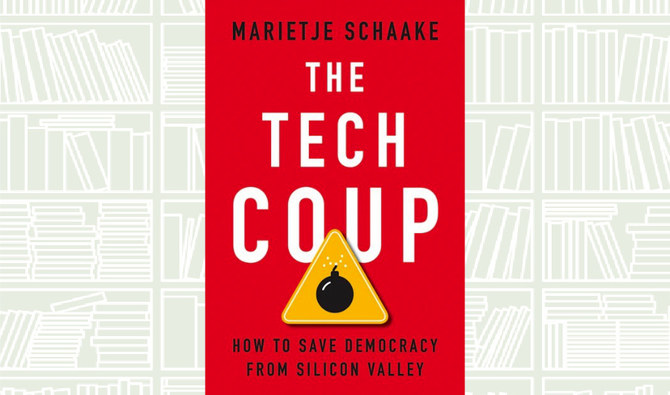
What We Are Reading Today: The Tech Coup

Short Url
Updated 16 July 2024
Follow

What We Are Reading Today: The Tech Coup

Author: Marietje Schaake

Over the past decades, under the cover of “innovation,” technology companies have successfully resisted regulation and have even begun to seize power from governments themselves. Facial recognition firms track citizens for police surveillance. Cryptocurrency has wiped out the personal savings of millions and threatens the stability of the global financial system. 

In “The Tech Coup,” Marietje Schaake offers a behind-the-scenes account of how technology companies crept into nearly every corner of our lives and our governments.


What We Are Reading Today: ‘Ego is the Enemy’

Photo/Supplied
Updated 19 January 2026
Follow

What We Are Reading Today: ‘Ego is the Enemy’

  • Reading this made me reflect on moments when I was more focused on proving myself than improving myself, when ego pushed me to speak before listening or rush before learning

Author: Ryan Holiday

I did not pick up “Ego is the Enemy” by Ryan Holiday because I thought I had a big ego. Like most people, I assumed the book was meant for someone else: the overly confident, the loud, the self-obsessed. I certainly did not think I was being sabotaged by my own ego.

That assumption did not last long. By the time I moved through the first section of the book, it became clear that ego is not always obvious and that was the unsettling part. 

What Holiday does so effectively is break the book into three distinct stages: when you are aspiring for success, when you are successful, and when you hit failure.

In each stage, he shows how ego quietly and secretly works against you. Not through arrogance alone, but through impatience, comparison, defensiveness, and the need to validate yourself instead of doing the work. 

In the aspiration stage, ego disguises itself as ambition. It convinces you that wanting something badly is the same as earning it, and that recognition should come before mastery.

Reading this made me reflect on moments when I was more focused on proving myself than improving myself, when ego pushed me to speak before listening or rush before learning. 

The success stage was even more uncomfortable. Holiday explains how ego, once fed, can turn success into a trap. It creates a false sense of permanence, making you believe past wins are enough to carry you forward.

This section felt like a reminder to stay grounded, to resist entitlement, and to understand that real confidence often shows up as humility and restraint, not noise. 

Then comes failure, the stage we try hardest to avoid. Here, ego becomes fragile. It refuses accountability, blames circumstances, and turns setbacks into personal attacks. Holiday reframes failure as a test of character rather than identity, and this shift felt liberating.

The book does not just point out how ego sabotages you at this stage; it shows you how to catch it, sit with discomfort, and respond with discipline instead of defensiveness. 

What I appreciated most about “Ego is the Enemy” is that it does not try to motivate you with grand promises. It simply sharpens your awareness.

Through historical examples, athletes, writers, and leaders, Holiday illustrates how ego has quietly undone many capable people and how others learned to master it. 

For me, this book became less about fixing myself and more about managing myself. It encouraged me to detach from validation, focus on process over praise, and recognize ego not as an enemy to destroy, but as something to constantly monitor. 

If you are looking for a book that flatters you, this is not it. But if you are willing to acknowledge that your ego may be working against you even when you think it is not, “Ego is the Enemy” is a powerful and honest place to start.