There was a lot for the US Olympic team to like on Monday. And a lot not to like.
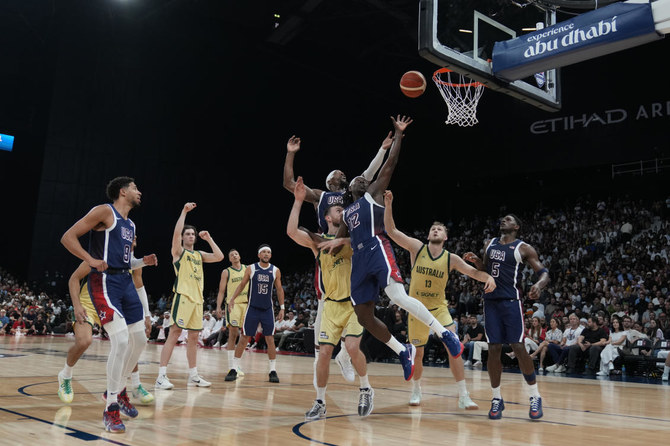
Anthony Davis scored 17 points and grabbed 14 rebounds, Tyrese Haliburton came up with a pair of late 3-pointers that helped stop a freefall by the Americans, and the US beat Australia 98-92 on Monday to improve to 2-0 in its five-game slate of exhibitions leading into the Paris Olympics.
Devin Booker scored 16 for the US, Anthony Edwards scored 14 and three players — LeBron James, Bam Adebayo and Joel Embiid — finished with 10 for the Americans, who are playing host to a pair of exhibitions at Abu Dhabi, United Arab Emirates, this week. They’ll play Serbia there on Wednesday.
Jock Landale scored 20 for Australia, which got 17 from Josh Giddey and 14 from Dyson Daniels.
The US led by 24 midway through the third quarter, yet saw that lead cut to six with 5:05 left after Australia went on a 39-21 run. But Haliburton had the next six points on his 3s, pushing the lead back to 92-80.
Australia cut it to four on two separate occasions, but Booker went 4-for-4 from the line in the final 8 seconds to ensure the US would escape.
“Third quarter, we started turning the ball over,” US coach Steve Kerr said. “We gave up a ton of points at the basket. Back cuts, offensive boards and so, the game shifted. It’s a good lesson for us. Better to learn that lesson now than later. And this will be a good tape for us to watch. But I give Australia a ton of credit. They were great. They fought. They were really physical. Took it to us in the last quarter and a half and really made it a game.”
Second unit, again
Just like in the Canada game, the so-called second unit — Haliburton, Jrue Holiday, Adebayo, Davis and Booker — changed the game.
That was the group on the floor when the Americans took a game that was tied at 19-19 with 3:15 left in the first and turned it into a 39-23 lead — a 20-4 run in a span of just over 5 minutes.
Kerr used that group as his starting five to open the second half. But it’s become a clear trend already: when the US goes to its bench and can replace All-Stars with other All-Stars, it’s just going to be a massive problem for opponents who don’t have anywhere near that same level of depth.
“The strength of our team is our depth and we have to utilize our depth,” Kerr said.
It’s been something the Americans have used to their advantage in the past. Dwyane Wade led the gold-medalist 2008 US Olympic team in points, even though he was sixth in minutes on that team and came off the bench in all eight games.
Turnovers
Here’s the big trouble sign right now for the US: turnovers.
FIBA games are shorter than NBA games, 40 minutes instead of 48 minutes. That means there are fewer possessions and makes it even more imperative to not give the ball away.
Which the Americans did. A lot.
After committing 15 turnovers in last week’s exhibition win over Canada, the US had 18 giveaways on Monday and Australia used them to fuel the comeback effort — getting 25 points off turnovers in the second half alone.
“Our turnovers, it’s all about focus and execution,” Davis said.
Injury watch
Kevin Durant missed his second consecutive game because of a calf strain, and with only one practice between games it wouldn’t seem likely that he plays Wednesday against Serbia either.
Derrick White, who arrived in Abu Dhabi over the weekend and got into his first practice with the team on Sunday, also didn’t play. White replaced Kawhi Leonard — who deals with knee issues — on the US roster after the Americans determined last week that it wasn’t in Leonard’s best interest to play this summer.


![]()

US holds off Australia for 98-92 win in Olympics tuneup in Abu Dhabi
Short Url
https://arab.news/ywbb7
US holds off Australia for 98-92 win in Olympics tuneup in Abu Dhabi
- The US led by 24 midway through the third quarter, yet saw that lead cut to six with 5:05 left after Australia went on a 39-21 run


Latest updates


© 2026 SAUDI RESEARCH & PUBLISHING COMPANY, All Rights Reserved And subject to Terms of Use Agreement.