

Iraqis protest over summer blackouts and water shortages

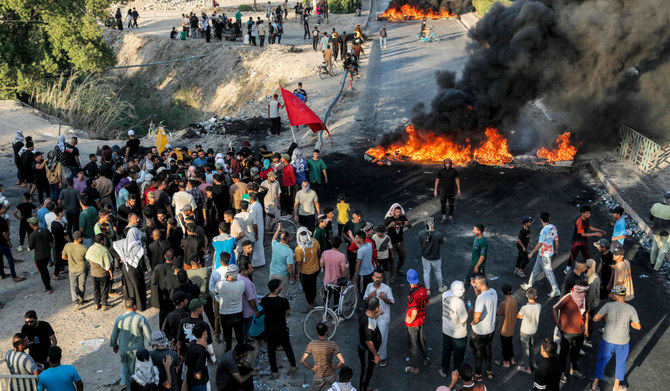
Demonstrators gather to block a road with burning tyres during a protest against power cuts and water shortages during the extreme heat of summer, in the village of Shafeiya on the southwestern outskirts of Diwaniyah in south-central Iraq on July 15, 2024. (AFP)
Short Url
Updated 16 July 2024
Follow

Iraqis protest over summer blackouts and water shortages

  • Iraq is the second-largest oil producer in the OPEC cartel, but despite having immense oil and gas reserves, it remains dependent on imports to meet its energy needs
  • Many households have just a few hours of mains electricity per day, and those who can afford it use private generators to keep fridges and air conditioners running

DIWANIYAH, Iraq: Hundreds of Iraqis in the southern province of Diwaniyah protested on Monday against power cuts and water shortages during the extreme heat of summer, an AFP correspondent said.
Decades of war have left the country’s infrastructure in a pitiful state, with power cuts worsening the blistering summer when temperatures often reach 50 Celsius (122 Fahrenheit) mostly in southern provinces.
Dozens of villages in Diwaniyah have also suffered for years from water shortages because of a four-year-long drought and reduced river flows.
On Monday, around 500 angry protesters encircled the municipality building in Shafeiya village, burning tires and chanting for better services.
“We don’t have electricity. We used to get it for only two hours (per day), but now it is only one hour and 15 minutes,” said protester Youssef Kamel.
“We don’t have water or agriculture,” he said, adding that “everyone has left to look for jobs” as laborers in the cities.
Last week, hundreds of people also protested outside electricity department offices in Ghamas district, blocking roads and burning tires.
On Saturday, police used tear gas to disperse protesters, and dozens were briefly detained.
Iraq is the second-largest oil producer in the OPEC cartel, but despite having immense oil and gas reserves, it remains dependent on imports to meet its energy needs.
Neighbouring Iran supplies about a third of its power sector requirements.
Many households have just a few hours of mains electricity per day, and those who can afford it use private generators to keep fridges and air conditioners running.
Anger over corruption, unemployment and blackouts helped to fuel deadly protests from late 2019 to mid-2020.
The protests morphed into an unprecedented anti-government movement, mostly across southern Iraq and in Baghdad, before a security crackdown killed more than 600 people.


Israel PM holds coalition meeting after objecting to Gaza panel

Updated 6 sec ago
Follow

Israel PM holds coalition meeting after objecting to Gaza panel

  • Israeli Prime Minister Benjamin Netanyahu convened a meeting of his ruling coalition partners on Sunday after objecting to the composition of a Gaza advisory panel
JERUSALEM: Israeli Prime Minister Benjamin Netanyahu convened a meeting of his ruling coalition partners on Sunday after objecting to the composition of a Gaza advisory panel formed by the White House, according to an official and media reports.
The White House announced this week the setting up of a “Gaza Executive Board,” which would operate under a broader “Board of Peace” to be chaired by US President Donald Trump as part of his 20-point plan to end the war in Gaza.
The executive board, described as having an advisory role, includes Turkish Foreign Minister Hakan Fidan and Qatari diplomat Ali Al-Thawadi, alongside other regional and international officials.
Late on Saturday, Netanyahu’s office objected to the composition of the executive board.
“The announcement regarding the composition of the Gaza Executive Board, which is subordinate to the Board of Peace, was not coordinated with Israel and runs contrary to its policy,” the office of Netanyahu said.
“The Prime Minister has instructed the Foreign Affairs Minister to contact the US Secretary of State on this matter.”
It did not explain the reason for its objection, but Israel has previously objected strongly to any Turkish role in post-war Gaza, with relations between the two countries deteriorating sharply since the war began in October 2023.
In addition to naming Turkiye’s foreign minister to the executive board, Trump has also invited Turkish President Recep Tayyip Erdogan to join the overarching Board of Peace.
Media reports said that leaders of the country’s ruling coalition were scheduled to meet on Sunday to examine the composition of the executive board.
“There is a meeting scheduled of the coalition at 10:00 am (0800 GMT),” the spokesman of Netanyahu’s Likud Party told AFP, declining to provide further details.
Alongside Likud, the coalition includes the Religious Zionist Party led by far-right Finance Minister Bezalel Smotrich and Otzma Yehudit (Jewish Power) led by far-right National Security Minister Itamar Ben Gvir.
The White House said Trump’s plan would include three bodies: the Board of Peace, chaired by Trump; a Palestinian committee of technocrats tasked with governing Gaza; and the Gaza Executive Board, which would play an advisory role.
The Palestinian technocratic committee held its first meeting in Cairo on Saturday.
The diplomatic developments came as the United States said this week that the Gaza truce plan had entered a second phase, shifting from implementing a ceasefire to the disarmament of Hamas, whose October 7, 2023 attack on Israel triggered the Israeli offensive in Gaza.