KABUL: At least 35 people were killed and 230 injured on Monday after heavy rain in eastern Afghanistan, a local official said.
“On Monday evening, stormy rains killed 35 people and injured 230 others in Jalalabad and certain districts of Nangarhar” province, Quraishi Badloon, head of the department of information and culture, told AFP.
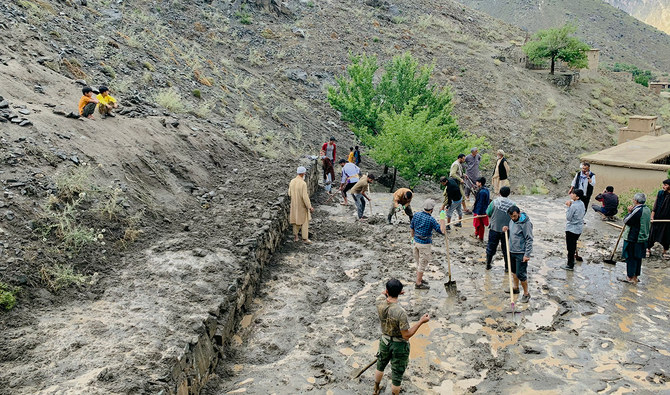
The casualties were caused by heavy storms and rains that collapsed trees, walls and roofs of people’s houses, Badloon said.
“There is a possibility that casualties might rise,” he went on, adding that the wounded as well as victims’ bodies were brought to Nangarhar regional hospital and Fatima-tul-Zahra hospital.
Images shared by Badloon’s department showed medical personnel wearing white and blue uniforms giving treatment to the wounded.
Other pictures on social media showed battered buildings and power masts.
Nangarhar authorities said on X that 400 houses were damaged, while electricity was out of service in the provincial capital of Jalalabad.
They added that several citizens had donated blood at the hospital to support the recovery efforts.
A camp at the Torkham border crossing with Pakistan, built for Afghans returning to their country, was particularly devastated as tents were swept away.
“We share the grief of the families of the victims,” said Zabihullah Mujahid, a spokesman for the Taliban government.
“The relevant institutions of the Islamic Emirate have been directed to go to the affected areas as soon as possible,” Mujahid wrote on X, adding they would provide shelter, food and medicine to displaced families.
The tragedy comes after flash floods killed hundreds of people in Afghanistan in May and swamped agricultural lands in the country, where 80 percent of the population depends on farming to survive.
Among the poorest countries in the world, Afghanistan is particularly exposed to the effects of climate change.
This year, it saw an unusually wet spring after an extremely dry winter.

Heavy rains kill at least 35 in eastern Afghanistan — official
https://arab.news/bbbws
Heavy rains kill at least 35 in eastern Afghanistan — official
- The storms and rains collapsed trees, walls and roofs of several houses in Jalalabad and Nangarhar
- The tragedy comes after flash floods killed hundreds of people and swamped agricultural lands in May
Modi starts Mideast-Africa tour as India-Oman free-trade pact nears completion
- Oman’s Shoura Council approved the trade deal’s draft last week
- Modi begins trip in Amman, heading to Addis Ababa and Muscat
NEW DELHI: Prime Minister Narendra Modi left New Delhi on Monday for a tour covering Jordan, Oman and Ethiopia, as his government looks to strengthen partnerships with West Asia and Africa and finalize a free-trade deal with Muscat.
Modi’s four-day trip will start in Amman, at the invitation of King Abdullah.
“I am sure this visit will boost bilateral linkages between our nations,” Modi said on social media upon his arrival in Jordan, where he was received by Prime Minister Jafar Hassan.
On Tuesday, he is scheduled to arrive in Addis Ababa for his first state visit to Ethiopia. A day later, he will be in Muscat, where the Shoura Council last week approved the draft Comprehensive Economic Partnership Agreement with India.
“If it is signed during this visit, it will significantly deepen the economic ties between India and Oman. And it will open up a new chapter in the history of India-Oman trade and commercial relationship,” Ministry of External Affairs Secretary Arun Chatterjee told reporters ahead of Modi’s departure.
He said Modi would be accompanied by a high-level delegation for his second visit to Oman, after his last trip in February 2018. It also follows the visit of Oman’s Sultan Haitham bin Tariq to India in December 2023.
Free-trade negotiations between India and Oman began in November 2023, with the first round in New Delhi and the second in Muscat.
When the talks concluded in March 2024, Oman sought revisions on market-access terms and the final signature was postponed.
Announcements of the deal’s possible finalization have been made in the past few months by India’s Commerce and Industry Minister Piyush Goyal and the Omani ambassador to New Delhi, Issa Saleh Al-Shibani.
It would be its second with a GCC country after a 2022 trade deal with the UAE, as India has been trying to reach a similar agreement with the whole bloc.
“The framework is expected to be the same as the UAE’s, that is, a Comprehensive Economic Partnership Agreement. This is significant given that the progress on India-GCC FTA has been slow and non-consequential so far,” said Muddassir Quamar, associate professor at the School of International Studies, Jawaharlal Nehru University.
While Oman is one of Delhi’s smaller GCC trading partners — trailing behind the UAE and Saudi Arabia, with bilateral trade about $10 billion — it remains strategically important, particularly in energy and logistics.
“The FTA is likely to give a boost to India-Oman economic and trade relations, especially of goods and services. (It is) important given India has worked to enhance its trade and economic relations with the Gulf countries that are (among) the most dynamic and fast-expanding global economies,” Quamar told Arab News.
“It is also important because there is immense potential for Indian businesses and industries to partner with their Gulf and Omani partners in contributing to the diversification and economic growth plans.”