KIGALI: Rwanda’s President Paul Kagame has scored a crushing election victory that will extend his iron-fisted rule by another five years, according to partial results issued Monday.
De facto leader since the end of the 1994 genocide and president since 2000, Kagame scored 99.15 percent of the vote, the National Election Commission announced after 79 percent of ballots had been counted.
It tops the 98.79 percent Kagame won in the last election in 2017 and puts him streets ahead of the only two candidates authorized to run against him.
Democratic Green Party candidate Frank Habineza scraped 0.53 percent of the vote and independent Philippe Mpayimana 0.32 percent.
The outcome of Monday’s poll was never in doubt, with Kagame’s regime accused of muzzling the media and political opposition, and several prominent critics barred from the race.
Soon after the partial results were announced, giving Kagame a fourth term, he thanked Rwandans in an address from the headquarters of his ruling Rwandan Patriotic Front (RPF).
“The results that have been presented indicate a very high score, these are not just figures, even if it was 100 percent, these are not just numbers,” he said.
“These figures show the trust, and that is what is most important,” he added. “I am hopeful that together we can solve all problems.”
Full provisional results are due by July 20 and definitive results by July 27.
With 65 percent of the population aged under 30, Kagame is the only leader most Rwandans have ever known.
The 66-year-old is credited with rebuilding a traumatized nation after the genocide but he is also accused of ruling in a climate of fear at home, and fomenting instability in the neighboring Democratic Republic of Congo.
Over nine million Rwandans — about two million first-time voters — were registered to cast their ballot, with the presidential race being held at the same time as legislative elections for the first time.
“(Kagame) gives us everything we ask him, such as health insurance. This is why he wins by a big margin,” said 34-year-old mechanic Francois Rwabakina.
Kagame won with more than 93 percent of the vote in 2003, 2010 and in 2017, when he again easily defeated the same two challengers.
He has overseen controversial constitutional amendments that shortened presidential terms from seven to five years and reset the clock for the Rwandan leader, allowing him to potentially rule until 2034.
Rwandan courts had rejected appeals from prominent opposition figures Bernard Ntaganda and Victoire Ingabire to remove previous convictions that effectively disqualified them from Monday’s vote.
The election commission also barred high-profile Kagame critic Diane Rwigara, citing issues with her paperwork — the second time she was excluded from running.
The imbalance between the candidates was evident during the three-week campaign, as the well-oiled PR machine of the ruling RPF swung into high gear.
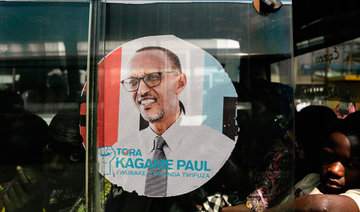
The party’s red, white and blue colors and its slogans “Tora Kagame Paul” (“Vote Paul Kagame“) and “PK24” “Paul Kagame 2024“) were everywhere.
His rivals struggled to make their voices heard, with barely 100 people showing up to some events.
Despite the lacklustre turnout at his rallies, Habineza hailed the “free and fair atmosphere.”
“This is a very good show of the level of growth in democracy in our country. We have been able to campaign (across) the whole country,” he told AFP.
Kagame’s RPF militia is lauded for ending the 1994 genocide when it marched on Kigali — ousting the Hutu extremists who had unleashed 100 days of bloodletting targeting the Tutsi minority.
The perpetrators killed around 800,000 people, mainly Tutsis but also Hutu moderates.
Kagame has overseen a remarkable economic recovery, with GDP growing by an average of 7.2 percent per year between 2012 and 2022, although the World Bank says almost half the population lives on less than $2.15 a day.
Ahead of the vote, Amnesty International said Rwanda’s political opposition faced “severe restrictions... as well as threats, arbitrary detention, prosecution, trumped-up charges, killings and enforced disappearances.”
Abroad, Kigali is accused of meddling in the troubled eastern DRC, where a UN report says its troops are fighting alongside M23 rebels.
Kigali was also accused of killing tens of thousands of Hutus in the DRC during its pursuit of fleeing genocide perpetrators.
Discussion of these alleged massacres remains taboo and is considered genocide “revisionism” in Rwanda.
In the parliamentary election, 589 candidates were chasing 80 seats, including 53 elected by universal suffrage. In the outgoing assembly, the RPF held 40 seats and its allies 11, while Habineza’s party had two.
Another 27 spots are reserved for women, the youth and people with disabilities.


![]()

Rwanda’s Kagame cruises to crushing election victory

Short Url
https://arab.news/66nd2
Rwanda’s Kagame cruises to crushing election victory
- Incumbent Paul Kagame has won more than 93% of the vote at each of the three previous elections
- Kagame is running against two other candidates, Frank Habineza and Philippe Mpayimana

Latest updates


© 2026 SAUDI RESEARCH & PUBLISHING COMPANY, All Rights Reserved And subject to Terms of Use Agreement.