
AL-MUKALLA: Yemen’s Houthi militia on Saturday rejected a demand by UN Yemen Envoy Hans Grundberg to hold discussions with the Yemeni government to resolve knotty economic problems, especially the government’s punitive actions against Sanaa banks.
In a post on X, Hussein Al-Ezzi, the militia’s deputy foreign minister, said that Grundberg was informed that the Houthis would only take part in talks with the Yemeni government about implementing the UN-brokered road map to end the war in Yemen, undermining his efforts to end the country’s deepening economic divisions.
“There will be no negotiations save in the context of addressing the implementation of the agreed-upon road map,” Al-Ezzi said.
The UN Yemen envoy has asked the government and the Houthis to meet without preconditions to discuss financial issues and their effect on Yemen’s deteriorating humanitarian situation, his office said.
“We believe a dialogue, in good faith and without preconditions, is the best possible way to address several important economic issues, including the banking sector issue, and come to solutions that prioritize the interests of the Yemeni people,” Mayy El-Sheikh, director of strategic communications and public information at Grundberg’s office, told Arab News.
In a letter dated July 10, Grundberg urged the chairman of the Presidential Leadership Council, Rashad Al-Alimi, to halt the government’s most recent decision to revoke the licenses of six banks in Houthi-held Sanaa that refused to relocate their offices to the southern city of Aden, the interim capital of Yemen.
Grundberg also encouraged the Yemeni government to engage in negotiations with the Houthis to resolve economic issues.
The envoy, in his letter, expressed sympathy for the Yemeni government’s anger over the Houthi attacks on oil terminals, which resulted in the cessation of oil exports.
But he also cautioned that the government’s punitive measures against the banks in Sanaa would worsen the living conditions of Yemenis and potentially reignite the war.
The PLC agreed on Friday to suspend the revocation of six Sanaa bank licenses and to begin talks with the Houthis on the condition that the dialogue would focus on resuming oil exports, unifying currencies, and addressing the Houthis’ measures against banking and trading, including trade harassment and the militia’s ban on imports from government-controlled areas.
The Houthis have prevented the circulation of banknotes printed by the Yemeni government, attacked oil terminals in government-controlled provinces, banned cooking gas imports from government-controlled Marib, and prohibited traders in areas they control from importing goods through Aden and other government ports, all in an effort to drive the Yemeni government into bankruptcy.
The government responded by directing banks and state bodies to relocate their offices from Sanaa to Aden, withdrawing old banknotes that were commonly used in Houthi areas, restricting the issuing or receiving of international transfers to authorized banks, and most recently, revoking the licenses of six banks in Sanaa.
Meanwhile, Houthi military spokesperson Yahya Sarea said on Friday evening that militia forces targeted the Chrysalis ship twice in the Red Sea and the Bab Al-Mandab Strait, using ballistic missiles and drones, for allegedly breaching the group’s prohibition on sailing to Israel.
It is the latest in a series of claims by the Houthis concerning attacks on ships in the Red Sea and other vital maritime channels off Yemen.
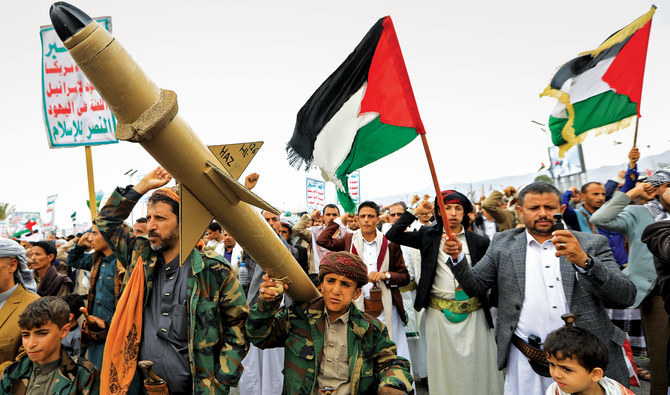
The militia has described the campaign as an act of solidarity with the Palestinian people.
Also on Friday, US Central Command said that its forces had destroyed three drones in a Houthi-controlled part of Yemen.