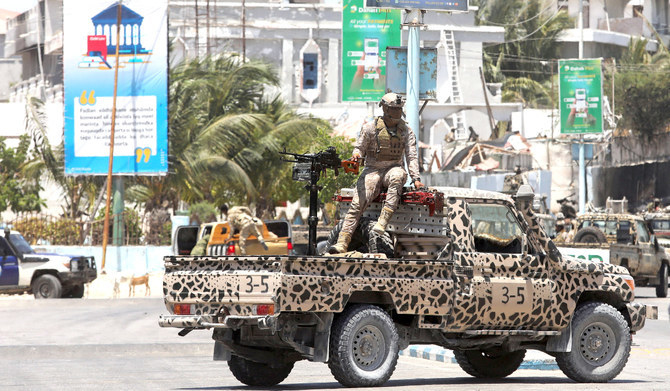
MOGADISHU: Five inmates were killed in Somalia’s capital Mogadishu on Saturday after gunfire broke out between security forces and some prisoners who had acquired weapons and were trying to escape, state media and residents said.
The firefight between the security forces and inmates broke out in the capital’s main prison, located in the city’s south near the port.
“Somalia’s prison forces concluded an operation in which prisoners fought inside the cell. Prisoners who tried to fight were shot dead,” Somalia National TV said in a post on their Facebook account.
The five inmates who died were members of the Islamist group Al-Shabab who had been sentenced to death, it added.
It did not say whether any prisoners had escaped during the firefight.
Two security personnel at the prison, who asked not to be named for fear of retribution, told Reuters grenades and guns had been smuggled into the cell and the inmates had used them to start the firefight.
“We heard gunfire and...explosion inside the cell. The gunfire stopped after like 15 minutes. Government forces cordoned (off) the whole area,” said Abdullahi Aden, a local resident who lives near the prison.
A police spokesperson could not be reached for a comment.
Al Shabab has been fighting Somalia’s central government for nearly two decades and wants to establish its own rule based on its strict interpretation of Islamic sharia law.

Five inmates killed in attempted breakout from Somalian prison
https://arab.news/zujgj
Five inmates killed in attempted breakout from Somalian prison
- The firefight between the security forces and inmates broke out in the capital’s main prison
- The five inmates who died were members of the Islamist group Al-Shabab who had been sentenced to death
UN chief condemns Israeli law blocking electricity, water for UNRWA facilities
- The agency provides education, health and aid to millions of Palestinians in Gaza, the West Bank, Jordan, Lebanon and Syria
United Nations Secretary General Antonio Guterres condemned on Wednesday a move by Israel to ban electricity or water to facilities owned by the UN Palestinian refugee agency, a UN spokesperson said.
The spokesperson said the move would “further impede” the agency’s ability to operate and carry out activities.
“The Convention on the Privileges and Immunities of the United Nations remains applicable to UNRWA (United Nations Relief and Works Agency for Palestine Refugees in the Near East), its property and assets, and to its officials and other personnel. Property used by UNRWA is inviolable,” Stephane Dujarric, spokesman for the secretary-general, said while adding that UNRWA is an “integral” part of the world body.
UNRWA Commissioner General Phillipe Lazzarini also condemned the move, saying that it was part of an ongoing “ systematic campaign to discredit UNRWA and thereby obstruct” the role it plays in providing assistance to Palestinian refugees.
In 2024, the Israeli parliament passed a law banning the agency from operating in the country and prohibiting officials from having contact with the agency.
As a result, UNRWA operates in East Jerusalem, which the UN considers territory occupied by Israel. Israel considers all Jerusalem to be part of the country.
The agency provides education, health and aid to millions of Palestinians in Gaza, the West Bank, Jordan, Lebanon and Syria. It has long had tense relations with Israel but ties have deteriorated sharply since the start of the war in Gaza and Israel has called repeatedly for UNRWA to be disbanded, with its responsibilities transferred to other UN agencies.
The prohibition of basic utilities to the UN agency came as Israel also suspended of dozens of international non-governmental organizations working in Gaza due to a failure to meet new rules to vet those groups.
In a joint statement, Canada, Denmark, Finland, France, Iceland, Japan, Norway, Sweden, Switzerland and the United Kingdom said on Tuesday such a move would have a severe impact on the access of essential services, including health care. They said one in three health care facilities in Gaza would close if international NGO operations stopped.


