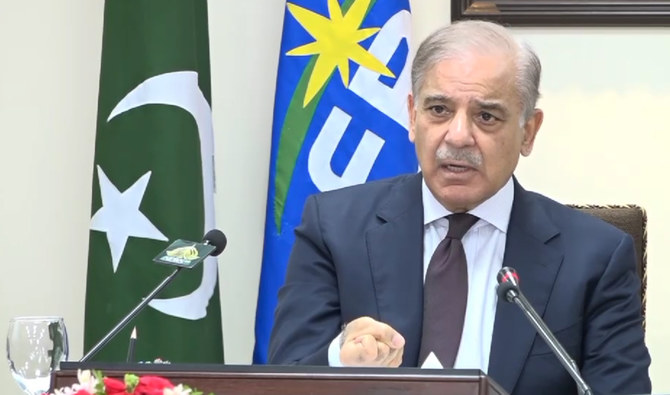
ISLAMABAD: Prime Minister Shehbaz Sharif on Saturday urged officials to make speedy and tireless efforts to make a newly secured $7 billion loan deal with the International Monetary Fund (IMF) Pakistan’s last bailout from the global lender.
The prime minister’s statement came during a meeting of fiscal authorities of the country he presided over in the federal capital of Islamabad.
The meeting came hours after Pakistan reached a staff-level agreement with the IMF for a new $7 billion loan, which is subject to IMF board’s approval.
Sharif congratulated Finance Minister Muhammad Aurangzeb and other officials for their hard work in the recent budget that helped materialize the deal.
“Now is the time that we have to act and act speedily and work tirelessly, only then it would be last IMF program,” he said in televised comments.
“Taxing common people who pay tax, if you will impose further tax on them, [then] it’s a premium for those who don’t pay tax and it’s a penalty for those who are honest taxpayers.”
The deal came weeks after Sharif’s government presented its first budget, aiming to collect Rs13 trillion ($44 billion) in taxes, a 40 percent increase from the last fiscal year.
The government has said that it would ensure an increase in the number of taxpayers in the country from the existing 5 million people who paid taxes.
During the meeting, Sharif asked the Federal Board of Revenue (FBR) chairman to collect even the “last penny.”
“Whatever you need in the public interest, national interest to collect the last penny, which is our due right, I will spend any amount of money to get those gadgetries which are required for this purpose,” he offered.
Islamabad wrangled for months with IMF officials to unlock the new loan announced on Friday, which will be paid out over 37 months.
It came on condition of far-reaching reforms including hiking household bills to remedy a permanently crisis-stricken energy sector and uplifting pitiful tax takings.
More unusual methods have seen the tax authority block 210,000 SIM cards of mobile users who have not filed tax returns in a bid to widen the revenue bracket.
Under the deal “revenue collections will be supported by simpler and fairer direct and indirect taxation including by bringing net income from the retail, export, and agriculture sectors properly into the tax system,” IMF Pakistan mission chief, Nathan Porter, said in a statement.
Islamabad also aims to reduce its fiscal deficit by 1.5 percent to 5.9 percent in the coming year, heeding another key IMF demand.
The IMF said the loan and its conditions should allow Pakistan to “cement macroeconomic stability and create conditions for stronger, more inclusive and resilient growth.”
But Pakistan’s public debt remains huge at $242 billion and servicing it will still swallow up half of the government’s income this fiscal year, according to the lender.


![]()

PM urges efforts to make new $7 billion loan deal Pakistan’s last IMF bailout
Short Url
https://arab.news/5u8d4
PM urges efforts to make new $7 billion loan deal Pakistan’s last IMF bailout
- The new loan, spanning over 37 months, is subject to approval by the IMF executive board
- It came on condition of reforms including hiking household bills and expanding the tax net
Latest updates


© 2026 SAUDI RESEARCH & PUBLISHING COMPANY, All Rights Reserved And subject to Terms of Use Agreement.