

Pakistani Taliban deny plans to attack public places during Muharram amid security alerts

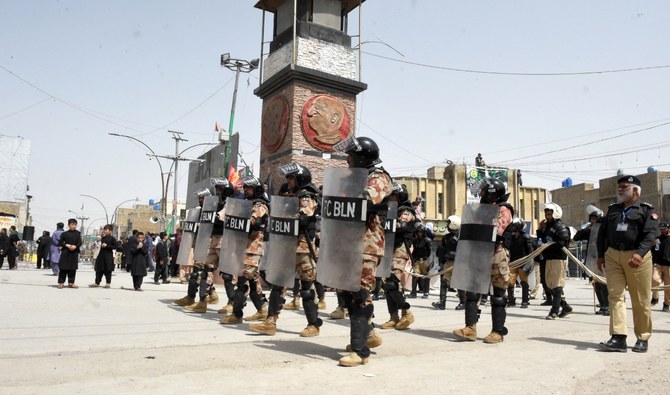
Security personnel stand guard during a procession of Shiite Muslims on the tenth day of Ashura in the Islamic month of Muharram, in Quetta on July 29, 2023. (AFP/File)_
Short Url
Updated 12 July 2024
Follow

Pakistani Taliban deny plans to attack public places during Muharram amid security alerts

  • Spokesperson Mohammad Khorsani says striking public places neither permissible nor aligned with TTP’s objectives
  • The TTP claimed responsibility for several deadly attacks in the past, including the massacre of 134 school children

ISLAMABAD: A proscribed militant network, Tehreek-e-Taliban Pakistan (TTP), on Friday responded to recent security alerts issued by state agencies about its plans to launch attacks during Muharram, the first month of the Islamic calendar, saying that targeting public places was neither permissible nor aligned with its objectives.

The TTP, also known as the Pakistani Taliban, claimed responsibility for some of the deadliest attacks in Pakistan since its formation in 2007, including the massacre of 134 children in a school attack.

Pakistan has accused the interim Taliban administration in Kabul of providing sanctuary to TTP leaders and facilitating their attacks. Although the two groups are not directly affiliated, the Pakistani Taliban owe allegiance to their Afghan counterparts.

Pakistan has historically experienced sectarian violence during Muharram, a significant month for Shia Muslims who observe mourning rituals to commemorate the martyrdom of the Prophet Muhammad’s (PBUH) grandson in the Battle of Karbala.

“We consider it necessary to clarify that not only during Muharram but at any time, we do not consider it permissible to attack public places nor is it among our goals,” TTP Spokesperson Mohammad Khorasani said in a statement on Friday.

“Such fake threats and statements attributed to us have nothing to do with us,” he added, referring to the security alerts circulated by Pakistani law enforcement agencies.

Khorasani blamed the state for spreading fear among people by saying the TTP wanted to launch attack in Muharram.

“Our objectives are clear and pre-announced, which do not include targeting any group, sect or individual based on religious and intellectual differences,” he added.

Since 2007, Pakistan has conducted multiple military operations against the TTP, yet the militant network continues its attacks, primarily targeting the two western provinces bordering Afghanistan.

These attacks have surged since November 2022, following the collapse of a fragile truce brokered by the Afghan Taliban between Islamabad and the TTP.


Pakistan PM convenes political leaders to discuss Iran crisis, regional tensions

Updated 31 min 5 sec ago
Follow

Pakistan PM convenes political leaders to discuss Iran crisis, regional tensions

  • Leaders of major parties attend meeting on regional security and Pakistan’s military campaign
  • Parliamentarians call for national unity and cohesion under current circumstances, says PMO 

ISLAMABAD: Prime Minister Shehbaz Sharif briefed leaders of various parliamentary parties on Wednesday about the ongoing crisis in Iran and Pakistan’s ongoing military conflict with Afghanistan, his office said in a statement. 

The meeting comes as Pakistan has intensified military operations against the Afghan Taliban and militant groups targeting its civilians and security forces along its western frontier, while the wider region faces growing instability after recent US-Israeli strikes on Iran and subsequent attacks across the Gulf.

Sharif decided to convene the session to update the leaders of various political parties in parliament on the security situation and Pakistan’s diplomatic outreach as tensions spread across the region.

“Participants emphasized the need for national unity, consensus and cohesion in the current circumstances,” the Prime Minister’s Office (PMO) said in a statement. 

The statement said parliamentarians appreciated Pakistan’s diplomatic efforts for peace in the region and stressed the need to accelerate them further.

They presented suggestions to the government on what its future course of action should be.

“All participants reaffirmed their strong resolve to eliminate terrorism from the country,” the statement said. 

Representatives of major political parties, including the ruling Pakistan Muslim League-Nawaz, Pakistan Peoples Party, Jamiat Ulema-e-Islam, Muttahida Qaumi Movement and other parliamentary groups attended the briefing.

Pakistan has accused Afghanistan’s Taliban authorities of allowing militant groups such as the Tehreek-e-Taliban Pakistan (TTP) to operate from Afghan territory, allegations Kabul denies. Islamabad says it has targeted militant hideouts across the border after repeatedly raising the issue with Afghan officials.

The briefing also comes as the government closely monitors developments in the Middle East, where regional tensions have heightened concerns about energy supplies and broader security implications for the country.