

Pakistan says ‘deeply values’ cooperation with Afghanistan as ties sour over deportations, militancy

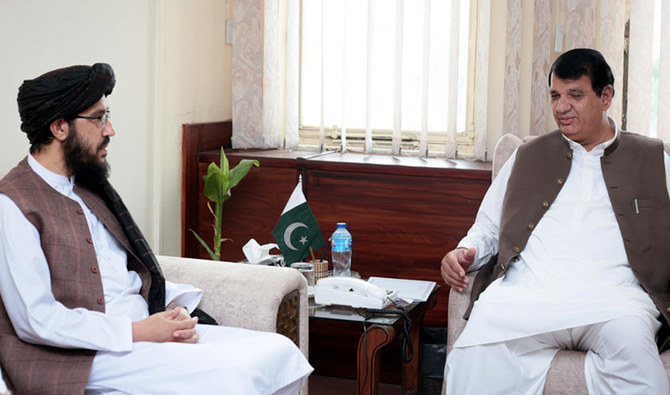
Pakistani Federal Minister for States and Frontier Regions, Amir Muqam (right), meets Charge d’Affaires of Afghanistan, Sardar Ahmed Khan Shakib, in Islamabad on July 12, 2024. (Radio Pakistan)
Short Url
Updated 12 July 2024
Follow

Pakistan says ‘deeply values’ cooperation with Afghanistan as ties sour over deportations, militancy

  • Pakistan says Kabul not doing enough to tackle militant groups using Afghan territory to target Pakistan, which it denies
  • Over 600,000 Afghans expelled since November last year when Islamabad launched deportation drive against illegal foreigners

PESHAWAR: Pakistani Federal Minister for States and Frontier Regions, Amir Muqam, discussed bilateral ties with Afghan’s Charge d’Affaires, Sardar Ahmed Khan Shakib, on Friday, saying that his country “deeply valued” its cooperation with Afghanistan in addressing the issue of refugees.

Relations between Islamabad and Kabul have soured in recent months amid a surge in militant attacks that Pakistan blames on Afghanistan, saying its Taliban rulers were not doing enough to tackle militant groups using its territory to target Pakistan, which they deny.

The Pakistani Taliban have stepped up attacks against Pakistan security forces in recent months, with daily assaults on army and paramilitary posts and targeted killings of police and government officials.

“Pakistan deeply values its longstanding friendship and cooperation with Afghanistan,” Muqam was quoted as saying in a statement released by his office after his meeting with Shakib in Islamabad.

The Pakistani minister said the people of the two countries had made immense sacrifices, adding that restoring peace was essential for their well-being.

“We encourage Afghanistan to focus on ensuring the welfare and integration of its citizens residing in Pakistan, with an emphasis on their return as a long-term solution,” he said.

The Afghan diplomat thanked Pakistan for extending the deadline of UNHCR-issued Proof of Registration (PoR) cards for almost 1.5 million Afghan refugees for one year.

Islamabad launched a deportation drive last year against illegal foreigners residing in the country after a spate of suicide bombings which the Pakistan government, without providing evidence, said were carried out by Afghan nationals. Islamabad has also blamed them for smuggling, militant violence and other crimes.

A cash-strapped Pakistan navigating record inflation, alongside a tough International Monetary Fund bailout program last year, had also said undocumented migrants had drained its resources for decades.

Until the government initiated the expulsion drive last year, Pakistan was home to over four million Afghan migrants and refugees out of which around 1.7 million were undocumented, as per government figures.

Afghans make up the largest portion of migrants, many of whom came after the Taliban took over Kabul in 2021, but a large number have been present since the 1979 Soviet invasion of Afghanistan.

Islamabad insists the deportation drive is not aimed specifically at Afghans but at all those living illegally in Pakistan.

In October 2023, Pakistan announced phase one of the “Illegal Foreigners’ Repatriation Plan” with a 30-day deadline for “undocumented” aliens to leave the country or be subject to deportation, putting 1.4 million Afghan refugees at risk. Over 600,000 Afghans have been expelled under this phase.

In phase two, Afghans holding Pakistan-issued Afghan citizenship cards (ACCs) will be expelled while phase three is expected to target those with UNHCR-issued PoR cards.


Attack on paramilitary post in northwest Pakistan kills seven security personnel, child

Updated 5 sec ago
Follow

Attack on paramilitary post in northwest Pakistan kills seven security personnel, child

  • Blast hits Frontier Corps checkpoint in Bajaur near Afghan border
  • Police recover bodies from rubble as rescue operation continues

ISLAMABAD: An attack on a paramilitary checkpoint in northwest Pakistan killed at least seven security personnel and a child on Monday, officials said, the latest in a series of attacks in a region bordering Afghanistan.

Pakistan has witnessed a steady rise in attacks in the northwestern Khyber Pakhtunkhwa province since the Taliban returned to power in Afghanistan in 2021, with most violence targeting police and security forces in former tribal districts along the border.

Islamabad says the Tehreek-e-Taliban Pakistan (TTP) militant group has reorganized across the frontier and operates from safe havens inside Afghanistan, a charge Kabul rejects, insisting it does not allow its territory to be used against other countries.

The latest attack struck a Frontier Corps (FC) post in the Mamond area of Bajaur district, destroying a small compound where security personnel were stationed.

“We have recovered seven dead bodies, one of them police, and two injured from the debris while search for other bodies is underway,” Deputy Superintendent of Police Niaz Mohammad told Arab News, describing the compound as “a structure comprising four to five rooms.”

Rescue teams continued operations to locate anyone trapped beneath the rubble, officials said.

Police did not comment on the nature of the attack but a statement from the Khyber Pakhtunkhwa chief minister’s office described it as a suicide bombing and confirmed casualties among security personnel and a child.

“The martyrdom of security personnel and a child in the terrorist attack is extremely tragic,” the statement said, adding that emergency services had been instructed to speed up rescue efforts.

Authorities said operations against militants in the province would be intensified.

Districts along Pakistan’s border with Afghanistan, including Bajaur and Bannu, have repeatedly been targeted in bombings and assaults on security checkpoints since a fragile ceasefire between Islamabad and the TTP collapsed in late 2022. Security forces continue to conduct intelligence-based operations in the region, but patrols and outposts remain frequent targets.