PM calls for restructuring Pakistan wheat board weeks after import crisis protests

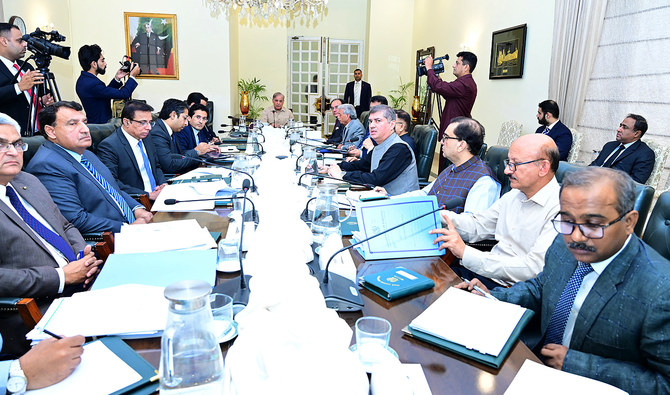
Prime Minister Shehbaz Sharif chairs a meeting on restructuring of Wheat Board in Islamabad on July 12, 2024. (Photo courtesy: PMO)
Short Url
Updated 12 July 2024
Follow

PM calls for restructuring Pakistan wheat board weeks after import crisis protests

  • Wheat has nine percent share in Pakistan’s agriculture sector and contributes 2.2 percent of GDP 
  • Pakistan saw weeks of protests by farmers demanding government stop wheat imports that had flooded market

ISLAMABAD: Prime Minister Shehbaz Sharif has called for the restructuring of the country’s wheat board and steps to enhance production of wheat and other crops, his office said on Friday, weeks after farmer protests over wheat imports. 
Pakistan saw weeks of protests this year by farmers in Punjab, the country’s largest province and “bread basket,” who demanded the government stop wheat imports that had flooded the market at a time when they expected bumper crops.
Pakistan’s wheat production during 2023-24 stood at 31.4 million tons as compared to 28.2 million tons last year, posting a growth of 11.6 percent. According to official data, the country had over 36 million tons of wheat stock by June, including carry-forward stock.
Wheat has a 9 percent share in Pakistan’s agriculture and contributes 2.2 percent of the GDP and is harvested in Pakistan from April to June, with peak vegetation development occurring between late March and early February.
Sharif, while presiding over a meeting of officials of the national food security ministry and other bodies, issued directives to include representatives of the Land Information and Management System and the Space & Upper Atmosphere Research Commission (SUPARCO) in the wheat board.
“Farmer representatives should be included in the wheat board,” Sharif was quoted as saying in a statement issued by his office.
The prime minister urged authorities to devise an alternate strategy to purchase wheat and consult Gilgit-Baltistan, Azad Kashmir and provincial governments in this regard.
During earlier protests, farmers had said the import of wheat in the second half of 2023 and the first three months of this year had resulted in excess amounts of the commodity in the country, leading to reduced prices. 
Official data shows Pakistan spent over $1 billion to import 3.5 million tons of wheat from July 2023 till May 2024.
Agriculture is one of the most significant income sectors in Pakistan, making up nearly 23 percent of the GDP of the country.


Pakistan to promote mineral sector at Saudi forum this month with 13 companies

Updated 02 January 2026
Follow

Pakistan to promote mineral sector at Saudi forum this month with 13 companies

  • Delegation will take part in the Future Minerals Forum in Riyadh from Jan. 13-15
  • Petroleum minister will lead Pakistan, participate in a 90-minute country session

ISLAMABAD: Around 13 Pakistani state-owned and private companies will attend the Future Minerals Forum (FMF) in Saudi Arabia from Jan. 13 to 15, an official statement said on Friday, as the country seeks to ramp up global engagement to develop its mineral resources.

The FMF is an international conference and investment platform for the mining sector, hosted by mineral-rich countries to attract global investors, companies and governments.

Petroleum Minister Ali Pervaiz Malik confirmed Pakistan’s participation in a meeting with the Saudi envoy, Nawaf bin Said Al-Malki.

Pakistan hosts one of the world’s largest copper-gold zones. The Reko Diq mine in southwestern Balochistan, with an estimated 5.9 billion tons of ore, is partly owned by Barrick Gold, which calls it one of the world’s largest underdeveloped copper-gold deposits. Its development is expected to boost Pakistan’s struggling economy.

“Upon an invitation of the Government of the Kingdom of Saudi Arabia, the Federal Minister informed the Ambassador that Pakistan will fully participate in the upcoming Future Minerals Forum (FMF), scheduled to be held in Riyadh later this month,” Pakistan’s Press Information Department (PID) said in an official statement.

The Pakistani minister will lead his country’s delegation at the FMF and take part in a 90-minute country showcase session titled “Unleashing Potential: Accelerating Pakistan’s Mineral Revolution” along with local and foreign investors.

Pakistan will also establish a dedicated pavilion to highlight the vast potential of its rich geological landscape to the global mineral community.

The Saudi envoy welcomed Pakistan’s decision to participate in the forum and discussed enhancing bilateral cooperation in the minerals and energy sectors during the meeting.

According to the statement, he highlighted the potential for cooperation between Saudi Arabia and Pakistan in the minerals and energy sectors, expressing confidence that the FMF would provide a platform to expand collaboration.
Pakistan’s mineral sector, despite its rich reserves of salt, copper, gold and coal, contributes only 3.2 percent to the country’s GDP and just 0.1 percent to global mineral exports.

However, many countries, including the United States, have shown interest in Pakistan’s underdeveloped mineral sector, particularly in copper, gold and other critical resources.

In October, Pakistan dispatched its first-ever shipment of rare earth and critical minerals to the United States, according to a Chicago-based US public relations firm’s report.