JOHANNESBURG: In his workshop stocked with piles of fabric and sewing machines, Sonwabile Ndamase is proud that the Madiba shirts he designed for Nelson Mandela 30 years ago endure as a legacy of South Africa’s first democratically elected leader.
Worn untucked and without a jacket, the loose Madiba shirts remain a favorite among South African politicians, making a statement 10 years after Mandela’s death.
Madiba is the clan name by which Mandela is known in South Africa.
Ndamase’s clients include South Africa’s current president, Cyril Ramaphosa, as well as his predecessors, Thabo Mbeki and Jacob Zuma. The country’s political and business elite — including ministers, government spokesmen and local politicians — regularly place orders.
Even former US president Bill Clinton and boxing great Mike Tyson have a Madiba shirt.
“Anybody who wants to live a Mandela legacy or who wants to live Mandela ethos in life, guess what they are doing? They will go and pick up Madiba shirts,” Ndamase told AFP.
The jovial 64-year-old designer recalls when he was contacted by Winnie Mandela soon after the apartheid government released her husband from prison in 1990.
Having spent 27 years in jail, the hero of the fight against white-minority rule and South Africa’s soon-to-be president needed new clothes.
Ndamase met Mandela in his home Johannesburg’s Soweto. “He started to tell me that he wanted something that could look conservative enough for him to go and address the captains of industry and... then also to address the masses without having to change,” he said.
Mandela wanted a style that would make him stand out among other statesmen and did not require a tie.
The self-taught designer came up with the loose-fitting, casual-but-smart silk shirts with bold patterns that are associated with Mandela even after his death in 2013 at the age of 95.
The shirts often feature oriental-style patterns. Some boast deep colors such as burgundy, dark grey and royal blue, with playful designs; others are of cooler, tan hues, depicting elements from nature like leaves or twigs.
All are recognizable as the signature Mandela look. It is a style that Ndamase, who suffered a mild stroke in March 2024, is passing on to a new generation of garment-makers.
The jocular designer — whose perfect impersonation of Mandela is a testament to their time spent together — is taking his know-how to New York in September when he will host a masterclass for young designers.
On the same trip, he will showcase his Vukani brand’s new collection at an event for celebrity and elite buyers that will pay tribute to the 30 years of democracy since South Africa’s first all-race election in 1994.
The collection takes on a more casual, loungewear aesthetic, a breakaway from his usual style, Ndamase said. The occasion will feature in a documentary by a US-based filmmaker about his career.
Sporting a grey goatee, Ndamase laughs off the many other designers who claim to have pioneered the Madiba shirt or sell versions resembling his own, which today cost around 1,800 rand ($90) apiece.
Once described by the late Winnie Mandela as “part of the furniture,” he says never wanted to use the Mandela name commercial purposes. “I dressed one generation to another,” he said. “The relationship I had was a family relationship.”
Born in the Mdantsane township on the southeastern coast, Ndamase still spends time behind the sewing machine in his Johannesburg workshop.
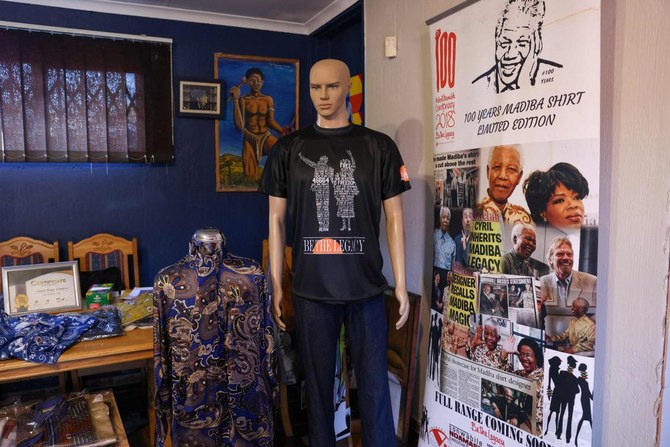
“It’s a dream come true,” he said, squinting at shirt he is working on. “It’s a legacy collection,” he said, pointing to a T-shirt from the new range that is emblazoned “BE THE LEGACY” and features a famous silhouette of Nelson and Winnie Mandela walking free in 1990.


![]()

In South Africa, Madiba shirts keep Mandela’s legacy alive
Short Url
https://arab.news/8vwtx
In South Africa, Madiba shirts keep Mandela’s legacy alive
- Sonwabile Ndamas proud that the Madiba shirts he designed for Nelson Mandela 30 years ago endure as a legacy of South Africa’s first democratically elected leader


Latest updates


© 2026 SAUDI RESEARCH & PUBLISHING COMPANY, All Rights Reserved And subject to Terms of Use Agreement.