

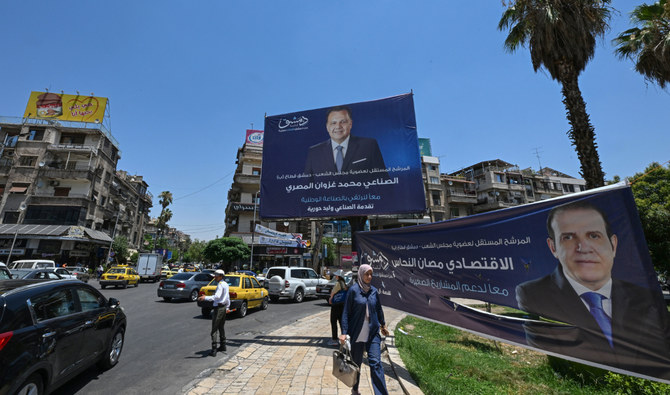

DAMASCUS: Campaign posters have sprung up across Damascus as Syria prepares to hold a parliamentary election in government-held areas on Monday that is designed to renew the ruling Baath party’s grip on power.
It will be the fourth election to Syria’s largely rubber-stamp parliament since civil war erupted in 2011. As in the previous ones, President Bashar Assad’s Baath party, in power since 1963, is expected to secure most of the 250 seats.
“Although there are new candidates... the old ones that we’re used to seeing” are still running, said Fawaz Hanna, 56.
“Our demands are solely focused on living conditions,” said Hanna, referring to the hyperinflation caused by the war, which has driven millions into poverty.
“We urge candidates to take responsibility for their slogans and to keep their promises,” he added.
Outside his photography studio in central Damascus, candidates have put up campaign posters promising to revive the economy.
On one banner, a candidate pledged “to support small businesses,” while another, a few meters away promised “a competitive industry... a thriving economy.”
The Baath party and its secular left-wing and Arab nationalist allies are running virtually unopposed in the election with independents the only alternative.
Polling stations will operate only in government-controlled areas, effectively disenfranchising the millions of Syrians who live in the Kurdish-controlled northeast or in areas along the Turkish border controlled by Ankara-backed rebels or by jihadists.
Candidates are still contesting seats allocated to the north and northeast but only voters who have moved to government-controlled areas can cast ballots in the designated polling stations.
The millions of Syrians who have found refuge abroad also have no vote.
Syria’s exiled opposition issued a statement Wednesday condemning the election as “absurd” and saying that polls organized by the government “only represent the ruling authority.”
Authorities said 8,953 candidates, including 1,317 women, are competing for a seat in parliament.
“Most of the candidates are men, I only saw pictures of two female candidates,” said Aya Jdid, 22, a Damascus University student.
In another part of the city, a group presenting themselves as independents set up a tent with pictures of candidates on their list — mostly businessmen wearing suits.
“I don’t expect these elections to be any different than the previous ones, because we’re seeing the same” candidates, said 46-year-old event planner Johnny Arbash.
“However, we ask that they work in the interest of the people, who are tired after years of war,” he said.
Arbash said the fledgling rehabilitation of Assad’s government on the regional diplomatic stage gave him some hope for the economy.
“We are following news of political openings with Saudi Arabia and a possible rapprochement with Turkiye, and we hope this will have an impact on... living conditions,” Arbash said.
Last year, Damascus was readmitted to the Arab League after reconciling with Gulf Arab states that had championed its suspension from the regional bloc.
Earlier this month, President Recep Tayyip Erdogan said he might invite Assad to Turkiye “at any moment.”
Geography teacher Hossam Shaheen, 40, told AFP he was excited to vote and had urged his friends to do so too.
“We must vote instead of watching and criticizing,” he said.
But Bashir, 33, who gave only his first name, said he intended to spoil his ballot in protest at the “predetermined” outcome.
“I don’t believe in any of the candidates, but at the same time... it’s my right to participate,” he said.
“I will cast a blank vote.”


