

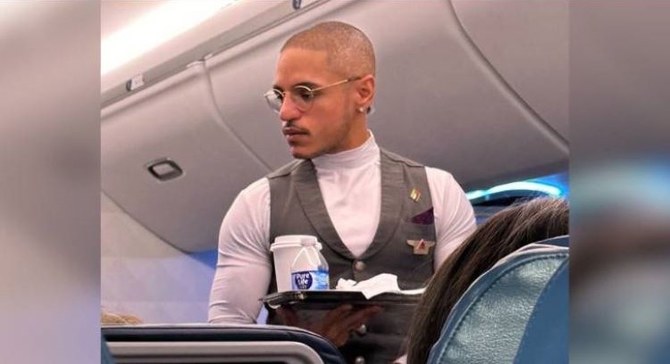
Delta Air Lines faces backlash for linking Palestine flag pins to Hamas in social media post

A Delta flight attendant wearing a Palestinian flag pin. (Social Media)
Short Url
Updated 11 July 2024
Follow

Delta Air Lines faces backlash for linking Palestine flag pins to Hamas in social media post

  • US carrier responds to user’s ‘Hamas badge’ claim, says ‘I’d be terrified as well’
  • Council on American-Islamic Relations urges Delta to apologize for ‘racist anti-Palestinian tweet’

LONDON: Delta Air Lines has sparked controversy by appearing to support a post on X claiming that Palestine flag pins worn by two of its cabin crew members were “Hamas badges.”

In a now-deleted response, the US carrier’s account seemed to validate a user’s accusation that its staff were allowed to wear “Hamas badges in the air.”

The company wrote: “I hear you and I’d be terrified as well, personally. Our employees reflect our culture and we do not take it lightly when our policy is not being followed.”

It added in another reply: “Nothing to worry, this is being investigated already, particularly the involved parties.”

The incident reportedly occurred during a flight last Friday between Boston and West Palm Beach in Florida.

The photo showing crew members wearing Palestine flag pins initially surfaced on the social media platform and was subsequently shared by several pro-Israel advocacy groups, including StopAntisemitism, which humorously suggested that Delta was opening “a new summer route” to Palestine.

The account also shared images from one of the flight attendant’s personal Instagram pages.

Delta Air Line’s response triggered an outcry on X, with users calling for a boycott of the airline over its handling of the situation.

The Council on American-Islamic Relations urged Delta to apologize for the post, describing it as a “racist anti-Palestinian tweet.”

CAIR Deputy Director Edward Ahmed Mitchell said in a statement on Thursday: “Whether this racist post on Delta’s X account was approved or unauthorized, Delta must apologize and take steps to educate its employees about this type of dangerous anti-Palestinian racism.”

The incident adds to a series of controversies involving the American carrier, including previous criticism over alleged discrimination, particularly against Muslims.

In a reported incident in May, media outlets revealed that Delta staff had asked a Jewish activist to cover up a T-shirt reading “Jews say ceasefire now” during a flight.


Israel arrests 2 Turkish CNN journalists over live broadcast outside IDF HQ

Updated 03 March 2026
Follow

Israel arrests 2 Turkish CNN journalists over live broadcast outside IDF HQ

  • Police said reporter Emrah Cakmak and cameraman Halil Kahraman were detained on suspicion of filming a sensitive security facility
  • Since the Gaza war began, restrictions have expanded significantly, including tighter limits on filming soldiers on duty and sensitive or strategic sites

LONDON: Israeli police have arrested two Turkish CNN journalists who were broadcasting live outside the Israel Defense Forces’ headquarters in Tel Aviv.

Police said the pair were detained on suspicion of filming a sensitive security facility, according to the Israel Police Spokesperson’s Unit.

Reporter Emrah Cakmak and cameraman Halil Kahraman, from the network’s Turkish-language channel, had been reporting near the IDF’s Kirya military headquarters on Tuesday after Iran launched another missile barrage at Tel Aviv and other parts of central Israel.

During the live broadcast, two men believed to be soldiers approached the crew and seized the reporter’s phone, according to initial reports and a video circulating online that could not be independently verified.

Police said officers were dispatched after receiving reports of two people carrying cameras and allegedly broadcasting in real time for a foreign outlet.

Israel’s long-standing military censorship system, overseen by the IDF Military Censor, has long barred journalists and civilians from publishing material deemed harmful to national security.

Since the Gaza war began, restrictions have expanded significantly, including tighter limits on filming soldiers on duty and sensitive or strategic sites.

After a series of similar incidents involving foreign media — most of them Palestinian citizens of Israel working for Arab-language and international media, along with foreign journalists — during the 12-Day War, Israeli police halted live international broadcasts from missile impact sites, citing concerns that exact locations were being revealed.

The Government Press Office later imposed a blanket ban on live coverage from crash and impact areas.

Communications Minister Shlomo Karhi and National Security Minister Itamar Ben-Gvir subsequently ordered that all foreign journalists obtain prior written approval from the military censor before broadcasting — live or recorded — from combat zones or missile strike locations.

Police said that when officers asked the CNN Turk crew to identify themselves, they presented expired press cards and were taken in for questioning.

Burhanettin Duran, head of Turkiye’s Directorate of Communications, condemned the arrests as an attack on the press and said Ankara is working to secure the journalists’ release.