

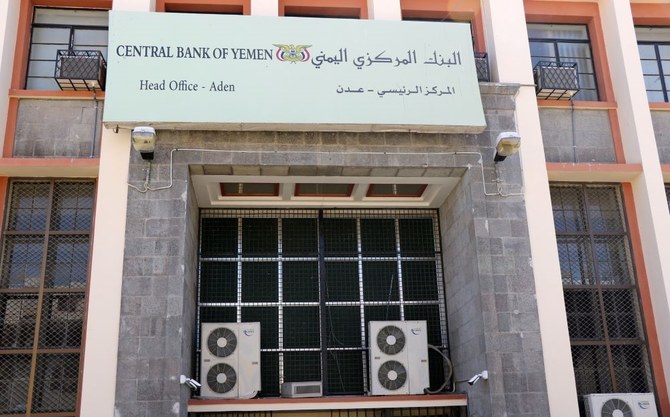

AL-MUKALLA: The Central Bank of Yemen has revoked the licenses of six Yemeni banks for failing to relocate their offices from Houthi-held Sanaa to the southern city of Aden, the war-torn country’s temporary capital. The decision is expected to provoke retaliation from the Houthis.
In a circular distributed on July 7, the contents of which were confirmed by Arab News on Thursday, the bank canceled the licenses of Tadhamon Bank, Yemen Kuwait Bank, Shamil Bank of Yemen and Bahrain, Al-Amal Microfinance Bank, Al-Kuraimi Islamic Microfinance Bank, and International Bank of Yemen for failing to comply with its relocation order. However, it said branches of the banks can continue to operate in government-controlled territories.
In April, the Central Bank gave banks in Sanaa two months to move their headquarters to Aden or face penalties. This came shortly after the Houthis announced the minting of a new, 100-riyal currency for the first time since the war began in late 2014, angering the Yemeni government and its Central Bank.
The government accuses the Houthis of waging an economic war by prohibiting the use of government-printed banknotes, attacking oil terminals in government-controlled Hadramout and Shabwa, preventing local traders from importing goods through Aden, and prohibiting imports of gas for cooking from the central city of Marib.
Authorities responded to the latest development by ordering banks and other key businesses, including telecoms companies and national airline Yemenia, to move their headquarters to Aden.
In May, the Central Bank ordered local financial institutions to stop dealing with the six sanctioned banks, accusing them of refusing to relocate and dealing with the Houthis, an organization classified as “terrorist” by the Yemeni government, the US and other countries.
Unlike previous actions taken by the Central Bank, which were publicized by Yemen’s official media, the decision to revoke the banks’ licenses was emailed to the targeted institutions rather than published publicly online.
An official familiar with the government’s economic measures told Arab News on Thursday that the Central Bank did not publicize its decision because it wanted to enable efforts by “mediators” to persuade the Houthis to halt their economic activities such as the printing of a new currency.
Meanwhile, Mustafa Nasr, the director of Yemen’s Studies and Economic Media Center, told Arab News that the Central Bank decision was expected because the banks were bowing to Houthi pressure, and that revoking their licenses would “isolate” financial institutions in Houthi-controlled areas.
“This step is harsher and more punitive in response to banks that have yet to move their headquarters to Aden,” he said.
“Allowing these banks’ branches to function in government-controlled regions provides a partial lifeline to avoiding total closure, which might expose them to the disaster of collapse.”
The revocation of the licenses comes as the Yemeni riyal fell to another record low against the dollar in government-controlled territories. In June, the riyal had fallen to 1,770 versus the dollar, down from 215 in early 2015. On Thursday, currency traders in Aden reported a further drop to 1,895.
Nasr attributed the depreciation of the riyal to depletion of Yemen’s foreign currency reserves as a result of the suspension of oil exports following Houthi attacks, speculation by money traders, Houthi purchases of hard currencies from government-controlled areas to weaken the riyal, and corruption in government institutions.
“The issue is not just with the Central Bank but also with the government’s financial policies and foreign-exchange income after the termination of the most significant source of foreign currency: oil exports,” he added.


