

Ex-PM Khan’s party to challenge Pakistan court verdict connecting him to May 9 riots 

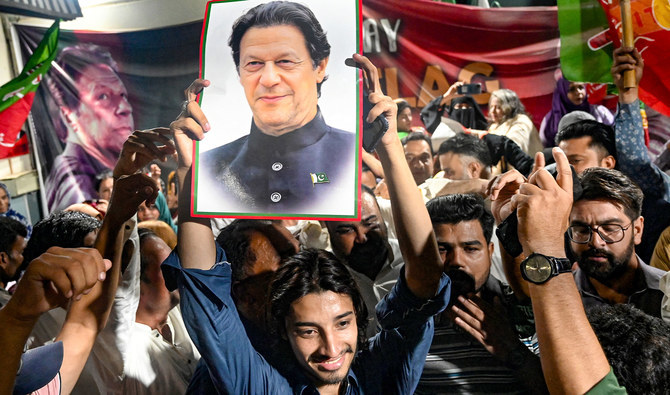
Supporters of Pakistan's jailed former Prime Minister Imran Khan hold his poster as they celebrate after he was aquitted of leaking state secrets following a court verdict in Karachi on June 3, 2024. (AFP/File)
Short Url
Updated 11 July 2024
Follow

Ex-PM Khan’s party to challenge Pakistan court verdict connecting him to May 9 riots 

  • Khan’s arrest in land graft case on May 9 last year led to his alleged supporters damaging government, army properties
  • Anti-terrorism court ruled on July 9 there was “reasonable” evidence that Khan was behind the violence of May 9

ISLAMABAD: The Pakistan Tehreek-e-Insaf (PTI) party said on Thursday it would challenge a lower court’s verdicts dismissing three bail pleas by its founder and former Prime Minister Imran Khan in cases involving riots last year and declaring there was “reasonable” evidence of his involvement.

Alleged supporters of the PTI party attacked and damaged government and military installations on May 9, 2023, after Khan’s brief arrest that day in a land graft case. The attacks took place a little over a year after Khan fell out with Pakistan’s powerful military, blaming the institution for colluding with his rivals to oust him from office in a parliamentary vote in April 2022. The military and the political parties Khan blames reject the allegations.

Hundreds of PTI workers and leaders were arrested following the May 9 riots in a state-led crackdown on charges of involvement in the riots, and some continue to remain behind bars as they await trial. The military has also initiated army court trials of at least 103 people accused of involvement in the violence. Many close Khan aides have since deserted him, due to what is widely believed to be pressure from the army, which denies interfering in politics. 

Khan and other key leaders of his party are widely believed to have masterminded the violence but the ex-PM has distanced himself from the riots and says they have been used as a ruse by political rivals and the military to crack down on the party, which is arguably the most popular in Pakistan. They deny the charge.

“Party will most definitely challenge the verdict,” the PTI said on Thursday in a text message to reporters about the verdict by an Anti-Terrorism Court (ATC) in Lahore dismissing Khan’s bail petitions in three May 9 cases. “The judgment contained no evidence of Imran Khan ordering the May 9 violence.”

The ATC had on Saturday reserved its verdict on Khan‘s bail petitions in three cases concerning attacks on Lahore’s Jinnah House, the residence of the top military commander in the city, as well as Askari Tower and Shadman police station. 

The party said ATC Judge Khalid Arshad dismissed the PTI founder’s bail pleas by “drawing interferences and assumptions.” While ATCs in other parts of the country, including Rawalpindi and Sargodha, had dismissed May 9-related cases against Khan, the Lahore ATC had declared him a “main accused,” the party said, adding that this was another “politically motivated case” being used to prolong Khan’s “illegal incarceration.” 

Khan has been imprisoned since August last year after he was convicted in at least four separate cases, with two of the judgments suspended and Khan acquitted in a third case.

ATC VERDICT

Pakistan’s anti-corruption agency arrested Khan from the premises of the Islamabad High Court on May 9 last year, unleashing nationwide protests by his followers. That case involves accusations Khan and his wife received, when he was still prime minister, land worth up to 7 billion rupees ($24.7 million) from a property developer who had been charged in Britain with money laundering. The government says British authorities had returned 190 million pounds ($240 million) to Pakistan in connection with money laundering, but Khan had returned the money to the developer instead of keeping it in the national exchequer.

Khan’s PTI party called on supporters to “shut down Pakistan” over his May 9 arrest, writing on Twitter: “It’s your time, people of Pakistan. Khan has always stood for you, now its time to stand for him.”

Hundreds of Khan supporters blocked roads in cities and major highways across the country, as police poured into the streets, public gatherings were banned and telecommunications networks suspended. Previous attempts to arrest Khan from his Lahore home had already resulted in heavy clashes between his supporters and law enforcement personnel.

In its order dated July 9, the ATC court said Khan had instructed the party’s top leadership to stage the protests and damage military installations in the event of his arrest. It also quoted a video message by Khan right before his arrest in which he said the country would descend into a state “worse” than Sri Lanka if he was arrested. 

“Two prosecution witnesses participated in the meeting of hatching of criminal conspiracy in Zaman Park [Khan’s Lahore home] on May 7 and May 8 last year by the petitioner [Khan] and other top leadership of PTI wherein the petitioner himself instructed them regarding his apprehension of arrest and the reaction thereon of launching or protest and damage of military installations,” the court order said. 

The order highlighted that another meeting was held by top leaders of the PTI at the Rose Hotel on May 1 last year “wherein it was decided to block Marred and Kachahri Chowks to resist the movement of higher army officials.”

“You all [PTI leaders] in the leadership of Dr. Yasmin Rashid would gather PTI workers and attack military installations, government properties, and armed institutions for his release,” the court order said, quoting Khan as giving his party its plan of action in the event of his arrest. 

“The petitioner like other accused is responsible for the commission of heinous offenses against the State being member of the mob conjointly having common object so this [bail] petition deserves dismissal …

“An extraordinary concession of pre-arrest bail is meant for an innocent person and not the petitioner (Khan) who hatched, and materialized the alleged criminal conspiracy [...] to wage war against the state to topple over the government,” the order read.

It concluded that “reasonable grounds” existed to connect the petitioner with the alleged offenses, citing it as the reason to dismiss Khan’s pre-arrest bail requests and withdraw his interim bail.


In rural Sindh, a woman-led business finds a low-cost answer to tomato price swings

Updated 9 sec ago
Follow

In rural Sindh, a woman-led business finds a low-cost answer to tomato price swings

  • The company turns tomatoes into powder using a manual, sun-drying process that cuts production costs
  • It seeks partnerships with major food brands to expand beyond rural markets, tap into large urban centers

MIRPURKHAS: A small but fast-growing woman-led food company in southern Pakistan is using a simple, low-cost production method to turn tomatoes into powder, a product its founder says could cut costs for major food companies by as much as 50 percent while helping stabilize prices for consumers.

The business operates without electricity-driven drying machines, relying instead on manual labor and natural sunlight to dry tomatoes during periods of oversupply, when prices collapse and farmers are forced to discard produce.

The company, Red Royal Foods (RRF), is based in Jhuddo village in Sindh’s Mirpurkhas district and produces organic powder from ripe tomatoes that are sliced by hand, sun-dried over several days and treated with sea salt, without the use of artificial preservatives, additives or machines.

Founded and led by 24-year-old Zainab Munawar, RRF has grown from a small local operation into a supplier serving markets in Mirpurkhas and Hyderabad. Munawar now aims to sell her product to large local and international food brands operating in Pakistan’s major cities.

“Our target is to do business with National and Shan [Foods],” Munawar, nicknamed Nainsukh, told Arab News while standing inside her factory, which she recently acquired from a wedding lawn owner.

“We also target to collaborate with the brands on an international level like McDonald’s and Kababjees which are very much in demand right now in Pakistan,” she added.

McDonald’s is a major US multinational fast-food chain, while Kababjees is a Pakistani restaurant brand that has expanded beyond traditional barbecue into fried chicken and pizza.

Food manufacturers in Pakistan have been under pressure from rising input costs, driven by higher energy prices, climate-related disruptions to agricultural supply chains and inflation. Corporate taxes can also reach 40 percent, further squeezing margins for those in the business.

Munawar, who holds a master’s degree in medical physics, said RRF’s appeal lies in its ability to sharply reduce production costs by eliminating electricity and heavy machinery from the drying process.

“Ours is a manual technique in which you don’t have to add the electricity and machinery costs and that’s why the rates we offer are 50 percent cheaper than the market,” she added.

Tomatoes, a staple ingredient in Pakistani cooking and food processing, have become a symbol of food inflation in recent years, with prices swinging sharply between periods of glut and shortage.

“We have a time when tomato sales are very high like currently. We are receiving tomatoes at Rs7 per kilogram as these are high in supply and people are even throwing them,” she explained. “We buy tomatoes these days, make powder out of it and preserve it.”

When supplies tighten, prices can soar.

“Then there is a time when tomatoes go short in supply and are retailed at a price as high as Rs400 per kilogram,” she said.

“We then sell our tomato powder at the same price,” she added, referring to Rs100 per 80-gram packet.

For consumers, the powder has become a practical hedge against price volatility.

Inflation stood at 6.1 percent in November, with core inflation described by the State Bank of Pakistan as “relatively sticky.”

Ganga, a 45-year-old RRF worker who lives with her brothers, said the product has changed how households cope with seasonal shortages.

“In the off season, the tomato prices become so high that you can’t even buy a kilogram of it,” she said.

“Then we buy a packet of this tomato powder for Rs100 which lasts for four to five days.”

RRF’s production process is deliberately simple. Tomatoes are sliced by hand, dried in open spaces under the sun for four to six days depending on sunlight intensity and then ground using basic household-type machines.

The initiative received support after the devastating floods of 2022, which destroyed crops and livelihoods across southern Sindh.

Mahdi Hassan, a livelihood officer at the Sindh Rural Support Organization (SRSO), said RRF was backed through post-flood recovery programs implemented with Germany’s Malteser International.

“After the floods of 2022, there was a lot of destruction in Jhuddo because of which people’s livelihoods were greatly affected,” he said, adding that SRSO had supported around 24 similar initiatives in the area, mostly led by women, with about Rs30 million ($107,000) in funding.

Beyond livelihoods, RRF is also trying to reduce Pakistan’s reliance on imported food products.

“No company is producing this dried-tomato powder in Pakistan yet,” said Ahsan Khan, the company’s technical supervisor.

“What is available in the market is being imported ... We are trying to manufacture this dried tomato powder locally and give competitive rates to our buyers.”

During peak seasons, RRF sells up to four tons of tomato powder per month. Munawar said she expects that volume to rise, noting that entry into Karachi’s large food market could significantly boost revenues from last year’s Rs650,000 ($2,319).

“Last year we were in collaboration with Al-Noor Foods while now we have sent requests [business proposals] to National Foods and Shan Foods, who will become our customers after approving those requests,” she said.
RRF has also sent proposals to international brands such as McDonald’s.

“We would be targeting to double, triple our revenues this year if we get approvals from these brands,” she added.