

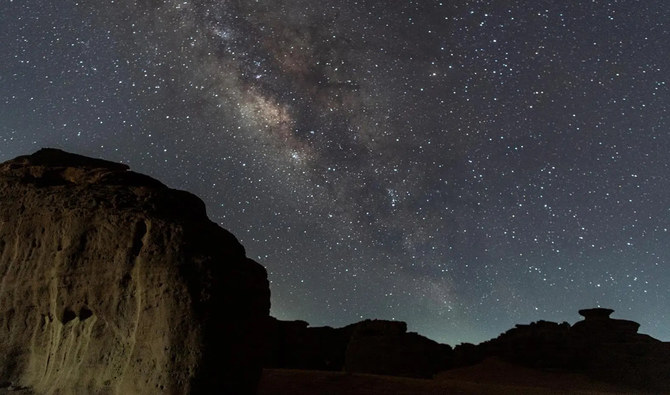
Night falls and stars come out to play over Tabuk’s Hisma desert

1 / 4
Hisma desert also boasts unique rock formations known locally as masabih and gharamil. (SPA)
2 / 4
Hisma desert also boasts unique rock formations known locally as masabih and gharamil. (SPA)
3 / 4
Hisma desert also boasts unique rock formations known locally as masabih and gharamil. (SPA)
4 / 4
Hisma desert also boasts unique rock formations known locally as masabih and gharamil. (SPA)
Short Url
Updated 12 July 2024
Follow

Night falls and stars come out to play over Tabuk’s Hisma desert

  • Magnet for astro-tourists, says local astronomer
  • Has unique rock formations over 500m years old

RIYADH: As the lights of nearby towns fade into the distance, visitors will no doubt find themselves spellbound by the majesty of the cosmos unfolding over the Hisma desert, situated 90 km west of Tabuk.

Beneath this heavenly canopy adorned with countless twinkling stars that stretch in all directions, Hisma desert also boasts unique rock formations known locally as masabih and gharamil, the Saudi Press Agency reported recently.

In an interview with the SPA, Abdulaziz bin Laboun, a geological expert and professor, said the distinctive rock formations are the result of erosion processes spanning millions of years.

“This natural sculpting has created a geological wonderland estimated to be over 500 million years old, forming a landscape of rare aesthetic beauty that is hard to find anywhere else in the world,” he said.

“As night falls, Hisma’s distance from high artificial light pollution makes it an ideal spot for observing stars, galaxies, passing meteors, and falling comets.”

This captivating natural landscape is a magnet for enthusiasts of “astro-tourism,” a growing factor in the region’s tourism appeal, says Majed Abu Zahra, president of the Jeddah Astronomical Society.

“Astro-tourism is a novel addition to the diverse types of tourism, joining the ranks of recreational, medical, and cultural tourism, among others,” he explained.

The crown jewel of Hisma’s celestial display is the Milky Way galaxy. Our solar system, nestled in one of its spiral arms, lies approximately 8,000 light years from the galactic center.

This vast cosmic metropolis, home to over 100 billion stars, stretches across the night sky like a luminous ribbon, offering observers a front-row seat to the galaxy’s dazzling core.

The Hisma desert serves as a natural amphitheater for both astronomical wonder and scientific discovery. Its pristine skies provide an ideal backdrop for a variety of cosmic events, from World Space Weeks to Astronomy Day, the SPA reported.

It is a prime location for engaging in a wide range of astronomical activities, including the observation of solar and lunar eclipses, meteor showers, and planetary alignments, the report stated.

Decoder

Stargazing at Hisma desert

Located 90 km west of Tabuk city in northwest Saudi Arabia, the desert of Hikma is fast becoming a center of “astro-tourism.” Hisma’s distance from high artificial light pollution makes it an ideal spot for observing stars, galaxies, passing meteors, and falling comets at night time, says Majed Abu Zahra, president of the Jeddah Astronomical Society.


Hafez Galley’s exhibition pays tribute to two Egyptian artists who shaped a visual era

Both artists emerged in an era when newspapers and magazines played a central role in shaping Egypt’s visual culture. (Supplied)
Updated 6 sec ago
Follow

Hafez Galley’s exhibition pays tribute to two Egyptian artists who shaped a visual era

  • Artworks by Attyat Sayed and El Dessouki Fahmi will be on display until Feb. 28

JEDDAH: Hafez Gallery in Jeddah has opened an exhibition showcasing the works of influential Egyptian artists Attyat Sayed and El Dessouki Fahmi. The exhibition runs until Feb. 28.

Kenza Zouari, international art fairs manager at the gallery, said the exhibition offers important context for Saudi audiences who are becoming increasingly engaged with Arab art histories.

Artworks by Attyat Sayed and El Dessouki Fahmi will be on display at Hafez Gallery until Feb. 28. (Supplied)

“Attyat Sayed and El Dessouki Fahmi’s decades-long practice in Cairo established foundational models for how artists across the region approach archives, press, and ultimately collective memory,” Zouari told Arab News. 

Both artists emerged in an era when newspapers and magazines played a central role in shaping Egypt’s visual culture. Their early work in press illustration “demanded speed, clarity, the ability to distill complex realities into a single, charged image,” the gallery’s website states.

Seeing the works of both artists side-by-side is breathtaking. It’s fascinating to witness how press illustration shaped such profound and lasting artistic voices.

Lina Al-Mutairi, Local art enthusias

Heba El-Moaz, director of artist liaison at Hafez Gallery, said that this is the second time that the exhibition — a posthumous tribute to the artists —has been shown, following its debut in Cairo.

“By placing their works side by side, it highlights how press illustration, often considered ephemeral, became a formative ground for artistic depth, narrative power, and lasting influence, while revealing two distinct yet deeply interconnected artistic paths within modern Egyptian visual culture,” she told Arab News. 

Artworks by Attyat Sayed and El Dessouki Fahmi will be on display at Hafez Gallery until Feb. 28. (Supplied)

Sayed’s work evolved from black-and-white illustration into “layered, dynamic compositions that translate lived emotion into physical gesture, echoing an ongoing negotiation between the inner world and its outward form,” the website states. Viewed together, the works of Sayed and Fahmi “reveal two distinct yet deeply interconnected artistic paths that contributed significantly to modern Egyptian visual culture.”

The exhibition “invites visitors into a compelling dialogue between instinct and intellect, emotion and structure, spontaneity and reflection; highlighting how artistic rigor, cultural memory, and sustained creative exploration were transformed into enduring visual languages that continue to resonate beyond their time,” the gallery states.

Lina Al-Mutairi, a Jeddah-based art enthusiast, said: “Seeing the works of both artists side-by-side is breathtaking. It’s fascinating to witness how press illustration shaped such profound and lasting artistic voices. The exhibition really brings their vision and influence to life.”