

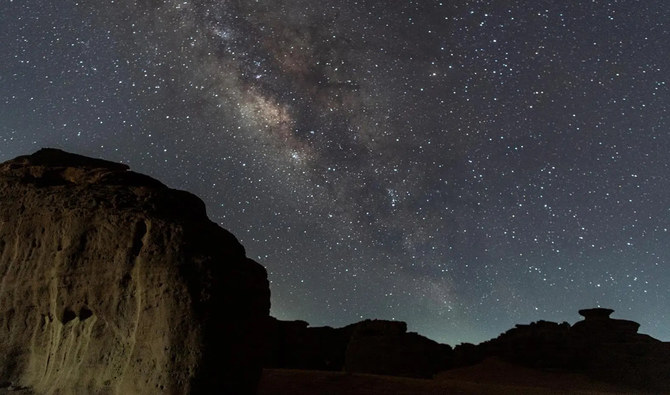
Night falls and stars come out to play over Tabuk’s Hisma desert

1 / 4
Hisma desert also boasts unique rock formations known locally as masabih and gharamil. (SPA)
2 / 4
Hisma desert also boasts unique rock formations known locally as masabih and gharamil. (SPA)
3 / 4
Hisma desert also boasts unique rock formations known locally as masabih and gharamil. (SPA)
4 / 4
Hisma desert also boasts unique rock formations known locally as masabih and gharamil. (SPA)
Short Url
Updated 12 July 2024
Follow

Night falls and stars come out to play over Tabuk’s Hisma desert

  • Magnet for astro-tourists, says local astronomer
  • Has unique rock formations over 500m years old

RIYADH: As the lights of nearby towns fade into the distance, visitors will no doubt find themselves spellbound by the majesty of the cosmos unfolding over the Hisma desert, situated 90 km west of Tabuk.

Beneath this heavenly canopy adorned with countless twinkling stars that stretch in all directions, Hisma desert also boasts unique rock formations known locally as masabih and gharamil, the Saudi Press Agency reported recently.

In an interview with the SPA, Abdulaziz bin Laboun, a geological expert and professor, said the distinctive rock formations are the result of erosion processes spanning millions of years.

“This natural sculpting has created a geological wonderland estimated to be over 500 million years old, forming a landscape of rare aesthetic beauty that is hard to find anywhere else in the world,” he said.

“As night falls, Hisma’s distance from high artificial light pollution makes it an ideal spot for observing stars, galaxies, passing meteors, and falling comets.”

This captivating natural landscape is a magnet for enthusiasts of “astro-tourism,” a growing factor in the region’s tourism appeal, says Majed Abu Zahra, president of the Jeddah Astronomical Society.

“Astro-tourism is a novel addition to the diverse types of tourism, joining the ranks of recreational, medical, and cultural tourism, among others,” he explained.

The crown jewel of Hisma’s celestial display is the Milky Way galaxy. Our solar system, nestled in one of its spiral arms, lies approximately 8,000 light years from the galactic center.

This vast cosmic metropolis, home to over 100 billion stars, stretches across the night sky like a luminous ribbon, offering observers a front-row seat to the galaxy’s dazzling core.

The Hisma desert serves as a natural amphitheater for both astronomical wonder and scientific discovery. Its pristine skies provide an ideal backdrop for a variety of cosmic events, from World Space Weeks to Astronomy Day, the SPA reported.

It is a prime location for engaging in a wide range of astronomical activities, including the observation of solar and lunar eclipses, meteor showers, and planetary alignments, the report stated.

Decoder

Stargazing at Hisma desert

Located 90 km west of Tabuk city in northwest Saudi Arabia, the desert of Hikma is fast becoming a center of “astro-tourism.” Hisma’s distance from high artificial light pollution makes it an ideal spot for observing stars, galaxies, passing meteors, and falling comets at night time, says Majed Abu Zahra, president of the Jeddah Astronomical Society.


Rebuilding lives: Saudi initiative gives fresh hope to amputees

Updated 08 December 2025
Follow

Rebuilding lives: Saudi initiative gives fresh hope to amputees

  • Baitureh Health Association has provided life-changing support to more than 1,000 people
  • Prosthetic limbs can cost up to $76,000

MAKKAH: The Baitureh Health Association for the Care of Amputees has quickly become one of Saudi Arabia’s most impactful humanitarian initiatives, transforming support for people with lost limbs.

Established in 2020, the association deals with people’s physical, psychological and social needs and fills a long-standing gap in the national health system.

CEO Badr bin Alyan told Arab News that the initiative was created in response to a growing need, driven by amputations linked to accidents, blood disorders, occupational injuries and other causes.

Its operations were “based on service integration rather than fragmentation, enabling beneficiaries to return to their lives with confidence, ability and independence,” he said.

This holistic process covers everything from initial evaluations to psychological and physical rehabilitation, family support, prosthetic fitting and ongoing maintenance.

Its psychological support programs include group sessions led by certified mentors who have undergone similar experiences, as well as field visits to support patients before and after amputation.

More than 1,000 people across the Kingdom have so far benefitted from the association’s work, about 10 percent of them children, whom Alyan said were “the most sensitive and the most in need of intensive psychological and family support.”

Its specialist programs for children — My First Step and Therapeutic Entertainment — help young people adapt to prosthetics, overcome trauma and build confidence in a safe and supportive setting.

The association has completed more than 300 prosthetic fittings, including silicone cosmetic limbs, mechanical, hydraulic, electronic and 3D-printed models. 

Alyan said the type of prosthetic selected depended on a number of factors, such as age, lifestyle, type of amputation, activity level and psychological readiness.

Children also have to undergo frequent adjustments to their new limbs to account for their growth.

Each prosthetic cost between SR20,000 ($5,300) and SR285,000, Alyan said.

The association funds its work through sponsorships, community contributions and strategic partnerships.

Despite its success, Alyan said there were still challenges to be faced, including the lack of a consolidated base for the provision of psychological support and therapy services and prosthetics development and maintenance.

There was also a shortage of local experts, he said.

In response, the association set up a rehabilitation center, which Alyan said would help to localize prosthetics manufacturing, reduce costs and accelerate fitting processes and create opportunities for local experts to develop their knowledge and experience.

But providing prosthetics was only part of the association’s work, he said.

“Rebuilding a human life is the deeper goal.”