

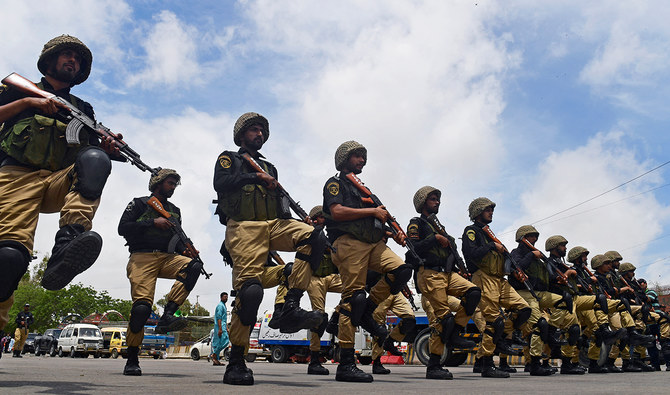

KARACHI: Police in Pakistan’s southern Sindh province on Wednesday announced it had arrested a highly wanted militant who planned to target a Muharram procession with a suicide blast in Karachi, saying that the attack could have caused “large-scale destruction.”
Muhammad Shoaib, an alleged commander of the Pakistani Taliban or Tehreek-e-Taliban Pakistan (TTP) group, was arrested by the Counter-Terrorism Department (CTD) of Sindh Police on Wednesday.
The Khyber Pakhtunkhwa Police had placed a Rs2 million [$7182] bounty on Shoaib, who was arrested in Karachi’s Ittehad Town area following a shootout with police, a CTD Sindh official said during a news conference.
“The arrested terrorist disclosed that he had to carry out a suicide attack during Muharram-ul-Haram with his accomplices in Orangi Town, Karachi,” deputy inspector-general of CTD, Asif Ejaz Shaikh, told reporters in Karachi.
The attack, Shaikh added, could have posed a “risk of large-scale casualties and large-scale destruction in Karachi.”
He said the alleged TTP commander planned to meet his accomplices and relative Ishaq to plan the attack.
“Ishaq too was involved in serious offenses and was wanted for terrorism,” Shaikh disclosed. “Ishaq was supposed to arrive [in Karachi] and join forces with the suspect to carry out this terrorist plot.”
The official said Shoaib was also implicated in the 2021 kidnapping of 16 coal miners in KP.
“When their relatives refused to pay ransom, the workers were allegedly killed and buried in a mass grave,” Shaikh said. “The initial report of this incident was filed at CTD Kohat.”
He said Shoaib was also wanted in multiple cases of murder, kidnapping for ransom, attacks on the army, clashes with peace committees and bombings.
Shaikh said Shoaib’s son, Muaz, had previously been shot dead in an encounter with security forces.
Muharram marks the beginning of the new year in the Islamic lunar calendar during which Shia Muslims across Pakistan hold gatherings and organize religious processions to pay homage to Imam Hussain, the grandson of Prophet Muhammad (peace be upon him).
Hundreds of thousands take out processions across the country on Ashura, the 10th of Muharram, to mourn Hussain’s martyrdom centuries ago in Karbala, present-day Iraq. Militants in the past have stoked sectarian tensions in the country by attacking religious processions in Muharram.
The government each year adopts heightened security measures to protect Muharram processions from militant attacks.
In 2009, an Ashura procession was targeted in a bomb attack on Karachi’s busy M.A. Jinnah Road. At least 43 people were killed and 60 wounded in the attack that was claimed by the TTP.
In response to a question, Shaikh said Shoaib was part of a large TTP network operating in Karachi, adding that the outfit also has sleeper cells in the port city.
When asked if the TTP was involved in a gun attack in Karachi on Sunday that killed a counterterrorism official, Shaikh said it was highly likely that the banned outfit was involved.
“There is a 90 percent likelihood that the TTP was involved in the killing of Deputy Superintendent of Police Ali Raza,” he said.
Raza, who was an official working in Sindh CTD’s investigation cell, was fatally attacked by unidentified assailants in the city.


