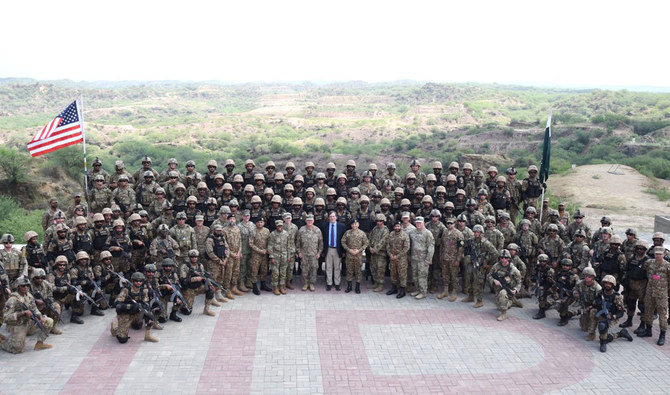
ISLAMABAD: In a first, the United States and Pakistan conducted a two-week counterterrorism exercise at the National Counter Terrorism Center in Pabbi, Punjab province, to address the “perpetual terrorism threat” faced by both nations, the military’s media wing announced on Wednesday.
Last year, Chief of Army Staff General Asim Munir met with US Central Command (CENTCOM) Chief General Michael Erik Kurilla in Washington where both military leaders emphasized the need to increase joint military training between the two countries.
The US and Pakistan have shared strong defense and security relations in the past, particularly during the Cold War after the 1979 Soviet invasion of Afghanistan. However, more recently, US officials criticized Pakistan for not sufficiently supporting their military efforts against the Taliban following the 9/11 attacks.
“The Infantry Rifle Company Exercise 2024 between Pakistan and the US has been conducted for the first time in the counter-terrorism domain,” the Inter-Services Public Relations (ISPR) said in a statement. “The two-week-long exercise commenced on June 29, 2024, at the National Counter Terrorism Center in Pabbi.”
The statement noted that Pakistani and US troops participated in the exercise with “efficiency and zeal,” displaying the highest standards of professional excellence.
The exercise focused on marksmanship skills, urban warfare tactics and refining individual and collective expertise. The training aimed to improve drills and procedures while sharing vital counterterrorism experience.
The US State Department has reiterated its commitment to expanding security cooperation with Pakistan, with counterterrorism as top priority.
Matthew Miller, the department’s spokesperson, stated this week the two countries have a “shared interest” in combating regional security threats when asked if the US would support Pakistan if it conducts cross-border attacks against militant targets in Afghanistan.

US and Pakistan conduct first joint counterterrorism exercise to address ‘perpetual terrorism threat’
https://arab.news/8kgqh
US and Pakistan conduct first joint counterterrorism exercise to address ‘perpetual terrorism threat’
- The exercise was conducted at the National Counter Terrorism Center in Pakistan’s Punjab province
- The US said this week the two countries have ‘shared interest’ in countering regional security threats
Pakistan says defense pact with Saudi Arabia elevated brotherly ties to ‘new heights’
- Pakistan, Saudi Arabia signed strategic defense pact last year pledging aggression against one will be treated as attack on both
- Deputy PM Ishaq Dar says enduring bonds with Islamic and Arab nations form vital pillar of Pakistan’s foreign policy
ISLAMABAD: Deputy Prime Minister Ishaq Dar said on Wednesday that Pakistan’s defense pact with Saudi Arabia elevated its brotherly ties with the Kingdom to “new heights,” stressing that close ties with Arab and Islamic nations form a key pillar of Islamabad’s foreign policy.
Pakistan and Saudi Arabia signed a Strategic Mutual Defense Agreement on Sept. 17 last year, pledging that aggression against one country would be treated as an attack on both, enhancing joint deterrence and formalizing decades of military and security cooperation.
Both nations agreed in October 2025 to launch an economic cooperation framework to strengthen trade and investment ties.
“In the Middle East, our landmark Strategic Mutual Defense Agreement with Saudi Arabia has elevated our brotherly ties to new heights,” Dar said while speaking at the Pakistan Governance Forum 2026 event in Islamabad.
The Pakistani deputy prime minister was speaking on the topic “Navigating International Relations Amidst Changing Geo-Politics.”
Dar noted that Pakistan has reinforced partnerships with other Middle Eastern nations such as the UAE, Qatar, Jordan, Oman, Egypt and Bahrain. He said these partnerships have yielded “concrete agreements” in investment, agriculture, infrastructure, and energy sectors.
“Our enduring bonds with Islamic and Arab nations form a vital pillar of our foreign policy, and we will continue to expand our partnerships across Asia, Latin America, and Africa,” he said.
Dar pointed out that the presidents of Kazakhstan, Uzbekistan and Kyrgyzstan have undertaken visits to Pakistan in recent months, reflecting Central Asian nations’ desire to boost cooperation with Islamabad.
On South Asia, the Pakistani deputy PM said Pakistan has successfully transformed its fraternal ties with Bangladesh into “a substantive partnership.”
“Similarly, the trilateral mechanism involving China, Pakistan, and Bangladesh has been launched with a view to expanding and deepening regional cooperation and synergy,” the Pakistani minister said.
He said Islamabad has strengthened its “all-weather” partnership with China via the second phase of the multi-billion-dollar China-Pakistan Economic Corridor agreement and “unwavering support” from both sides for each other’s core interests.
Dar said Pakistan had also reinvigorated its partnership with the US, advancing cooperation in trade, technology, investment, and regional stability.
“This calibrated approach has enhanced our ability to navigate complexity with skill and confidence, ensuring that our national interests are served without compromising our core foreign policy principles,” he said.


