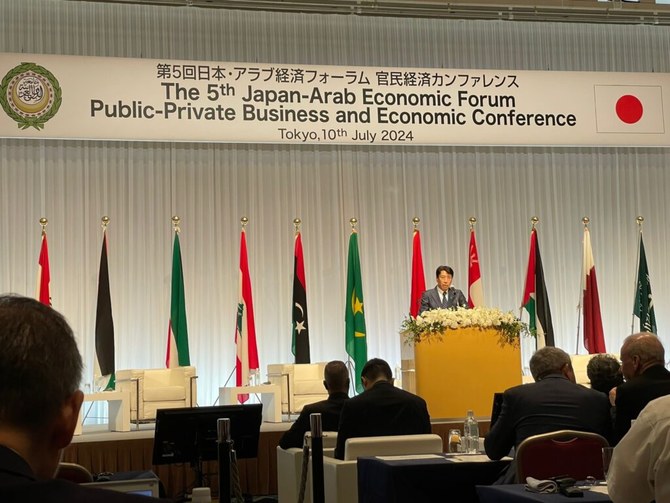

TOKYO: Officials from Japan and the Arab League are holding talks here on forming new economic partnerships and strengthening existing agreements in sectors including energy and healthcare.
The 5th Japan-Arab Economic Forum began in Tokyo on Tuesday and ends on July 11. Previous forum meetings took place in 2009, 2013, 2010 and 2016.
On Wednesday, the officials participated in a “Public-Private Economic Conference” featuring Japan’s Economy, Trade and Industry Minister Ken Saito.
Nobuyuki Nakajima, the managing director of the Japan External Trade Organization, or JETRO, based in Dubai, delivered the opening remarks.
Saito said: “The world is now at a major turning point. In addition to the increasing complexity of the international situation, Japan and Arab countries are important partners based on historical friendly relations, with global issues such as deoxygenation, energy, water and poverty.
“Now is the time for us to take advantage of each other’s strengths while addressing these global challenges.”
He said Japan aims to realize growth in Japan and the Arab world through solving social problems and strengthening new partnerships.
“The Ministry of Economy, Trade and Industry has secured a $1 billion budget to develop a flagship project that symbolizes cooperation with Global South countries,” he said.
“Specific projects such as decarbonization, digital and healthcare have already begun to work. The purpose of the Japan-Arab Economic Forum is to achieve peace, stability and prosperity between Japan and Arab countries through cooperation in a wide range of fields.”
Other participants included Dr. Ali bin Ibrahim Al-Maliki, head of the economic affairs sector of the Arab League, Dr. Saleh A. Al-Kharabsheh from Jordan’s Ministry of Energy and Mineral Resources and Dr. Khaled Hanafi, secretary-general of the Union of Arab Chambers.
For the following session, “Expanding Mutual Investment,” the keynote speech was delivered by Ahmed Aboul Gheit, secretary-general of the Arab League.
The session included Kazushige Tanaka, deputy director-general for trade and economic cooperation from the Ministry of Economy, Trade and Industry, and Wissam Hassan Fattouh, secretary-general of the Union of Arab Banks.
The early afternoon session focused on climate change, which included discussions on green products, water, waste management, hydrogen, and ammonia.
The participants included Ibrahim Al-Dakhiri, director-general of the Arab Organization for Agricultural Development, and Dr. Salem Hamidi, director-general of the Arab Atomic Energy Authority.
A later session on new technologies featured Dr. Ismail Abdel Ghaffar Ismail, president of the Arab Academy for Science, Technology and Maritime Transport, and Dr. Walid El-Hennawy, assistant secretary-general of the Arab Tourism Organization.
The day’s meetings ended with closing remarks by JETRO’s Chairman Norihiko Ishiguro.
- A version of this article originally appear on Arab News Japan