
QUETTA: Residents of Pakistan’s southwestern Makran coastal region decided to camp in Balochistan’s Turbat city on Tuesday to protest against prolonged power outages amid scorching heat as the Quetta Electric Supply Company (QESCO) said the situation was caused by Iran’s decision to suspend electricity supply to the area.
Pakistan shares a 959-kilometer frontier with Iran that begins at the Koh-i-Malik Salih Mountain and ends at Gwadar Bay in the Gulf of Oman. Iran and Pakistan signed an agreement in 2003 under which Iran daily supplies 35 megawatts of electricity to Balochistan’s coastal belt, including Gwadar, which is the heart of the multibillion-dollar China-Pakistan Economic Corridor (CPEC).
Pakistan’s top economic decision-making body, ECNEC, announced its plan in May 2019 to connect Makran Division with the national grid, but the border districts of Gwadar and Kech continue to receive power from Iran’s main transmission line.
Speaking to Arab News over the phone from Turbat in Kech district, the organizers of the protest said the power cuts – also called loadshedding in Pakistan – had disrupted life amid intense heat.
“Most of the power feeders in Kech have run out of electricity, resulting in 14 hours of loadshedding despite a soaring temperature of about 50°C [122°F],” Zarif Baloch, deputy convener of the All Parties Association of District Kech, informed.
He said there was a total power outage in Turbat as he spoke over the phone.

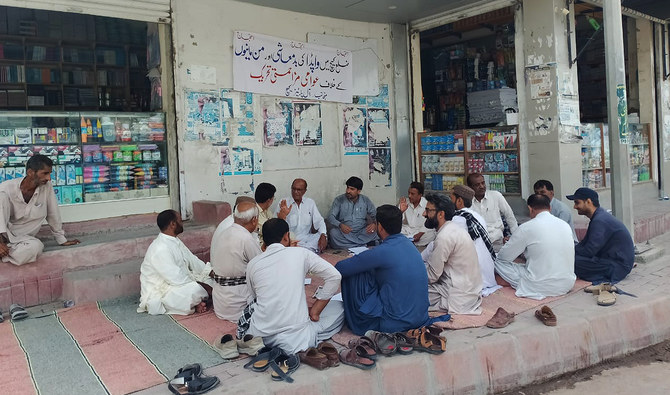
Members of All Parties Association in Pakistan’s remote Kech district protest against power outages in Makran division in Turbat city on July 9, 2024. (Photo courtesy: Supplied/Assad Baloch)
“When we contacted QESCO officials, they said Iran had suspended the power supply which was causing the situation in the district,” he continued. “We have been suffering from such a situation since the last month, but we have now called a shutter-down strike in Turbat from Thursday if the power supply is not restored.”
Muhammad Afzal Baloch, the QESCO spokesperson, told Arab News Pakistan had been receiving 200 megawatts of electricity from Iran, half of was supplied to Gwadar and half to Kech district.
“The power supply was suspended from Iran due to their own needs but it was restored in Makran Division on Monday night,” he said. “Although Iran has been providing 200 megawatts of electricity to our bordering districts, we consume the Iranian electricity as per our need.”
Last year in May, the top leaders of the two countries inaugurated the first border market on their frontier to strengthen trade relations. Prime Minister Shehbaz Sharif and Iran’s former president Ebrahim Raisi agreed to initiate 100 megawatts of additional electricity to Balochistan’s bordering districts from the Polan-Gabd transmission line.
Ishaq Roshan Dashti, president of the traders’ association in Kech district who runs his own clothing business in Turbat, said the prolonged power cuts were causing significant hardships for his fellow community members.
“We are very much disturbed during the peak summer months of June and July,” he told Arab News. “The situation has led to a 50 percent decrease in business activities in the area.”
Shahzad Baloch, who runs an ice factory, agreed with him.

Members of All Parties Association in Pakistan’s remote Kech district protest against power outages in Makran division in Turbat city on July 9, 2024. (Photo courtesy: Supplied/Assad Baloch)
“Every year, we face such electricity breakdowns in Makran during these months and the country’s power division blames Iran,” he said. “We cannot meet the regular demand for ice and have started using generators. But this has increased the price of each ice block by 35 percent compared to the previous year.”
Residents of Gwadar and Pasni also protested against unplanned power outages on Monday and blocked the country’s key coastal highway connecting Balochistan with Pakistan’s southeastern port city of Karachi.
However, they ended the protests after the authorities assured them that the power supply would be restored within a few hours.