

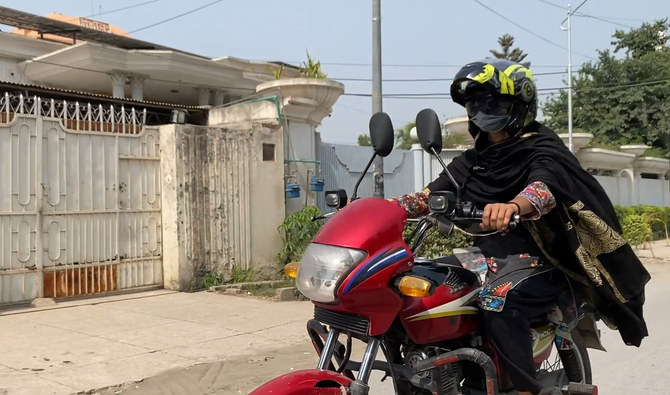

PESHAWAR: Huma Hashmat fixed her dupatta and kick-started the Honda Deluxe motorbike early one morning this month and then sped off through the bustling streets of Peshawar, a conservative city in northwestern Pakistan where women’s mobility is considerably restricted.
While it’s common to see women catching public transportation or riding in private vehicles with their families, a woman driving a motorbike is a rare sight in Peshawar. In fact, Hashmat, 20, is the only woman biker in the city, riding daily since 2020 from her house in Academy Town to the University of Peshawar where she is pursuing a degree in art and design.
In a city where a woman’s bicycle rally was canceled in 2019 due to threats from religious forces, Hashmat has a quest: to inspire other women and show them that greater mobility can foster autonomy.
Social norms and safety concerns limit women’s mobility across Pakistan, where general commuting and travel activity is estimated to be 80 percent dominated by men, according to a 2016 London School of Economics study on gender inequality in transportation. Things are even worse in the northwestern Khyber Pakhtunkhwa province, along the Afghan border, inhabited by deeply conservative, ethnic Pashtuns.
“I want to tell the girls that they can do nothing while sitting at home, until they begin to take a stand for themselves,” Hashmat told Arab News in an interview earlier this month. “The way I take care of all my chores independently, I want them to see me and get motivated, not necessarily by riding motorbikes, but they should learn this from me to do things on their own.”
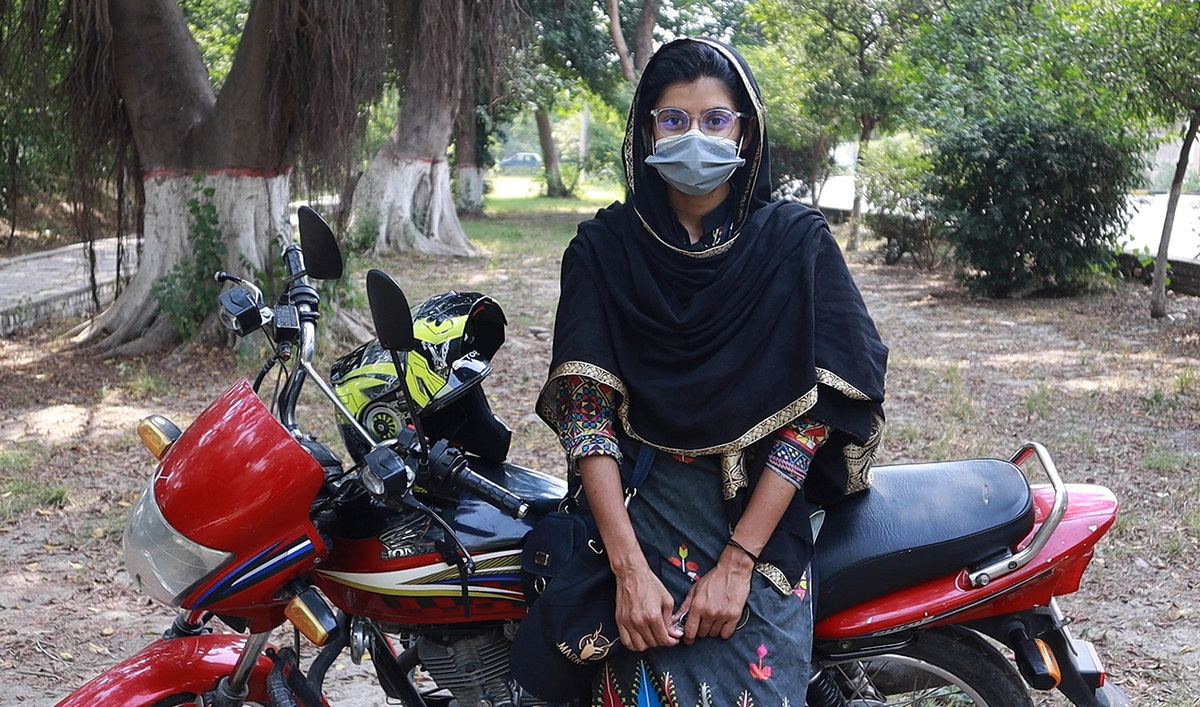
Huma Hashmat, 20, Pakistani student speaks during an interview with Arab News in Peshawar on July 5, 2024. (AN Photo)
Hashmat has three brothers and her father owns a small business and supported her decision to study arts instead of pushing her toward traditional fields like education or medicine which are deemed more suitable for women.
“My father allowed me [to ride the bike],” she said. “He supports me, just as my brothers who say, ‘If Baba says nothing, you are allowed from our side too’.”
To motivate other girls, Hashmat uploads her videos on TikTok.
“I have heard from a lot of women that Peshawar is a city where they cannot roam around freely ... I upload the videos to show them that I go to every corner of Peshawar on my bike, and nothing has happened to me, nor has anyone said anything to me,” Hashmat said. “This means that Peshawar city is safe in this regard.”
Speaking to Arab News, her father, Hashmat Ali, said he had wanted to raise his daughter like his sons.
“I have permitted her to do whatever she wants,” he said. “The only thing I stress upon is for her to cover herself since it is a society where women have to do it.”
Noor Muhammad, a senior official at Peshawar’s Social Welfare Department, said Hashmat was a role model for others.
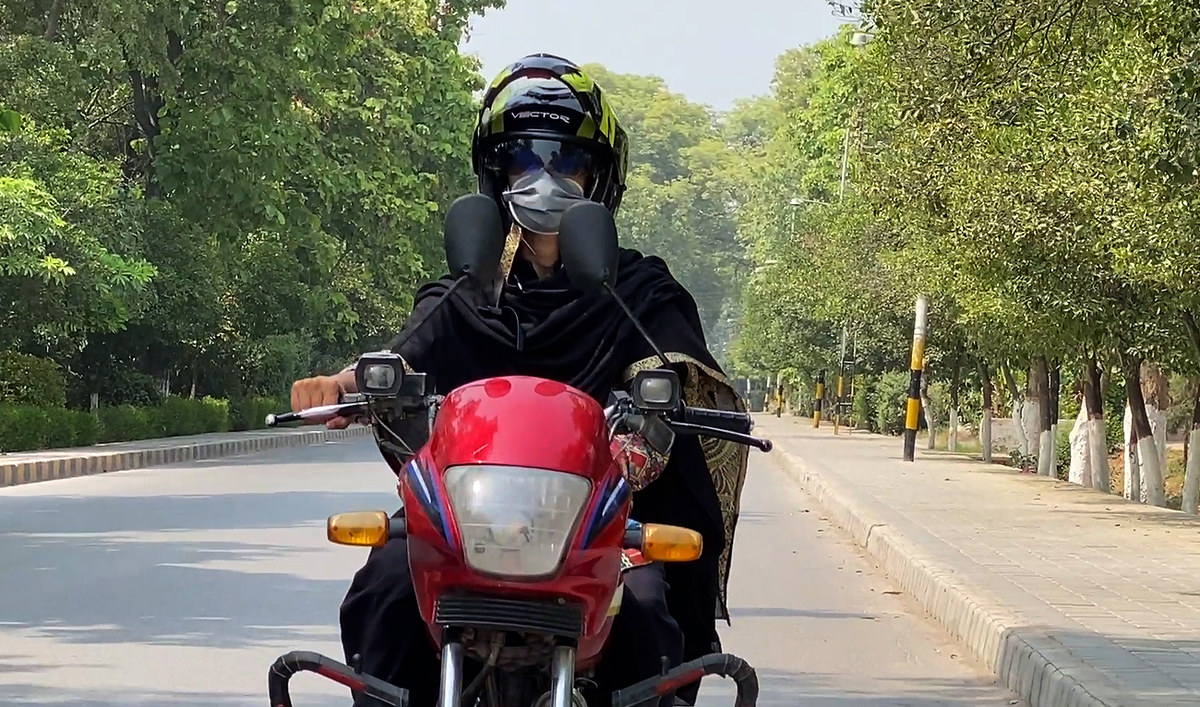
Huma Hashmat, 20, Pakistani student rides motorbike during an interview with Arab News in Peshawar on July 5, 2024. (AN Photo)
“Everyone is free, whether a man or a woman, to be on the road,” he said. “In fact, we empower and encourage women to travel on the road safely.”
However, he stressed the importance of all drivers following rules and regulations and obtaining a license before venturing out.
Hashmat’s friends also described her as “courageous,” and one classmate, Muskan Gul, said she was one of a kind.
“Many people in our society do not accept [such things] ... Huma’s decision to ride a bike is indeed an act of bravery.”


