ISLAMABAD: Prime Minister Shehbaz Sharif on Tuesday approved a three-month Rs50 billion ($179.5 million) subsidy package for electricity consumers using up to 200 units per month after backlash from the salaried class over the tax-laden federal budget that sparked debate over the rising cost of living in Pakistan.
The announcement came after the government approved approximately 51 percent increase in the cost of electricity last week for low-income consumers, with an aim to meet one of the conditions laid out by the International Monetary Fund (IMF).
Faced with a prolonged economic crisis, the Sharif administration is trying to secure yet another staff-level agreement with the IMF for a bailout of more than $6 billion.
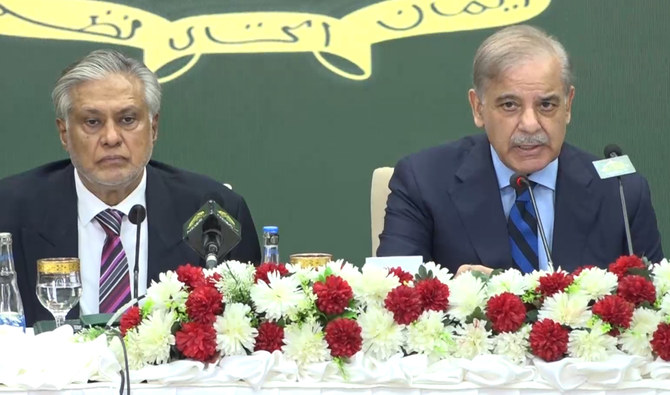
“The government will spend Rs50 billion which has been taken out from the development funds,” the prime minister said while addressing a ceremony on energy reforms in Islamabad. “We are providing the facility for three months from July, August and September to households that spend 200 units.”
He maintained the decision would benefit 25 million households, which constitute 94 percent of the domestic electricity users, adding they would only pay four to seven rupees per unit including K-Electric consumers.
“These three summer months are hard to cope with but electricity consumption also declines when the weather gets pleasant in October,” he added.
Pakistan produces expensive electricity due to a combination of factors including high reliance on imported fossil fuels, inefficient energy mix, substantial transmission and distribution losses apart from chronic issues like circular debt and regulatory inefficiencies.
The outdated infrastructure and inefficient power plants further exacerbate costs, while underutilization of domestic resources, such as hydropower and coal, add to the problem.
Additionally, fluctuations in foreign exchange rates and complex tariff structures contribute to higher electricity prices.


Pakistan PM approves $179.5 million for low-income electricity consumers amid cost-of-living crisis
https://arab.news/prtep
Pakistan PM approves $179.5 million for low-income electricity consumers amid cost-of-living crisis

- Shehbaz Sharif says the decision will benefit 25 million households constituting 94 percent of domestic consumers
- The three-month subsidy package is for people using up to 200 electricity units until the change of weather

IMF mission meets Pakistani officials ‘on the ground’ for loan reviews
- Visiting team carries out third and second reviews under two IMF funding programs
- The delegation meets central bank officials in Karachi as tranche decision looms
KARACHI: An International Monetary Fund (IMF) staff mission has begun review talks in Pakistan that will determine the release of the next tranche under the country’s $7 billion Extended Fund Facility (EFF) and the $1.4 billion Resilience and Sustainability Facility (RSF), officials familiar with the discussions said on Thursday.
The visit marks the formal launch of negotiations under the third EFF review and the second RSF review, both seen as critical to sustaining Pakistan’s fragile economic recovery and maintaining external financing stability. The discussions are expected to focus on fiscal consolidation, monetary policy, structural reforms and climate-related benchmarks tied to the RSF program.
“The team is on the ground now,” an IMF official told Arab News, requesting not to be named as the talks are ongoing.
The visiting IMF mission began its meetings in Pakistan’s commercial capital, Karachi, where they met banking regulators at the State Bank of Pakistan (SBP), the officials said.
Last week in Washington, IMF Director of Communications Julie Kozack said the staff team would begin review talks with Pakistani authorities from Feb. 25.
The IMF official declined to share details of the review agenda, saying: “It will be hard to answer the rest of your questions as the team is busy with meetings on the ground. We will post a press release at the conclusion of the mission.”
IMF staff missions typically conclude review talks within a fortnight, with any remaining discussions continuing virtually if the review is not finalized during the visit.
Separately, a senior SBP official confirmed the IMF delegation’s presence in Karachi but declined to provide details.
“Yes, the IMF team was here yesterday,” he told Arab News. “They held meetings at the central bank. I don’t know about the details of their discussion but can confirm only this much for now.”
The central bank plays a key role in IMF reviews, as the Washington-based lender has urged Pakistan’s monetary policymakers to maintain interest rates at “appropriately tight” levels to contain inflation, which, though declining from its peak, remains a concern.
The SBP in January defied market expectations for a rate cut and kept its benchmark policy rate at 10.5 percent, a move analysts said aligned with IMF program requirements.
“We don’t have any idea about who is part of the mission, how long they will stay here [in Karachi] and when and who they will meet there [in Islamabad],” the SBP official said.
The IMF communications director said last week that Pakistan’s recent performance under the program had improved.
“Pakistan’s policy efforts under the EFF have helped stabilize the economy and rebuild confidence,” Kozack told reporters in response to a query.
“Pakistan currently has a primary fiscal surplus of 1.3 percent of GDP in fiscal year 2025, which was in line with program targets,” she added. “Headline inflation has been relatively contained. And Pakistan posted its first current account surplus in 14 years in fiscal year 2025.”
The $7 billion EFF program, secured in 2024, aims to stabilize Pakistan’s economy through fiscal discipline, market-determined exchange rates and structural reforms.
The $1.4 billion RSF complements it by supporting climate resilience and sustainability reforms.


