UK resolves Rwanda asylum cases after government drops policy

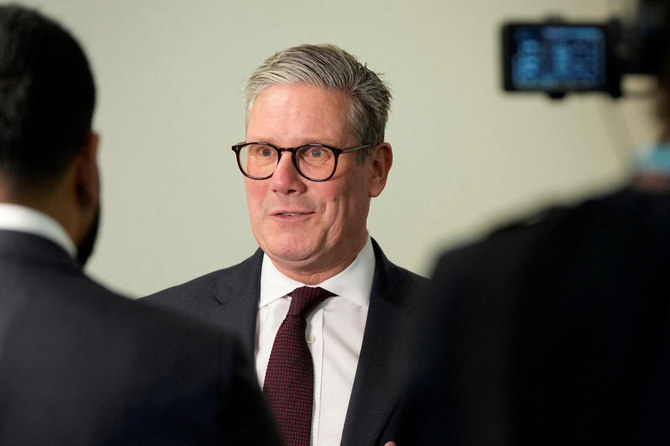
UK Prime Minister Keir Starmer said the migrant deportation plan forged by the ousted Conservative government was ‘dead and buried.’ (Reuters)
Short Url
Updated 09 July 2024
Follow

UK resolves Rwanda asylum cases after government drops policy

  • New UK leader: Migrant deportation plan forged by the ousted Conservative government ‘dead and buried’

LONDON: Three asylum seekers who brought court action to block the UK’s attempt to send them to Rwanda had their cases resolved on Tuesday, after the incoming Labour government ditched the policy.
Prime Minister Keir Starmer announced on Saturday that the migrant deportation plan forged by the ousted Conservative government was “dead and buried.”
There had already been a spate of legal challenges to the scheme, with the UK Supreme Court in November last year ruling that it was illegal under international law as Rwanda could not be considered a safe country for asylum seekers.
Government lawyer James Eadie told the High Court in London on Tuesday: “In relation to the three named claimants, these claimants’ cases will be fully disposed of and withdrawn subject to the (interior ministry) paying their costs.”
The Labour Party said before last Thursday’s general election that it would ditch the scheme, which the Tories said would deter huge numbers of migrants trying to get across the Channel to the UK on small boats from northern France.
Sixty-five people were brought ashore Monday — the first under the new government — taking the total number of arrivals so far this year to 13,639, according to an AFP tally of official figures.
Rwanda, home to 13 million people in Africa’s Great Lakes region, claims to be one of the most stable countries on the continent and has drawn praise for its modern infrastructure.
But rights groups accuse veteran President Paul Kagame of ruling in a climate of fear, stifling dissent and free speech.
A spokesman for his government said Monday that “Rwanda takes note of the intention of the UK government to terminate the Migration and Economic Development Partnership Agreement.”
As part of the deal, the UK has already paid some £240 million ($307 million) to Rwanda, with a further £50 million scheduled to be sent at a later date.
In January, Kagame said the money was “only going to be used if those people will come. If they don’t come, we can return the money.”
However, he later specified there was “no obligation” to do so.


Venezuela’s acting president calls for oil industry reforms to attract more foreign investment

Updated 16 January 2026
Follow

Venezuela’s acting president calls for oil industry reforms to attract more foreign investment

  • In her speech, Rodríguez said money earned from foreign oil sales would go into two funds: one dedicated to social services for workers and the public health care system, and another to economic development and infrastructure projects

CARACAS, Venezuela: Venezuela’s acting President Delcy Rodriguez used her first state of the union address on Thursday to promote oil industry reforms that would attract foreign investment, an objective aggressively pushed by the Trump administration since it toppled the country’s longtime leader less than two weeks ago.
Rodríguez, who has been under pressure from the US to fall in line with its vision for the oil-rich nation, said sales of Venezuelan oil would go to bolster crisis-stricken health services, economic development and other infrastructure projects.
While she sharply criticized the Trump administration and said there was a “stain on our relations,” the former vice president also outlined a distinct vision for the future between the two historic adversaries, straying from her predecessors, who have long railed against American intervention in Venezuela.
“Let us not be afraid of diplomacy” with the US, said Rodriguez, who must now navigate competing pressures from the Trump administration and a government loyal to former President Nicolás Maduro.
The speech, which was broadcast on a delay in Venezuela, came one day after Rodríguez said her government would continue releasing prisoners detained under Maduro in what she described as “a new political moment” since his ouster.
Trump on Thursday met at the White House with Venezuelan opposition leader María Corina Machado, whose political party is widely considered to have won 2024 elections rejected by Maduro. But in endorsing Rodríguez, who served as Maduro’s vice president since 2018, Trump has sidelined Machado.
In her speech, Rodríguez said money earned from foreign oil sales would go into two funds: one dedicated to social services for workers and the public health care system, and another to economic development and infrastructure projects.
Hospitals and other health care facilities across the country have long suffered. Patients are asked to provide practically all supplies needed for their care, from syringes to surgical screws. Economic turmoil, among other factors, has pushed millions of Venezuelans to migrate from the South American nation in recent years.
In moving forward, the acting president must walk a tightrope, balancing pressures from both Washington and top Venezuelan officials who hold sway over Venezuela’s security forces and strongly oppose the US Her recent public speeches reflect those tensions — vacillating from conciliatory calls for cooperation with the US, to defiant rants echoing the anti-imperialist rhetoric of her toppled predecessor.
American authorities have long railed against a government they describe as a “dictatorship,” while Venezuela’s government has built a powerful populist ethos sharply opposed to US meddling in its affairs.
For the foreseeable future, Rodríguez’s government has been effectively relieved of having to hold elections. That’s because when Venezuela’s high court granted Rodríguez presidential powers on an acting basis, it cited a provision of the constitution that allows the vice president to take over for a renewable period of 90 days.
Trump enlisted Rodríguez to help secure US control over Venezuela’s oil sales despite sanctioning her for human rights violations during his first term. To ensure she does his bidding, Trump threatened Rodríguez earlier this month with a “situation probably worse than Maduro.”
Maduro, who is being held in a Brooklyn jail, has pleaded not guilty to drug-trafficking charges.
Before Rodríguez’s speech on Thursday, a group of government supporters was allowed into the presidential palace, where they chanted for Maduro, who the government insists remains the country’s president. “Maduro, resist, the people are rising,” they shouted.