Pakistan authorizes top spy agency to tap calls, messages in ‘interest of national security’

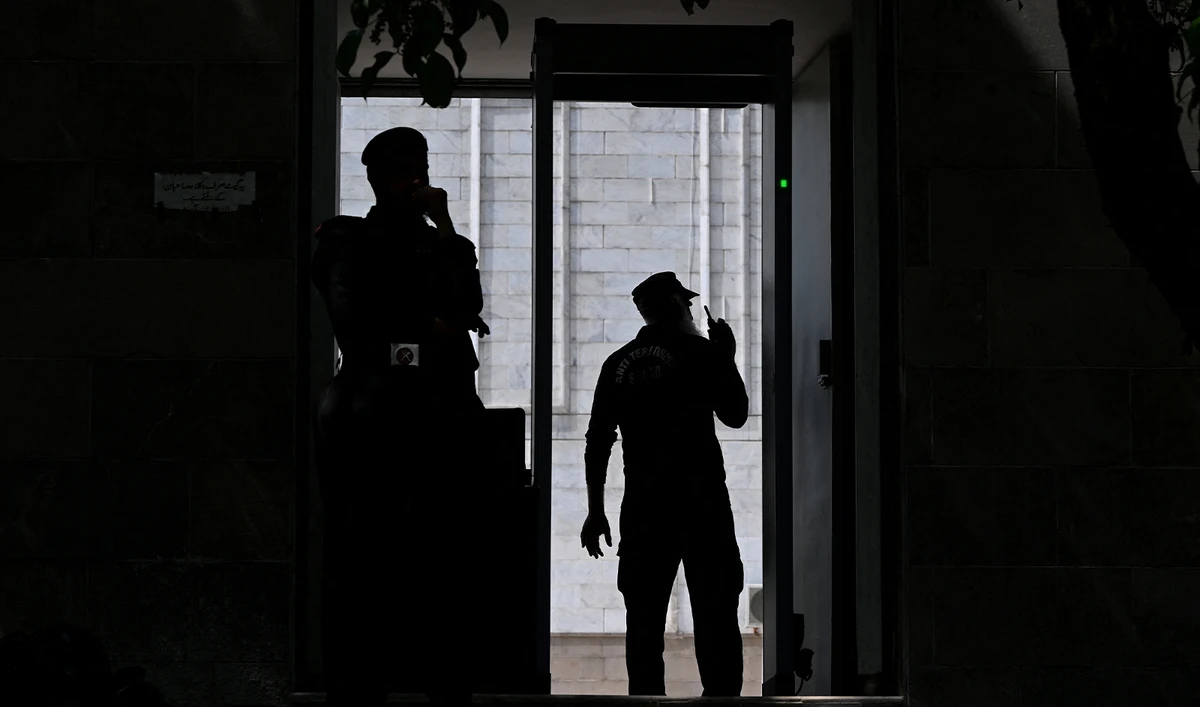
Policemen stand guard at the entrance of Islamabad High Court in Islamabad, Pakistan, on August 25, 2023. (AFP/File)
Short Url
Updated 09 July 2024
Follow

Pakistan authorizes top spy agency to tap calls, messages in ‘interest of national security’

  • Development comes after local court questioned legal basis of spy agencies using mass surveillance systems
  • ISI is widely believed to employ tens of thousands of agents, with informers in many spheres of public life

ISLAMABAD: The federal government has authorized Pakistan’s premier spy agency, the Inter-Services Intelligence (ISI), to intercept phone calls and messages “in the interest of national security,” a notification issued on Monday said, adding to the already outsized role and powers of the shadowy military outfit. 

The issue of surveillance by spy agencies came into the spotlight after audio clips, including those of former prime minister Imran Khan and his wife Bushra Khan, were released on social media in the lead-up to the February 8 general elections. Bushra and others filed petitions in the Islamabad High Court challenging the unauthorized surveillance and privacy violations. During the course of the hearings, it was revealed that the Pakistan Telecommunications Authority Pakistan Telecommunication Authority (PTA) had mandated telecom companies to finance, import, and install a mass surveillance system to access citizens’ data.

“In exercise of the powers conferred under section 54 of the Pakistan Telecommunication (Re-organization) Act, 1996 (the Act), the Federal Government in the interest of national security and in the apprehension of any offense, is pleased to authorize the officers not below the rank of grade 18 to nominated from time to time by Inter-Services Intelligence (ISI) to intercept calls and messages or to trace calls through any telecommunication system as envisaged under Section 54 of the Act,” a notification issued by the information technology ministry and dated July 8 said. 

Section 54 of the PTA Act deals with national security and authorizes such intercepts, though it does not specify the agency or the rank of officials that can issue the surveillance orders.

Omar Ayub Khan, the leader of the opposition in the National Assembly, called the government notification a “black law.” 

“Everything can be tapped for national security,” he told reporters. “There is no definition of national security defined. It could be anything. Remember this will be a black law.”

Created in 1948, the ISI gained importance and power during the 1979-1989 Soviet occupation of Afghanistan and is now rated one of best-organized intelligence agencies in the developing world.

Widely feared by Pakistanis, it is believed to have a hidden role in many of the nuclear-armed nation’s policies, including in Afghanistan and India. The ISI is seen as the Pakistani equivalent of the US Central Agency (CIA) and Israel’s Mossad. Its size is not publicly known but the ISI is widely believed to employ tens of thousands of agents, with informers in many spheres of public life.

Punjab expands Pakistan-India Wagah border arena with museum, partition-themed park

Updated 4 sec ago
Follow

Punjab expands Pakistan-India Wagah border arena with museum, partition-themed park

  • The border crossing, near eastern city of Lahore, is the primary land route between Pakistan and India and one of the most recognizable symbols of their often-tense relations
  • The site is best known for its daily flag-lowering ceremony, a choreographed military ritual performed by border forces from both countries that draws thousands of spectators

ISLAMABAD: Maryam Nawaz, chief minister of Pakistan’s Punjab province, on Thursday inaugurated the newly constructed arena at Wagah border cross between Pakistan and India, which includes a museum and a partition themed park.

The Wagah border crossing, located near the eastern city of Lahore, is the primary land route between Pakistan and India and one of the most recognizable symbols of the often-tense relationship between the two neighbors. It serves as a key point for prisoner exchanges and limited movement of travelers, while remaining tightly regulated due to security considerations.

The site is best known for its daily flag-lowering ceremony, a choreographed military ritual performed by border forces from both countries that draws thousands of spectators. Over the years, the ceremony has evolved into a popular tourist attraction, blending displays of nationalism with public spectacle and making it one of Pakistan’s most visited landmarks, which connects with India’s Attari.

Flanked by military officials, CM Nawaz visited the crossing and inaugurated the new arena, with its seating capacity increased from 7,500 to 25,000 spectators, the state-run Radio Pakistan broadcaster reported. The chief minister also visited the martyrs’ monument and offered her respects.

“In addition to the arena’s expansion, several new constructions have been added at the Joint Check Post Wagah. These new developments include a theme park depicting the partition of the Subcontinent, featuring models of a railway station, military equipment and a Martyrs’ Memorial,” the broadcaster reported.

“A Pakistan Museum has also been established within the arena, showcasing the country’s history and culture from the Freedom Movement to the present day.”

In August 1947, Britain divided the Indian Sub-continent, its former colony, into two countries — Hindu-majority India and Muslim-majority Pakistan.

Excitement over independence was quickly overshadowed by some of the worst bloodletting that left up to 1 million people dead as gangs of Hindus and Muslims slaughtered each other.

Creating two independent nations also tore apart millions of Hindu and Muslim families in one of the world’s largest peacetime migrations, which displaced at least 15 million people.

The fate of Kashmir, then a princely state, was left undecided. The Himalayan territory continues to remain a flashpoint in relations between the neighbors, who have fought multiple wars over it.