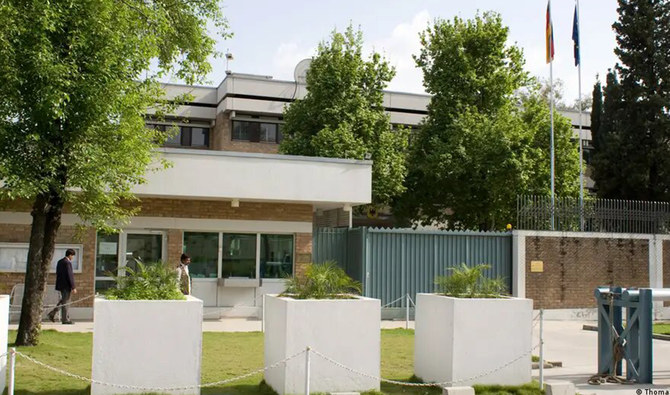
KARACHI: The German consulate in southern Pakistani city of Karachi has suspended its services for people who are not European Union (EU) citizens, the consulate said on Monday, citing “security concerns.”
The development comes amid a renewed wave of militant violence in the South Asian country, including attacks on foreign nationals and police officials in Karachi.
Unidentified militants on Sunday shot dead a senior counter-terrorism official, while five Japanese workers narrowly escaped a suicide attack in the city in April. No group claimed responsibility for attacks.
“Due to imminent security concerns the Consulate of the Federal Republic of Germany will remain closed for services of non-EU-citizens until further notice,” the German consulate said in a statement. “Already issued visa for non-EU-citizens can be picked up.”
A spokesperson for the German consulate offered no further details when asked about the nature of the security concerns.
Pakistan has primarily witnessed an uptick in militant attacks in its two western provinces, Khyber Pakhtunkhwa and Balochistan, since the Pakistani Taliban called off their fragile truce with the government in November 2022.
Insurgents have also targeted Chinese working in Pakistan on projects relating to the China-Pakistan Economic Corridor (CPEC) in recent months. In March, five Chinese nationals and their Pakistani driver were killed when a suicide bomber in northwest Pakistan rammed his explosive-laden car into a vehicle when they were heading to the Dasu Dam, the biggest hydropower project in Pakistan, where they worked.
It followed a Mar. 20 attack on a strategic port used by China in the southwestern province of Balochistan, where Beijing has poured billions of dollars into infrastructure projects, and a Mar. 25 assault on a naval air base, also in the southwest. Both attacks were claimed by the Baloch Liberation Army (BLA), the most prominent of several separatist groups in Balochistan.
Islamabad has blamed the surge in violence on militants operating out of neighboring Afghanistan. Kabul denies the allegation and says rising violence in Pakistan is a domestic issue of Islamabad.


![]()

German consulate in Karachi suspends services for non-EU citizens due to ‘security concerns’
Short Url
https://arab.news/v5j4k
German consulate in Karachi suspends services for non-EU citizens due to ‘security concerns’
- The development comes amid renewed wave of violence in Pakistan, including attacks on foreigners and police in Karachi
- Militants have also recently targeted Chinese working in Pakistan on projects relating to the China-Pakistan Economic Corridor
Latest updates


Recommended


© 2026 SAUDI RESEARCH & PUBLISHING COMPANY, All Rights Reserved And subject to Terms of Use Agreement.