

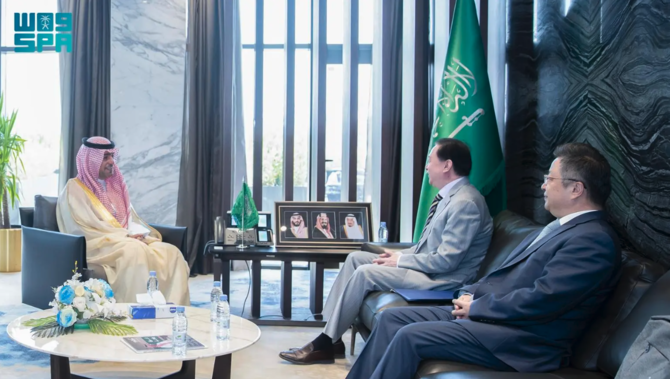

RIYADH: Strategic partnerships between Saudi Arabia and China across the municipal and housing sectors are set to be enhanced following a high-level meeting in Riyadh.
The Kingdom’s Minister of Municipal, Rural Affairs, and Housing Majid Al-Hogail met with Beijing’s Ambassador Chang Hua at the ministry headquarters in Riyadh to reiterate real estate relations.
Officials discussed opportunities to strengthen cooperation and partnership in real estate development, contracting, and municipal services, according to a report by the Saudi Press Agency.
Al-Hogail emphasized the ministry’s commitment to fostering strategic partnerships with China and expressed his aspiration to develop these relationships further, including forming a joint working team to explore new avenues for cooperation.
The meeting marks a significant milestone in Saudi-Chinese housing relations.
Following the Comprehensive Strategic Partnership agreement signed by King Salman and Chinese President Xi Jinping in December 2022, a new phase of bilateral cooperation in the real estate sector was launched.
The Saudi-Chinese strategic partnership aims to enhance the dynamics of the Saudi real estate market by collaborating with leading local and international companies and attracting investments in the housing sector.
This cooperation impacts more than 120 activities and industries, providing citizens with more affordable housing solutions and financing options.
The partnership aims to boost the gross domestic product of non-oil, with the real estate activities sector contributing 12.1 percent and the construction and building field contributing 11.2 percent.
This collaboration supports the targets of the Housing Program, part of Vision 2030, aiming to raise the homeownership rate to 70 percent by 2030, up from 63.74 percent at the end of 2023.
The National Housing Co. is working on developing residential suburbs and integrated urban communities, planning to build 300,000 housing units by the end of 2025.
The two nations have been continuously cooperating to boost the housing sector. In August 2023, the ministry signed 12 real estate agreements worth SR5 billion ($1.3 billion) with Chinese companies.
Additionally, the Kingdom’s NHC signed an agreement with Chinese construction firm CITIC Construction Group last May to establish an industrial city and logistic zones in Saudi Arabia.
During the meeting, Hua praised the historical and fruitful diplomatic relations between Saudi Arabia and China.
He highlighted China’s interest in enhancing commercial and investment relations with the Kingdom, particularly in the infrastructure and contracting sectors.
The ambassador also lauded the successful outcomes of Al-Hogail’s recent visit to China, which set the stage for deeper collaboration.
This meeting aligns with Saudi Arabia’s active efforts to boost bilateral cooperation across various sectors.
Earlier in July, Saudi Arabia and Turkiye expanded cooperation in real estate, infrastructure, and waste management, which was highlighted during a three-day official tour by Al-Hogail in Istanbul.
During that visit, he met with Turkish officials and companies to explore investment opportunities, reflecting Saudi Arabia’s broader strategy to forge strong international partnerships.
The Saudi real estate market’s rapid advancement, marked by ambitious urban development projects and significant infrastructure investments, continues to attract global interest, emphasizing sustainability and innovation.


