MOSCOW: India’s prime minister begins a two-day visit to Russia on Monday, his first since Moscow launched its invasion of Ukraine, a war that has complicated the relationship between the longtime allies and pushed Russia closer to India’s rival China.
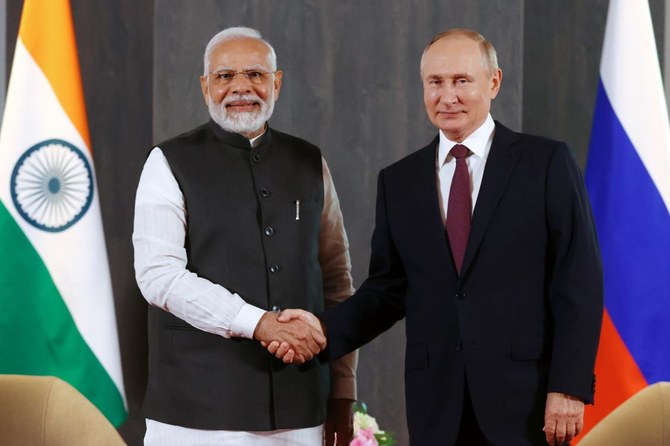
Prime Minister Narendra Modi’s visit will include a meeting with President Vladimir Putin, whom he last saw in Russia in 2019, in the far eastern port of Vladivostok. The two leaders also met in person in September 2022 in Uzbekistan, at a summit of the Shanghai Cooperation Organization bloc.
Russia has had strong ties with India since the Cold War, and New Delhi’s importance as a key trading partner for Moscow has grown since the Kremlin sent troops into Ukraine in February 2022. China and India have become key buyers of Russian oil following sanctions imposed by the United States and its allies that shut most Western markets off to Russian exports.
Under Modi’s leadership, India has avoided condemning Russia’s war in Ukraine while emphasizing the need for a peaceful settlement.
The partnership between Moscow and New Delhi has become fraught, however, since Russia started developing closer ties with India’s main rival, China, because of the hostilities in Ukraine.
Modi notably stayed away last week from the most recent summit of the Shanghai Cooperation Organization, in Kazakhstan.
Chietigj Bajpaee, senior South Asia research fellow at the UK-based Chatham House, said India is becoming increasingly estranged from forums in which Russia and China play a prominent role.
“This is evident in India’s relatively low key presidency of the Shanghai Cooperation Organization last year, and now the decision by Modi not to attend this year’s summit,” Bajpaee said.
A confrontation in June 2020 along the disputed China-India border dramatically altered their already touchy relationship as the rival troops fought with rocks, clubs and fists. At least 20 Indian soldiers and four Chinese soldiers were killed. Tensions have since persisted despite talks.
Those tensions have seeped into how New Delhi looks at Moscow.
“Russia’s relations with China have been a matter of some concern for India in the context of Chinese increased assertiveness in the region,” D. Bala Venkatesh Verma, a former Indian ambassador to Russia, told The Associated Press.
But Modi also will seek to continue close relations with Russia, an important trading partner and major defense supplier for India.
Since Western sanctions blocked Russian oil exports after the start of the Ukraine war, India has become a key buyer of Russian oil. It now gets more than 40 percent of its oil imports from Russia, according to analysts.
India is also strongly dependent on Russia for military supplies, but with Moscow’s supply line hit by the fighting in Ukraine, India has been diversifying its defense procurements, buying more from the US, Israel, France and Italy.
“Defense cooperation will clearly be a priority area,” Bajpaee said, adding that 60 percent of India’s military equipment and systems is “still of Russian origin.”
“We’ve seen some delay in the deliveries of spare parts ... following the Russian invasion of Ukraine,” he said. “I believe both countries are due to conclude a military logistics agreement, which would pave the way for more defense exchanges.”
India has adopted a neutral stance, neither condemning nor condoning Russia’s war on Ukraine, and has called for negotiations to end the fighting. That in turn has bolstered Putin’s efforts to counter what he calls the West’s domination of global affairs.
Facing an arrest warrant by the International Criminal Court for actions over the war in Ukraine, Putin’s foreign travel has been relatively sparse in recent years, so Modi’s trip could help the Russian leader boost his image.
“We kind of see Putin going on a nostalgia trip — you know, he was in Vietnam, he was in North Korea,” said Theresa Fallon, an analyst at the Center for Russia, Europe, Asia Studies. “In my view, he’s trying to demonstrate that he’s not a vassal to China, that he has options, that Russia is still a great power.”
Alexander Gabuev, head of the Carnegie Russia Eurasia Center, said that Putin’s interactions on the world stage show he “is far from isolated” and that Russia is not a country to be discounted.
Trade development also will figure strongly in the talks, particularly intentions to develop a maritime corridor between India’s major port of Chennai and Vladivostok, the gateway to Russia’s Far East.
India-Russia trade has seen a sharp increase, touching close to $65 billion in the 2023-24 financial year, due to strong energy cooperation, Indian Foreign Secretary Vinay Mohan Kwatra told reporters Friday.
Imports from Russia touched $60 billion and exports from India $4 billion in the 2023-24 financial year, Kwatra said. India’s financial year runs from April to March.
He said India was trying to correct the trade imbalance with Russia by increasing its exports. India’s top exports to Russia include drugs and pharmaceutical products, telecom instruments, iron and steel, marine products and machinery.
Its top imports from Russia include crude oil and petroleum products, coal and coke, pearls, precious and semi-precious stones, fertilizer, vegetable oil, gold and silver.


![]()

Indian Prime Minister Modi makes first visit to ally Russia since the start of its war on Ukraine
Short Url
https://arab.news/wy96n
Indian Prime Minister Modi makes first visit to ally Russia since the start of its war on Ukraine
- Prime Minister Narendra Modi’s visit will include a meeting with President Vladimir Putin
- India has avoided condemning Russia’s war in Ukraine while emphasizing the need for a peaceful settlement


Latest updates


© 2026 SAUDI RESEARCH & PUBLISHING COMPANY, All Rights Reserved And subject to Terms of Use Agreement.