

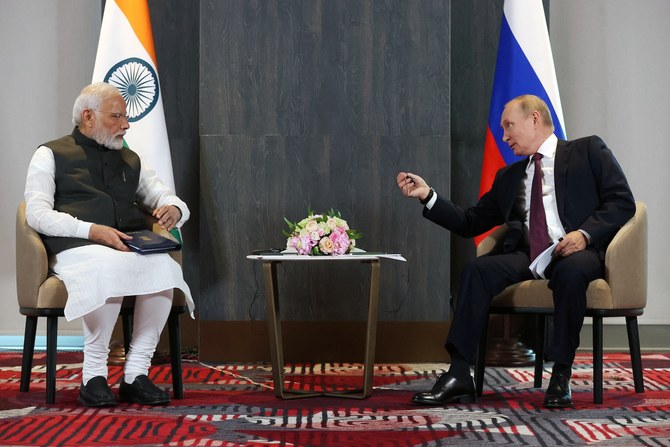

NEW DELHI: Prime Minister Narendra Modi will meet Russia’s President Vladimir Putin next week, India’s Foreign Ministry said on Friday, amid Western efforts to isolate Moscow on the world stage over its invasion of Ukraine.
Modi will be in the Russian capital on July 8-9 for the 22nd edition of the annual India-Russia summit that has been hosted alternately by the two countries since 2000.
The last meeting was held in 2021, when Putin visited Delhi, and the next was due in Moscow in 2022. It did not take place following Russia’s invasion of Ukraine in February that year.
“The 22nd annual summit between India and Russia would provide an opportunity to the two leaders to review the whole range of bilateral issues, including defense, trade linkages, investment ties, energy cooperation, S&T (science and technology),” Foreign Secretary Vinay Mohan Kwatra told reporters in Delhi.
Talks on the release of Indian nationals serving in the Russian army are also expected during the prime minister’s trip in the wake of reports that they have been sent to fight in the Ukraine war.
“The issue of early discharge of Indian nationals who have been misled into the service in the Russian army is also expected to figure in the discussions,” Kwarta said.
The last time Modi and Putin met in person was on the sidelines of the 2022 Shanghai Cooperation Organization summit in Uzbekistan. Modi skipped the SCO’s summit this week, so the meeting with the Russian president will be his first since the beginning of his third term in office.
It will also be his first bilateral visit since winning the general election last month.
“The annual summit between the two leaders is the highest mechanism to steer and drive cooperation between our two countries,” Kwarta said.
“They would also share perspectives on regional and global developments of mutual interest … (and) assess the status of bilateral engagements, groupings such as BRICS, the Shanghai Cooperation Organization, G20, East Asia summit and the UN.”
New Delhi’s ties with Moscow span over seven decades. India has abstained from publicly criticizing Russia over the Ukraine war and did not join the slew of international sanctions slapped on it, despite pressure from Western countries, especially the US.
Russia is also India’s biggest crude oil supplier and the main source of its military hardware.
“Russia is a great power … It is a member of the Security Council with the veto and we in India remember that the veto has been exercised in our favor several times in the past,” said Nandan Unnikrishnan, who leads the Eurasia program at the Observer Research Foundation in New Delhi.
“Russia is the largest country in the world. It has a (large) number of natural resources, and we are an economy that is growing, and we will soon require much larger amounts of natural resources, so for a variety of reasons, Russia is important … and it plays an important role in maintaining multipolarity in Asia.”
On the other hand, India’s partnership with the West has been growing for the last 20 years, and it is a member of the Quad. The four-state strategic security dialogue, comprising also the US, Japan and Australia, was established to counter the increased regional economic and military influence of China — India’s rival, with whom relations have been tense since the 2020 deadly clashes on their 3,500-km Himalayan border.
Both Russia and the US are strategic partners for India and clearly siding with one of them could cost it the relationship with the other.
While Modi has not met Putin for the past two years, Unnikrishnan said a perception was emerging that there was a “drift” in India’s ties with Russia amid Western efforts to isolate Moscow on the world stage.
“Our relationship with the US has been growing rapidly, becoming closer and closer … It was giving rise to all kinds of speculation that distance from Russia is growing. I think the PM felt that now it’s time to remove such a perception,” he told Arab News.
“India has multiple partners, and it will not have a relationship based on dictation by any third party. It will maintain relationships depending on the national interest.”


